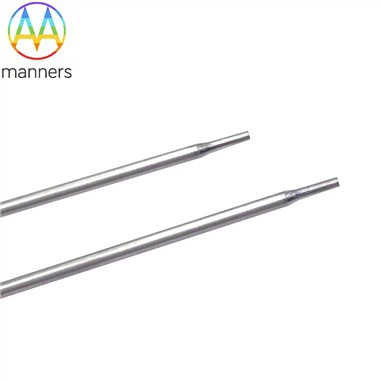
Rotary Forging Cold Forming Technology Of Pencil Point Needles
Jul 23, 2026
Rotary forging cold forming technology is the core proprietary process that distinguishes Pencil Point Needles from ordinary puncture needles and determines their unique closed tapered tip performance. Different from traditional cutting and hot processing molding technology, the rotary forging cold forming process adopted by professional manufacturers realizes gradient diameter reduction and tapered tip shaping of stainless steel tubes at room temperature. This innovative cold working process does not destroy the internal metal fiber structure of raw materials, and can be applied to almost all ductile alloy materials, providing a solid technological foundation for the high precision, high strength and high stability of Pencil Point Needles.
The working principle of rotary forging cold forming is to use multi-directional synchronous rotary forging force to perform uniform cold extrusion processing on stainless steel pipe blanks. During the processing, the equipment applies continuous and stable rotary pressure on the needle tube wall, so that the metal material produces uniform plastic deformation at room temperature, realizing synchronous shrinkage of the outer diameter and inner diameter of the needle tube and natural gradient forming of the closed tapered tip. Compared with traditional cutting molding, cold forming does not produce metal debris, burrs and tool marks, and the formed needle tip has smooth inner and outer walls, dense structure and uniform wall thickness. The overall integrated molding avoids the structural defects such as tip virtual connection and uneven stress caused by welding and splicing.
This process has unique technical advantages in the production of Pencil Point Needles' core structure. First, it ensures the geometric accuracy of the 12°-15° standard tapered angle. Through precise numerical control parameter setting, the rotary forging process can stably control the tip taper angle within the standard range, and can also adjust the geometric parameters according to customer customized requirements to realize personalized angle matching. Second, it perfectly retains the mechanical properties of stainless steel materials. Cold forming does not change the metal phase structure of raw materials, so the needle tip and needle body maintain original hardness and toughness, with stronger compression resistance and anti-deformation ability than hot processing products.
In the lateral coaxial hole forming link of Pencil Point Needles, the combination of rotary forging process and precise micro-drilling technology ensures the regularity and smoothness of the fluid channel. After the overall tapered tip is formed by rotary forging, professional equipment is used to process one or two symmetrical coaxial circular holes near the tip. The cold-formed dense structure effectively avoids hole edge deformation and burrs during drilling, ensuring smooth fluid circulation without residual dead angles. The integrated process makes the closed tip and lateral fluid holes perfectly matched, realizing the dual functions of non-coring puncture and precise fluid control, which cannot be achieved by traditional single processing technology.
All Pencil Point Needles produced by rotary forging cold forming technology comply with ISO13485 international quality standards. The whole process is digitally monitored, with stable process parameters and consistent batch quality. The finished products have smooth surface, precise structure, strong durability and excellent reusability, which can adapt to repeated puncture, cleaning and sterilization operations. This advanced cold forming process not only improves the structural precision and service performance of Pencil Point Needles, but also reduces product defective rate and production cost, becoming the core technological support for manufacturers to provide high-quality customized and standardized products.