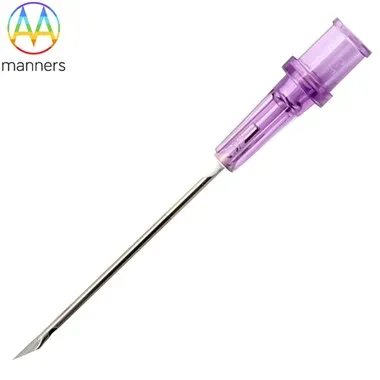
Quincke Spinal Needle 22G 90mm: From Tube To Sterile Pack
Nov 26, 2026
The Pain Point: Consistency Is the Product
A spinal needle is a disposable item bought by the thousand, and its value lies entirely in the fact that needle number one thousand behaves like needle number one. That consistency is not a property of the design; it is a property of the process. Bevel angle, edge radius, stylet alignment and cannula straightness all drift as grinding wheels wear, polishing baths age and assembly fixtures loosen, and the customer sees the drift as an inconsistent product rather than as a process out of control.
The 22G 90mm configuration makes this harder than it looks. Ninety millimetres of thin-wall tubing is a flexible workpiece: it deflects under grinding force, it springs back after clamping, and it transmits any hub-assembly misalignment along its whole length. A process that produces an acceptable tip on a short cannula can produce a bent or off-axis tip at ninety millimetres, and the defect will only appear when the needle is advanced into a patient.
The variability has a commercial face. Two suppliers can quote the same gauge, the same length and the same tip name, and deliver products that differ in ways the purchase order does not capture. One will have a stable bevel angle and a consistent edge, the other a distribution around a nominal value. The customer discovers the difference through complaints about feel, which are difficult to convert into a specification after the contract has been signed.
The Working Principle: Grind, Deburr, Finish, Assemble
The cannula begins as stainless steel tubing drawn to a specified outer and inner diameter. The bevel is created by grinding the tube against a rotating abrasive wheel at a controlled angle, with the tube held in a collet that also indexes the bevel orientation. The grind is usually done in two stages, a rough cut that removes most material and a finish cut that establishes the edge, because a single deep pass produces heat, deformation and a burr that no later step can fully remove.
Deburring follows. Mechanical brushing, abrasive flow or electrochemical finishing removes the rolled material at the edge and at the heel, and the choice of method matters: aggressive brushing rounds the cutting edge and raises penetration force, while insufficient deburring leaves a burr that tears tissue. Passivation comes next, removing free iron from the surface and restoring the chromium oxide layer; without it, a needle can show corrosion spots after sterilisation and storage.
Assembly is where the geometry can be lost. The cannula is inserted into the hub and bonded, either by an adhesive or by insert moulding, and the stylet is matched to the finished cannula. Both operations are alignment-critical. A cannula that enters the hub at a fraction of a degree of tilt will not be straight at ninety millimetres, and a stylet that is cut to the wrong length will either protrude or recede at the tip.
The Product Family: Materials and Configurations
Cannulas are made from 304 or 316L stainless steel, with 304 dominating on cost and 316L chosen where corrosion resistance matters more. Hubs are moulded from polypropylene, polycarbonate or a comparable medical-grade resin, and the choice affects transparency, which determines how easily fluid is seen, and toughness, which determines whether the Luer fitting survives connection and disconnection. Stylet wire is usually a finer gauge of the same alloy family as the cannula.
Configurations multiply the process requirements. Depth markings require laser marking on a finished cannula without introducing a heat-affected zone at the tip. Introducer needles require their own bevel and their own length control. Custom lengths require the grinder and the stylet-cutting station to be re-fixtured without losing the relationship between bevel angle and cannula axis, which is why custom spinal needles are usually quoted with longer lead times than catalogue items.
Table 1 Gauge, nominal outer diameter and colour code for 90 mm spinal needles
|
Gauge |
Nominal OD (mm) |
Colour Code |
Typical Role |
|
16G |
1.6 |
White |
High-flow therapeutic drainage (special order) |
|
17G |
1.4 |
Light Purple |
Rapid drainage and large-volume collection |
|
18G |
1.2 |
Pink |
Drainage, myelography, catheter placement |
|
19G |
1.1 |
Light Grey |
Fast collection where flow dominates |
|
20G |
0.9 |
Yellow |
Rapid collection and pressure measurement |
|
21G |
0.8 |
Green |
General adult lumbar puncture |
|
22G |
0.7 |
Black |
Standard adult diagnostic and therapeutic tap |
|
23G |
0.6 |
Dark Blue |
Balance of flow and reduced defect size |
|
24G |
0.55 |
Purple |
Fine diagnostic tap in suitable anatomy |
|
25G |
0.5 |
Orange |
Low-headache-risk elective anaesthesia |
|
26G |
0.45 |
Brown |
Obstetric and paediatric fine puncture |
|
27G |
0.4 |
Grey |
Finest available; slow flow, highest patience |
Colour codes follow the gauge identification convention; outer diameters are nominal values and vary within the tolerances of the cannula tubing standard.
Practical Use: A Process Route Worth Auditing
When auditing a supplier, ask for the route rather than the drawing, because the route reveals where control actually sits. A credible route reads: incoming tube inspection on diameter, wall and alloy; cutting to length with a documented end-face condition; two-stage bevel grinding with wheel dressing at a defined interval; deburring with a stated method and duration; edge inspection under magnification; passivation with bath concentration and time recorded; siliconisation or coating if specified; hub bonding; stylet matching and flush inspection; straightness check over the full length; functional flow and leak test; cleanroom assembly; pouch sealing; sterilisation; and lot release.
The two steps most often skipped in low-cost operations are edge inspection and straightness. Edge inspection is slow and needs magnification; straightness over ninety millimetres needs a fixture rather than a glance. Both are cheap relative to the cost of a complaint, and both are the first things a buyer should ask to see evidence of. A supplier that can show a magnification image of a bevel and a straightness reading over the full cannula is a supplier that understands what the product is.
A second process point concerns the handling of ninety millimetres of thin tube between stations. Every transfer is an opportunity to introduce a bend, and a bend is not recoverable by straightening, because straightening work-hardens the alloy and leaves residual stress. Trays, magazines and pick-and-place fixtures that support the cannula along most of its length are therefore not conveniences; they are part of what keeps the product in specification.
Field Experience: Where Processes Drift
Wheel wear is the classic drift. As the abrasive face glazes, the effective cut becomes shallower, the bevel angle slowly steepens, and penetration force rises. The symptom in the field is a needle described as "dragging" or "needing a push", and the fix is wheel dressing on a schedule tied to parts ground rather than to hours elapsed. The second drift is collet wear, which allows the tube to rotate slightly during grinding and produces a bevel that is not aligned with the intended plane, felt as a needle that tracks off-axis.
The third is adhesive or moulding variation at the hub. A bond that is sound but slightly asymmetric bends the cannula by a fraction of a degree, and at ninety millimetres that fraction becomes a visible curve. The symptom is a needle that will not advance past a certain depth without redirection, and the cause is usually invisible at the hub. Buyers who test straightness only on samples taken from the start of a run will miss it entirely, because the asymmetry develops as fixtures wear.
Summary: Control Points, Not Inspections
The process is controlled at four points: incoming tube dimensions, grinding wheel condition and collet alignment, edge and heel finishing, and hub bonding alignment with a full-length straightness check. Everything else is supporting work. A supplier that controls those four and records them will hold a specification over a long run; a supplier that inspects only the finished product will ship a distribution rather than a specification.
For the buyer, the practical translation is a short audit checklist and a certificate of analysis that reports actual values rather than pass or fail. Values tell you whether the process is centred or merely inside the limits, and the difference predicts the next shipment.
Outlook: Lights-Out Grinding
Grinding cells are becoming automated in a way that suits this product. In-process optical measurement of the bevel, closed-loop wheel dressing, and robotic loading of ninety-millimetre tubes remove the two largest sources of variation, which are operator judgement and manual handling. The same cell can be programmed for a family of lengths without re-fixturing the tip geometry, which makes custom lengths affordable rather than bespoke.
For the market, the effect is convergence. When tip geometry can be measured in process and recorded per piece, the difference between a premium needle and a commodity needle becomes visible in data rather than in feel, and buyers can price the difference instead of arguing about it. That is a healthier basis for a supply relationship than a sample box and a sales visit.