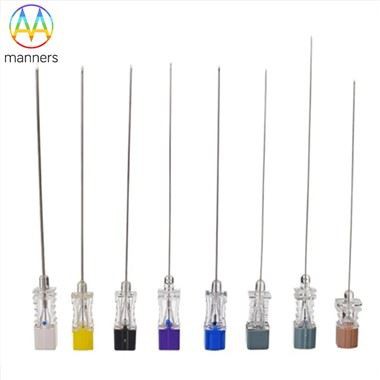
Quality Control System And ISO 13485 Certification Standard Interpretation For Pencil Point Needles
Jul 21, 2026
As precision instruments spanning medical, research and industrial fields, the quality stability, safety and dimensional precision of Pencil Point Needles directly determine medical treatment outcomes, laboratory data reliability and industrial finished product yield rates. Hence, the industry has established a rigorous full-lifecycle quality control system, with all core products certified under ISO 13485, the dedicated global quality management system standard for medical devices. This certification serves as the primary market access benchmark for premium medical consumables and precision fluid instruments worldwide, regulating the entire product lifecycle from raw material sourcing, manufacturing, inspection and sterilization to packaging, storage and after-sales traceability, forming the fundamental compliance guarantee for global circulation of Pencil Point Needles.
Tailored to medical device industry attributes, ISO 13485 mandates full-process risk control and standardized operations with strict requirements for Pencil Point Needle production systems. At the raw material control stage, all batches of 304 and 316 stainless steel tubing must provide complete material test reports and undergo sequential composition analysis, corrosion resistance testing, mechanical performance verification and biocompatibility screening to block substandard tubing with excessive impurities or unqualified mechanical properties from entering production. Custom special alloys require additional working condition compatibility testing to validate performance under extreme acid-alkali, temperature and repeated-use environments. Raw materials implement batch traceability management with dedicated production and inspection archives linked to every lot for full audit trails.
During manufacturing processing, all products are fabricated in controlled cleanrooms with strict monitoring of airborne particulate levels, bacterial counts, temperature and humidity to prevent surface contamination and impurity adhesion. Automated precision equipment executes core rotary swaging, side-hole drilling and mirror polishing processes with manual re-inspection dual quality control to eliminate human error. Every single needle passes five mandatory pre-assembly inspections: dimensional precision testing, tip angle calibration, side-hole coaxiality verification, inner wall smoothness inspection and puncture sealing performance assessment. Defective products with deformation, burrs, dimensional deviation, poor fluid throughput or compromised sealing are fully rejected. To validate reusability, batch durability tests are conducted including repeated puncture cycles and multiple sterilization rounds to verify long-term service stability.
A standardized final inspection protocol governs finished product testing and packaging warehousing workflows. Medical-grade needles complete sterility testing, biological toxicity screening, sealing performance evaluation and fluid throughput measurement; industrial variants undergo pressure resistance, corrosion tolerance and flow stability assessments. Only products passing all indicators are cleared for shipment. Classification-based customized packaging is adopted: sterile individually sealed packs for medical use prevent contamination during transport and storage, while heavy-duty standard cartons for industrial orders protect needles from impact and deformation during delivery. Manufacturers deploy a comprehensive product traceability system labeling each batch with lot numbers, production dates, full inspection reports and certification credentials, enabling rapid full-process data retrieval to locate and resolve quality issues efficiently. Rigorous quality control frameworks and authoritative certification standards secure top-tier industrial quality for Pencil Point Needles, earning widespread recognition from global clients.