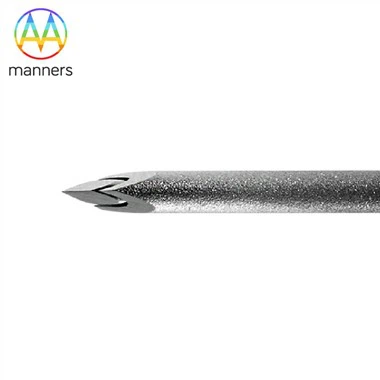
Puncture Method Of Lumbar Puncture Needle
Aug 23, 2022
Usually in a bent lateral position, intervertebral puncture is performed from lumbar 2 to sacral 1 (mainly from lumbar 3-4). After routine local disinfection and anesthesia, wear rubber gloves and slowly Pierce the needle along the spinous process with a 20-gauge puncture needle (21-22 for children). When the needle tip encounters bone during the process of needle entry, the needle should be retreated to the subcutaneous area to correct the Angle before puncture. When the needle is inserted about 4-6cm in adults (about 3-4cm in children), the dura can be penetrated to reach the subarachnoid space. The needle core can be withdrawn to drain the cerebrospinal fluid. After measuring pressure and slowly releasing fluid (no more than 2-3ml), the needle core can be inserted to pull out the puncture needle. The puncture point was slightly pressurized to stop bleeding, applied with sterile gauze and fixed with tape. Supine position for 4-6 hours after operation. If the initial pressure exceeds 2.94kPa(300mm water column), the fluid should not be discharged, and only the cerebrospinal fluid in the pressure measuring tube can be sent for cell counting and protein quantification.
1. Ask the patient to lie on the side of the hard bed, back and bed vertical, head forward chest flexion, hands holding knee close to the abdomen, so that the trunk bow; Or by the assistant in the surgeon opposite with one hand to hold the patient's head, the other hand to hold the popliteal fossa of both lower limbs and hold tightly, so that the spine as far as possible kyphosis to widen the vertebral space, facilitate needle entry.
2. To determine the puncture point, take the intersection of iliac crest line and posterior median line as the puncture point, generally take the spinous process space of the 3rd to 4th lumbar spine, sometimes can also be carried out in the space of one or the next lumbar spine.
3. After routine disinfection of the skin, sterile gloves were put on to cover the hole, and local infiltration anesthesia was performed with 2% lidocaine layer by layer from the skin to the intervertebral ligament.
4. The surgeon fixed the skin at the puncture point with his left hand, and held the puncture needle in his right hand to slowly Pierce the needle in the vertical direction of the back. The depth of the needle is about 4-6cm for adults and 2-4cm for children. When the needle passes through the ligament and dura, the resistance can be felt suddenly disappear and there is a sense of disappointment. At this point, the needle core can be slowly withdrawn (to prevent cerebrospinal fluid from rapidly flowing out, causing brain herniation), that is, CSF outflow can be seen.
5. Connect the pressure gauge tube to measure the pressure before draining the liquid. In the normal lateral position, the cerebrospinal fluid pressure is 0.69-1.764kPa or 40-50 drops /min. Queckenstedt test can be performed to determine whether subarachnoid space is obstructed. That is, after measuring the initial pressure, the assistant compresses one jugular vein for about 10s, then compresses the other side, and finally compresses both jugular veins at the same time. After normal compression of the jugular vein, the cerebrospinal fluid pressure immediately and rapidly doubled, and 10-20s after relief of the compression, rapidly decreased to the original level, which is called negative obstruction test, indicating patency of the subarachnoid space. If the pressure of cerebrospinal fluid cannot be increased after compression of the jugular vein, it is a positive obstruction test, indicating complete obstruction of the subarachnoid space. If the pressure rises slowly after the pressure is applied, then drops slowly after the pressure is relaxed, indicating incomplete obstruction. Where intracranial pressure is increased, this test is forbidden.
6. Remove the pressure measuring tube and collect 2-5ml cerebrospinal fluid for examination; If culture is required, the specimen shall be retained by aseptic operation.
7. At the end of the operation, after inserting the needle core, pull out the puncture needle together, cover with sterile gauze, and fix with tape.
8. Postoperative patients to occipital prone (if difficult, supine) 4-6h, so as not to cause postoperative intracranial hypotension headache
If you have any questions, please contact us. Our company can produce various customized needles, medical needles, puncture needles, hypodermic needles, biopsy needles, vaccine needles, injection needles, syringe needles, veterinary needles, pencil point needle, ovum pick up needles, spinal needles, etc. If you need customized needle products, please contact us. We look forward to your inquiry! The quality of the products manufactured in our factory will surely satisfy you!
Please contact us if you need: zhang@sz-manners.com