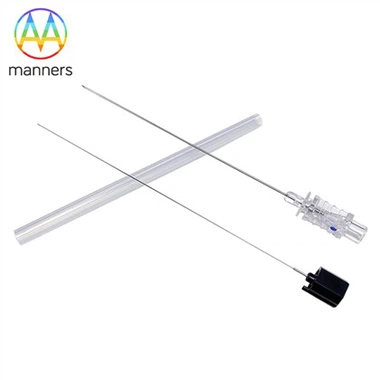
Preventing Hub Breakage In Disposable Stainless Steel Spinal Needles
Nov 25, 2026
A Failure That Happens at the Wrong End
Needle failure is usually imagined at the tip. In practice, the most common structural failure of a spinal needle occurs at the opposite end, where the shaft meets the hub. The shaft is slender by design, the hub is rigid, and the junction between them is the point where every bending moment applied at the skin surface is concentrated. When a needle is bent against the patient's back, the shaft does not break in the middle. It fatigues at the transition, and the consequence is a fragment in tissue and a procedure that changes character entirely.
The uncomfortable part is that hub damage is almost always the operator's signature rather than the manufacturer's. It arises from leverage, from forcing the needle past a bony obstruction, and from gripping the hub while advancing. Recognising those three habits is the practical route to preventing the failure.
Why the Hub Is the Weak Point
A spinal needle behaves as a cantilever. The skin surface acts as a fulcrum, the hub is the loaded end, and the shaft carries the resulting moment. Because the shaft is thin, even a modest side load at the hub produces a substantial bending stress near the junction, where the geometry changes abruptly from a slender tube to a rigid polymer block. That geometric discontinuity is a stress raiser, and repeated small load cycles accumulate damage in the same way that bending a paperclip back and forth eventually separates it.
There is a second mechanism that receives less attention. The hub is bonded to the shaft by an adhesive or an insert-moulded joint, and that joint is designed for axial load, not for torsion or leverage. Twisting the hub to redirect the bevel, pushing with the palm against the skin, and levering the needle to steer the tip all load the bond in directions it was not intended to carry. A third mechanism is stylet-related: repeated reinsertion of the stylet with force can crack the hub flange, and a cracked flange is a handling failure that no amount of shaft strength will compensate for.
Choosing Length and Gauge to Reduce Leverage
The most effective preventive measure is also the least discussed: make sure the needle is long enough. When a 90mm shaft is shorter than the skin-to-dura distance, the operator instinctively presses the hub into the skin to gain the missing centimetres, and that pressure is applied as a side load as often as an axial one. A custom length eliminates the compulsion to push, and with it a large share of the bending load.
Gauge choice matters in the same way. A larger bore such as 16G or 18G has a stiffer wall and tolerates more bending before it yields, but it also requires more force to advance, and force is what creates the problem. A 25G or 27G advances with less resistance but bends more readily. A full range of Disposable Stainless Steel Spinal Needles from 16G to 27G lets the operator match shaft stiffness to the tissue in front of them rather than defaulting to whatever is on the trolley. Twelve colour codes, from White at 16G through Pink, Yellow, Green, Black, and Purple to Grey at 27G, make that choice verifiable before the needle is used.
Tip geometry also affects load. A Quincke Point requires rotation to orient the bevel, and every rotation applies torque to the hub joint; a Pencil Point needs no orientation and therefore less handling. Both styles are available in stainless steel for anesthesia usage, and where a service wants a specific shaft stiffness or hub shape, a 2D or 3D drawing or a physical sample can be used to fix the specification, with the finished batch delivered in standard carton packaging and traceable to the agreed drawing.
Technique That Keeps the Joint Unloaded
Hold the needle by the shaft or by the fin, never by gripping the hub in a fist. Advance with the dominant hand while the non-dominant hand stabilises the skin, and keep the shaft aligned with the intended track so that the load path stays axial. If the shaft begins to bow, stop; the bow is a direct visual indication that the hub is carrying a bending moment.
Withdraw rather than lever when the trajectory is wrong. A withdrawal of five millimetres and a deliberate re-angle loads the joint far less than a lateral push at the hub. If the bevel must be reoriented, rotate the shaft gently with two fingers rather than wrenching the hub. Inspect the hub before use: a hairline crack at the flange, a loose stylet, or any wobble between shaft and hub is grounds for discarding the needle, and the replacement costs a fraction of the alternative. Never straighten a bent needle and continue, since the material has already been plastically deformed.
Field Observations from Difficult Cases
The cases that produce hub damage share a pattern. They involve a patient with dense bone or a deep spine, an operator working at the limit of the needle's length, and a moment of impatience after two failed passes. In that situation the natural response is to increase force at the hub, which is precisely the wrong response.
Experienced operators do two things differently. First, they check length before starting, and they switch to a custom length shaft rather than discovering the shortage midway. Second, they treat any visible bow as a stop signal, not as a warning to push more carefully. Departments that record needle-related incidents separately from procedural failures tend to discover that hub damage clusters around a small number of scenarios, which makes targeted training straightforward.
One scenario deserves separate attention because it is easily missed: the small hub crack that appears before any obvious bending. A stylet reinserted at an angle, a hub dropped onto a trolley, or a needle pushed through a tough carton seal can all start a fissure that widens under load. A two-second inspection before the needle is connected to anything catches it, and the cost of that inspection is negligible beside the cost of retrieving a fragment.
Storage and handling matter as well. Cartons stacked under heavy equipment, needles stored loose in a drawer rather than in their packaging, and trays opened long before use all expose hubs to loads the design never anticipated. Keeping the needles in their standard carton until the moment of use, and discarding any unit whose packaging is crushed at the hub end, removes a category of failure that never reaches the bedside.
There is also a training point worth making explicit. Junior operators are taught to advance with the dominant hand and stabilise with the other, but the grip itself is rarely demonstrated. Holding the shaft between thumb and index finger, with the palm clear of the hub, keeps the load path axial and gives finer depth control than the palm-push technique that causes most of the damage. A department that standardises on a documented set of Disposable Stainless Steel Spinal Needles, with the grip taught alongside the gauge, finds that the failure becomes rare rather than merely reportable.
Summary
Hub breakage is a load-path problem, not a materials problem. Keeping the shaft long enough, matching gauge to tissue resistance, holding the needle by the shaft rather than the hub, withdrawing instead of levering, and discarding any needle that has been bent are the measures that keep the junction unloaded. None of them requires new equipment; all of them require a change of habit.
The Direction of Practice
Manufacturers are beginning to address the joint rather than only the shaft. Hub geometries that discourage a palm grip, reinforced transition zones, and strain relief at the shaft entry all reduce the peak stress that a careless hand can apply. Combined with better pre-procedure length assessment and clearer colour coding, the trend points toward a future in which hub failure is treated as a design and training problem solved in advance, rather than as an incident investigated afterwards.
< img alt="news-1-1" src="/uploads/24240/news/202604241539186d0ff.png " />