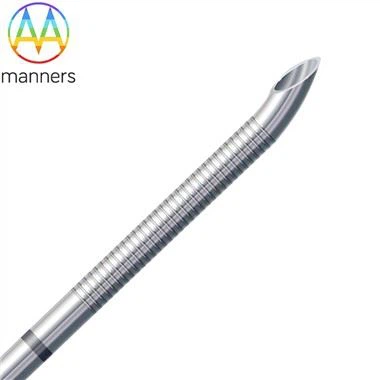
Precision Reflow Holes Hypotube For Peripheral Vascular Interventions
Sep 05, 2026
Introduction: The Kink Resistance Pain Point
Peripheral vascular interventions involve navigating the arteries and veins of the limbs, which are often tortuous and subject to external compression. A major pain point for device manufacturers is maintaining kink resistance while achieving the necessary flexibility. Laser cut hypotubes with aggressive patterns like interrupted spirals can kink at the cut sites if the edges are not properly treated. When the tube bends sharply, the jagged kerf edges can act as stress concentrators, leading to metal fatigue and eventual failure. This is particularly problematic in peripheral applications where the device may be subjected to repeated bending. The need for a hypotube that can endure these harsh mechanical conditions without compromising its structural integrity is a constant challenge.
Principle: Reflow for Kink Resistance
The reflow holes hypotube addresses this by smoothing the stress concentrators. During the reflow process, the edges of the laser cuts are melted into a rounded profile, distributing mechanical stress more evenly across the bend. This reduces the likelihood of crack initiation and propagation. The principle is similar to the fillet radius in engineering design-a smooth curve is stronger than a sharp corner. For a laser cut hypotube made from 304 or 17-7PH stainless steel, reflow holes enhance the fatigue life by eliminating micro-notches. The result is a device that can withstand thousands of bending cycles without kinking, making it ideal for peripheral vascular interventions where durability is paramount. The flexibility gradient from near end to far end is maintained, but the tube's resilience is significantly improved.
Equipment Classification for Peripheral Use
Equipment for peripheral reflow must handle a wide range of tube diameters, from 0.20mm to 20mm. The first class is large-chamber reflow systems with adjustable fixtures to accommodate different lengths. The second is robotic reflow stations that can manipulate the tube in multiple axes, ensuring uniform heat distribution along the entire length. The third class includes in-line reflow systems integrated into laser cutting lines, providing a seamless transition from cutting to reflow. These machines are equipped with real-time monitoring cameras to detect any signs of overheating or distortion. All equipment operates under ISO 9001:2015 guidelines to ensure consistent quality for medical applications.
Practical Guide: Ensuring Durability
To produce a durable reflow holes hypotube, manufacturers should start with a robust material like 316 stainless steel. The laser cutting parameters are optimized to produce a clean kerf with minimal dross. After cutting, the reflow process is applied with a focus on the high-stress areas, typically the distal end where bending is most severe. The temperature is carefully controlled to avoid annealing the metal, which could reduce its hardness. Post-reflow, the tube is subjected to a bending fatigue test to validate its kink resistance. Only after passing these tests is the tube cleaned, coated if required, and packaged. This rigorous process ensures that the reflow holes hypotube meets the demanding needs of peripheral interventions.
Real-World Experience: Surviving the Tortuosity
Our factory has supplied reflow holes hypotubes for peripheral atherectomy devices. One client shared that during in-vitro testing, their previous tubes would kink after just 50 bends in a simulated arterial model. After switching to our reflow process, the tubes withstood over 500 bends without failure. We attribute this success to the elimination of micro-burrs that previously acted as failure points. However, we also learned that the reflow process can slightly increase the tube's stiffness if overdone. By adjusting the reflow depth, we achieved the perfect balance between flexibility and kink resistance. These insights have made our reflow holes hypotube a preferred choice for peripheral applications.
Conclusion and Sublimation
The reflow holes hypotube is a triumph of materials engineering, turning a potential weakness-the laser cut edge-into a strength. It empowers medical device manufacturers to push the boundaries of minimally invasive surgery, knowing that their components can endure the rigors of the human body. This technology is not just about fixing a flaw; it's about redefining what's possible in peripheral vascular care.
Prospects and Recommendations
As peripheral interventions expand to include more complex anatomies, the demand for highly durable hypotubes will surge. We recommend exploring reflow processes for advanced alloys like L605, which offer superior strength. Additionally, developing a standardized testing protocol for reflow holes hypotubes could help accelerate regulatory approvals. Manufacturers should also consider the environmental impact of reflow processes and invest in energy-efficient equipment. The future of peripheral vascular devices is bright, and the reflow holes hypotube will be at its core.