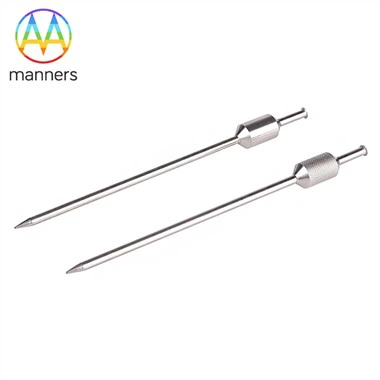
Precision Processing Technology Iteration & CT Puncture Accuracy Improvement Of Puncture Needles
Aug 08, 2026
1. Industry & Clinical Pain Points
Backward processing technology is the core factor leading to insufficient precision of traditional puncture needles and restricting CT-guided precise treatment. Most low-end products only adopt simple stamping and single grinding processes, lacking fine composite processes such as necking shaping, swaging reinforcement, laser precision cutting and electropolishing. The products have uneven needle tip radian, inconsistent lumen diameter and residual surface burrs, resulting in unstable puncture resistance and easy tissue scratching. During CT dynamic positioning adjustment, process defects cause needle path deviation, requiring repeated scanning and puncture correction, which increases patient radiation exposure and surgical time. Without laser marking technology, traditional needles lack accurate depth scales, relying entirely on doctors' empirical judgment, leading to inaccurate insertion depth and uneven particle implantation distribution. In addition, unpolished processing residues cause tissue adhesion during rapid needle withdrawal, resulting in incomplete sampling and increased postoperative complications, severely affecting the accuracy and safety of brachytherapy treatment.
2. Precision Process Iteration & CT Positioning Matching Principle
Brachytherapy particle implant puncture needles adopt six core precision processes including necking, swaging, grinding, laser cutting, laser marking and electropolishing, realizing full-dimensional precision iteration to match high-standard CT-guided precise surgery. Necking and swaging processes reinforce the needle root and body structure, improving structural stability and anti-deformation ability during multi-angle adjustment, ensuring that the actual needle path is completely consistent with the CT preoperative planned path. Precision grinding and laser cutting realize micron-level precise shaping of needle tip and lumen, forming uniform and sharp piercing structure, ensuring stable and controllable puncture speed and direction. Laser marking carves high-precision depth scales on the needle surface, realizing visualized digital depth control and eliminating empirical judgment errors. Electropolishing removes all surface processing residues and burrs to form an ultra-smooth surface, ensuring unobstructed particle delivery and non-adhesive rapid needle withdrawal, fully adapting to the high-precision, low-trauma and high-efficiency requirements of modern CT-guided brachytherapy.
3. Process Grade Classification & Clinical Precision Scenario Division
The product forms three differentiated process grades corresponding to hierarchical CT puncture precision scenarios. Primary conventional process products adopt basic grinding and cutting technologies, suitable for low-precision superficial large-mass routine puncture and particle implantation, meeting basic clinical treatment needs with high cost performance. Intermediate standard process products add necking and swaging structural reinforcement processes, with improved stability and dimensional consistency, suitable for most routine thoracic and abdominal tumor CT positioning surgeries, serving as mainstream clinical conventional products. High-end full-process products integrate all six core precision processes, with laser visualized depth calibration and mirror-level smooth surface, featuring ultra-high precision and ultra-low trauma, specially used for deep tiny masses, high-risk intercostal lesions and complex irregular tumor precise puncture. Customized products adopt personalized process parameter adjustment according to 2D/3D drawings and samples, realizing exclusive precision optimization for special complex surgical scenarios.
4. Process-Oriented Standard CT Puncture Operational Guidelines
Based on differentiated process grades, standardized hierarchical CT puncture precision operation specifications are formulated. For full-process high-precision products, implement ultra-precision digital positioning operation: accurately align CT-measured skin marking points, adjust needle depth in real time with reference to laser scales, stop insertion immediately when the needle tip reaches the mass edge, and complete breath-holding rapid puncture and sampling to realize zero-error precise targeting. For standard intermediate-process products, adopt routine standardized dynamic adjustment operation, verify needle path accuracy through multiple CT scans, and ensure uniform particle implantation distribution. For primary conventional-process products, limit to superficial low-risk lesion surgery, increase CT scanning frequency to compensate for process precision defects and avoid positioning deviation. All operations strictly follow preoperative measurement, sterile preparation, local anesthesia, staged puncture and postoperative verification procedures to ensure operational standardization and precision.
5. Practical Experience of Process Upgrading in Clinical Precision Improvement
Clinical precision monitoring data proves that full-process precision products achieve comprehensive improvement in CT puncture surgical indicators. The swaging and necking reinforcement process reduces needle deflection rate during dynamic adjustment to less than 0.3%, ensuring 100% consistency between actual needle path and CT planned path. Laser marking visualized depth scales control puncture depth error within 0.5mm, realizing accurate positioning of tiny lesions below 1cm. Electropolishing ultra-smooth surface completely eliminates tissue adhesion, improving lesion tissue sampling integrity rate to 99%. The one-time puncture success rate of high-precision products in complex deep tumor surgery exceeds 98%, reducing repeated scanning times by more than 40% and effectively lowering medical radiation exposure. Customized process optimized products can adapt to special-shaped lesion puncture paths, solving the precision bottleneck of difficult complex cases and greatly improving the overall clinical precision level of brachytherapy.
6. Summary & Technical Sublimation
The composite precision processing technology system is the core technical support for the high-precision clinical performance of brachytherapy particle implant puncture needles. Through multi-process iterative upgrading, the product completely solves the precision defects of uneven structure, rough surface and inaccurate depth control of traditional single-process products. The graded process layout realizes precise matching with low, medium and high-precision clinical scenarios, covering all routine and complex CT-guided puncture surgeries. The perfect integration of process precision advantages and standardized CT surgical procedures promotes the transformation of clinical operation from empirical judgment to digital precise control, greatly improving the accuracy, safety and efficiency of tumor brachytherapy and biopsy, and leading the industry's precision manufacturing upgrading direction.
7. Process Iteration Prospects & Optimization Suggestions
In the future, product processing technology will develop towards full automation, intelligence and micro-nano refinement. It is suggested to introduce fully automated laser composite processing equipment to realize integrated intelligent molding of cutting, grinding and marking, improving batch product precision consistency. Second, upgrade micro-nano electropolishing technology to further reduce surface roughness and enhance minimal invasive anti-adhesion performance. Third, formulate unified industry process grading and scenario matching standards to standardize clinical product selection. Fourth, strengthen customized process innovation, improve the parameter restoration accuracy of 2D/3D drawings and samples, and expand the coverage of high-precision customized scenarios. Continuous process refinement will further consolidate the product's leading advantage in CT-guided precise tumor treatment.