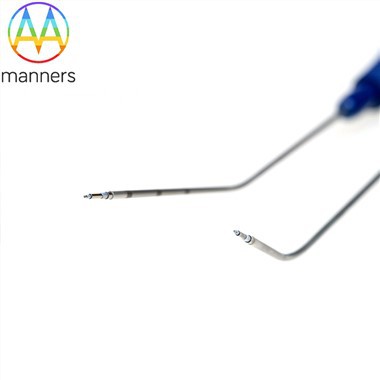
Precision Matching Of Three Core Parts For Vacuum-Assisted Breast Biopsy Needles
Jun 12, 2026
1. Needle Tip: Puncture Pioneer and Sealing Barrier
The needle tip is the first segment of the VABB needle to contact tissue. It adopts a triple-curve back-cut geometry analogous to the curved blade of a surgical scalpel, slicing through skin and breast parenchyma with minimal resistance during rotation or forward advancement. Its hardness is matched to the cutting cannula (both HRC 30–40) to prevent uneven abrasive wear.
A sealing shoulder is machined at the root of the tip, forming a tight fit with the front end of the sample notch cannula to block vacuum leakage. For MRI-compatible models, non-magnetic titanium alloy can replace SS316 as the tip substrate to eliminate imaging artifacts.
2. Sample Notch Cannula: Specimen Storage Chamber
The sample notch cannula is a thin-walled tube with a lateral opening. Standard notch length ranges from 10–20 mm, with width accounting for 60–70% of the tube outer diameter. All notch edges undergo electropolishing to form a fillet radius of roughly 0.05 mm, eliminating shear trauma to tissue as it is drawn inward by vacuum.
Micro-grooves are etched on the inner notch wall, or a hydrophilic coating is applied, enabling smooth specimen ejection once negative pressure is released. The cannula outer diameter defines puncture tract size: a 10G needle has an outer diameter of approximately 3.4 mm, while a 14G model measures around 2.1 mm. Clinicians select gauges according to lesion size and anatomical location.
3. Cutting Cannula: High-Speed Cutting Blade
Sliding over the exterior of the sample notch cannula, the cutting cannula performs rapid axial reciprocating motion (2–5 Hz frequency) driven by an electric motor or manual actuation. Its leading cutting edge receives specialized chamfering and hardening treatment to form a sharp punch-style rim.
After vacuum pulls tissue into the notch, the cutting cannula surges forward at high speed; its edge sweeps across the notch opening to sever tissue cleanly and seal off the cavity to hold the specimen internally. A buffer structure is fitted at the travel limit of the cannula to prevent impact damage to the needle tip.
The clearance between the cutting cannula inner diameter and sample notch cannula outer diameter is strictly controlled at 0.02–0.05 mm, balancing unobstructed sliding and prevention of tissue entrapment.
4. Synergistic Operation Cycle: Suction – Cutting – Transfer
- Suction phase: The vacuum pump generates negative pressure via side ports on the needle hub, drawing lesion tissue into the fully exposed notch (cutting cannula retracted to the rear position).
- Cutting phase: Once a sensor confirms the notch is filled with tissue, the cutting cannula is triggered to dart forward at high speed, severing tissue and sealing the notch opening.
Transfer phase: The cutting cannula retracts backward, pushing the tissue specimen toward the collection chamber at the needle hub (or expelled via reverse airflow). The cycle repeats until sufficient specimen volume is harvested.
A control system precisely synchronizes vacuum activation/deactivation, cutting timing and retraction speed, stabilizing per-sample weight at approximately 100–200 mg.
Conclusion