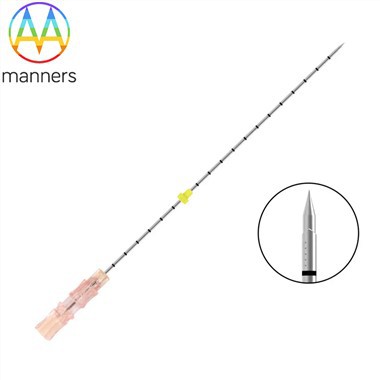
Precision Manufacturing Process & Quality Control Of PTC Needles
Jul 06, 2026
https://admin1.seo.com.cn/CustomerAdmin/S_News/Create?ru=%2FCustomerAdmin%2FS_News%2F
Though seemingly simple, a Chiba needle's performance hinges on tight-tolerance tubing, refined tip grinding, and rigorous QC.
1. Raw Material
Medical-grade SUS304/SUS316L capillary tube (ASTM A269/A908) or Nitinol (ASTM F2063)
Incoming checks: spectroscopy, hardness (HV 180–220 SUS304), OD ±0.02 mm, ID ±0.01 mm, surface flaw inspection
2. Cutting & Straightening
Diamond cut to length; deburr
Multi-roll straightening → straightness ≤0.3 mm over full length
3. Lumen Conditioning
Plug-drawing / die-pulling to final ID/OD
Electropolishing interior: Reduces Ra <0.2 µm → minimizes cell sticking & clot blockage
4. Tip Grinding - Critical Step
CNC bevel grinding to 25°–30° long bevel using resin-bond diamond wheel
Tip thickness ≤5 µm; penetration force <0.5 N (phantom gel)
Optional secondary relief grind to lower drag & improve US tip echo
Ultrasonic wash to remove micro-debris (prevents particulate embolization)
5. Exterior Finish & Marking
Electropolish outer surface
Laser-etched depth marks (5/10 mm) ±0.1 mm tolerance
Optional "echogenic ring" (micro-groove or inert coating) near tip
6. Hub Assembly & Sterilization
PP/PC hub press-fit or solvent-bonded to tail
Assemble stylet (if included), protective sleeve
Wash → ISO Class 7 cleanroom packaging → Tyvek pouch → EO sterilization (AE ≥12) → quarantine for sterility / EO residue / endotoxin
Key QC Tests
|
Test |
Method / Criterion |
|---|---|
|
Dimensions |
Vision system: OD, ID, bevel angle, bevel length, total length |
|
Penetration Force |
≤0.5–0.6 N in std gelatin; <20% force decay after 10 reps |
|
Flow Rate |
Water flow @ defined ΔP meets min spec |
|
Tip Integrity |
Microscope: no rolled edge, chipping, cracking |
|
Leak / Luer Lock |
Hold vacuum >30 s; torque test on hub |
|
Biocompatibility |
ISO 10993 cytotoxicity / sensitization / hemolysis (lot sample) |
|
Package Integrity |
Dye penetration / vacuum decay |
Common defects from poor manufacturing: dull tips → high insertion force & tearing; rough lumen → clogged aspirate / hemolysis; inaccurate markings → depth misjudgment.