Pre-Market Regulatory And Validation Documentation
Nov 18, 2026
The File That Decides the Launch
A device is designed, tooled, manufactured, and inspected, and then it waits. The delay is not technical. It is a documentation file that is incomplete, or a validation that used the wrong tissue model, or a technical file written to a template that no longer satisfies the current regulation. The product exists; the evidence that it is safe and performs as claimed does not yet exist in the required form.
For needle products the risk is particular. A needle is a simple object by appearance, so teams underestimate the evidence burden: materials, biocompatibility, sterility, mechanical performance, and clinical justification all require documentation, and each has a specific format depending on the market. This article sets out what the main frameworks require for a Crown End Needles type product, how the evidence types fit together, and how to build the file without losing months.
What Each Framework Requires
Three frameworks dominate, and they overlap more than they appear to.
A quality management system certified to ISO 13485 is the foundation. It establishes design control, purchasing control, process validation, traceability, complaint handling, and corrective action, and it is the framework within which all other evidence is produced. Without it, the remaining documents have no controlled origin and are difficult to defend.
For the European Union, the Medical Device Regulation requires a technical documentation file organised by annex, a clinical evaluation with literature and, where applicable, clinical investigation, a post-market surveillance plan, and a risk management file following ISO 14971. Classification determines the depth, and a needle for injection or sampling is typically in a class that requires notified body involvement.
For the United States, most new needle products follow the 510(k) pathway, which requires a demonstration of substantial equivalence to a legally marketed predicate device. That means a device description, a comparison with the predicate, performance data, biocompatibility, sterilisation validation, and a proposed indication statement. Where no suitable predicate exists, the de novo route applies.
Markets outside these two follow their own systems, but most accept a well-built technical file with local administrative additions.
Evidence Types and How They Fit
The evidence falls into a small number of categories, and each answers a distinct question.
Material and biocompatibility evidence answers what the device is made of and how the body responds. For stainless steel components this means grade identification, material certificates, and a biocompatibility assessment per ISO 10993 for the relevant contact category, with attention to nickel release where prolonged contact applies.
Mechanical performance evidence answers whether the device does what it claims. For a needle this includes tip penetration force, hub bond strength in pull and torque, shaft stiffness and resistance to bending, and for sampling devices, specimen adequacy in an appropriate model. Each test needs a method, a sample size, and an acceptance criterion stated in advance.
Sterilisation evidence answers whether the device is sterile and remains so. For ethylene oxide this means validation of the cycle, residuals testing, and aeration studies; for radiation, dose setting and material compatibility. Packaging and shelf life evidence answers whether the sterile barrier survives distribution and time, which requires ageing studies and distribution simulation.
Clinical evidence answers whether the device is acceptably safe and performs in use. For a well-established design this is often a literature-based clinical evaluation supported by bench and animal data, rather than a new clinical investigation.
Building the File Without Losing Time
The recurring failure is sequence. Documentation is treated as a task that follows development, so the tests are run without the acceptance criteria that the file will need, and the reports are written afterwards by someone reconstructing decisions.
The alternative is to define the file at the design input stage. That means identifying the target markets first, deriving the required evidence list from those markets, and writing each test protocol with the acceptance criterion before any testing begins. It means establishing a traceability matrix that connects each requirement to a verification or validation activity and to a result, so gaps are visible while there is still time to close them.
It also means choosing models deliberately. Bench models establish repeatability and discriminate between designs. Ex vivo tissue models, using animal tissue under controlled conditions, establish that performance survives contact with real tissue mechanics, and they are the appropriate level for claims about specimen quality. Animal models, used sparingly and under appropriate approval, address questions that neither bench nor tissue can answer, such as access, navigation, and the practical sequence of a procedure.
Deviations should be recorded as they occur, with the rationale, because a file with explained deviations is stronger than a file that appears to have none.
Where Submissions Commonly Stumble
Reviewers and regulatory consultants report familiar problems. The first is a device description that does not match the drawings, usually because a change was made during development and the description was not updated. The second is a performance section with results but no acceptance criteria, leaving the reviewer unable to judge adequacy.
The third is a comparison table that lists similarities and omits meaningful differences, which undermines credibility. The fourth is a sterilisation validation performed on a different configuration from the one submitted. The fifth is a clinical evaluation based on literature that is not specific to the intended use, or a claim of equivalence that is not supported by the depth of data required.
The sixth is a labelling or instructions-for-use document that introduces a claim the technical file does not support. Each of these is avoidable by internal review against the requirement list rather than against a previous submission.
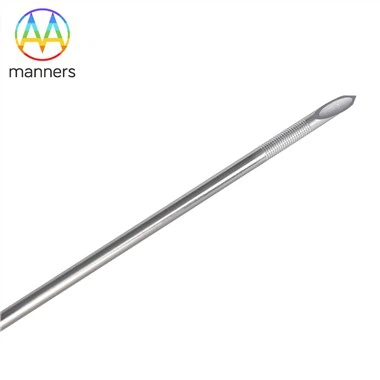
For buyers sourcing a Crown End Needles product, the practical implication is to ask for the documentation package early. A supplier certified to ISO 13485 who can provide material certificates, process validation summaries, sterilisation and packaging data, and inspection records is providing the raw material of a submission, and one who can supply product from 0.25 mm to 30 mm in stainless steel with selectable tip forms including Crown Core cut, Franseen, Menghini, Lancet, Whitacre, Closed Point, Backcut Bevel, and Trocar, customised from 2D or 3D drawings or a sample, makes it possible to align the drawing and the file from the outset.
Documentation as a Product Feature
The strategic point is that a complete file is a commercial asset. It shortens time to market, it makes distributor qualification straightforward, and it protects against the cost of a submission that has to be rebuilt. It also changes how a supplier is chosen: a supplier whose documentation supports a submission is worth more than one whose price is lower and whose file is thin.
Treating documentation as a design output rather than as an administrative task also improves the product, because the discipline of stating acceptance criteria in advance forces clarity about what the device is supposed to do. Specification and evidence then develop together, and the launch waits on production rather than on paperwork.
What Regulators Will Expect Next
The direction across major markets is toward more structured, more machine-readable, and more lifecycle-oriented submissions. Electronic formats with structured content are becoming the norm, and post-market data is being integrated into the assessment rather than treated as a separate obligation.
For manufacturers and for buyers, that raises the value of clean, consistent records from the beginning: one material database, one set of validated processes, one traceability structure, and one controlled document set that can be rendered into whichever format a market requires. A Crown End Needles programme built that way does not merely pass a review; it can be re-used as the basis for the next market, the next tip form, and the next custom project without rebuilding the evidence from scratch.