Pencil Point Needle Choice And Spinal Anaesthetic Spread
Nov 18, 2026
Why Spread Is Harder to Predict Than Block Height
Spinal anaesthesia usually works. The difficulty is that it does not always work the same way twice. Two patients of similar build, given the same drug, the same dose, and the same needle, can end with block heights that differ by several dermatomes, and one may need vasopressors while the other needs nothing.
Anaesthetists have long treated this variability as an intrinsic property of the technique, to be managed by choosing a conservative dose and by positioning the patient. Part of the variability is biological: cerebrospinal fluid volume, thecal sac dimensions, and intra-abdominal pressure differ between patients. But part of it is mechanical, and that part is influenced by the needle. The geometry of the tip determines the direction and the character of the jet that enters the cerebrospinal fluid, and that jet determines where the local anaesthetic goes before it dilutes. This article examines that mechanism, the designs available for spinal anaesthesia, and the practice that makes spread more predictable.
How Port Geometry Shapes the Plume
Injection through a needle orifice produces a jet. The jet's direction is set by the orientation of the opening, its velocity by the injection rate and the orifice area, and its dispersion by the balance between inertial forces and the viscosity of the fluid it enters.
Because cerebrospinal fluid is a low-viscosity medium, a fast jet travels further than intuition suggests. A bolus injected rapidly through a small side port emerges as a narrow plume that can carry a concentrated dose several centimetres in the direction the port faces. Injected slowly, the same volume emerges at low velocity, mixes locally, and disperses more by diffusion and by the natural circulation of the fluid.
The distinction between an end-hole and a side-port needle matters here. A bevelled needle with an end hole projects the anaesthetic forward along the shaft axis, which in a patient in the lateral position means toward the cephalad or caudad end of the thecal sac depending on the direction of insertion. A pencil point needle delivers through a side port, so the jet leaves at an angle to the axis, typically perpendicular to the shaft. The direction is then determined by the rotation of the hub, which is visible and controllable.
There is a further mechanical difference. A side port placed on a rounded tip is partially shielded by the taper, so the flow pattern is not a simple free jet; the taper shapes the emerging flow and reduces its peak velocity. This is one reason side-port pencil point designs are frequently described as producing a more gradual onset and a more symmetric block than end-hole designs injected at the same rate.
Pencil Point Options for Spinal Anaesthesia
The spinal needle market is dominated by a small number of concepts, and for a Wire Pencil Needles product the practical question is which flow pattern the tip produces.
A pencil point design with a lateral port near the tip is the most widely used atraumatic option, and its behaviour is the reference against which others are compared. A design with a more proximal port and a longer taper reduces peak velocity further and produces a gentler distribution. A design with the port cut slightly into the taper produces a partly directed jet with some of the characteristics of both families.
Conventional bevelled needles remain in use where a rapid, directed block is wanted, and their behaviour is well characterised. The trade-off is the larger, cutting dural defect and the associated headache risk, which is why their use is concentrated in settings where speed or block height control outweighs that consideration.
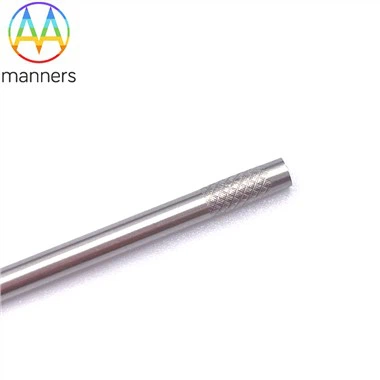
The Wire Pencil Needles range, formed from stainless steel in diameters from 0.25 mm to 30 mm with the side port positioned to a controlled distance from the tip, allows a department to choose between a proximal and a distal port configuration within the same product family. That consistency matters practically: an acute pain service that uses a distal port configuration for caesarean sections and a proximal port configuration for hip surgery can standardise its technique while keeping the different flow characteristics, rather than switching between products whose other dimensions also differ.
A Sequence That Gives Predictable Spread
Predictability comes from controlling the variables that are controllable.
The first is the dose for the patient's height and build, chosen from a local protocol rather than adjusted at the moment of injection. The second is patient position, held constant during injection and for a defined interval afterwards, because posture determines where the plume settles. The third is port orientation: rotate the hub so the port faces the direction in which the block is intended to extend, and record the orientation, since a port facing caudad will not produce the same block as a port facing cephalad.
The fourth is injection rate. A slow, steady injection over a defined period produces a more symmetric block than a rapid bolus, because it limits the distance the concentrated plume travels. Use a syringe size that makes slow injection easy; a small syringe with a fine bore gives finer control over the rate than a large one.
The fifth is confirmation of free flow before injection. Aspirate gently and observe spontaneous flow; a needle that flows sluggishly may have its port partly within the dura or partly occluded, and injecting into that state produces an unpredictable result. The sixth is to avoid unnecessary needle movement after the port has cleared, because moving the tip redistributes the plume.
Finally, record what was done: gauge, port configuration, orientation, rate, baricity, and volume. Local audit of these variables is the only reliable way to detect that a supplier change has altered behaviour, because the block will still work, just differently.
What Anaesthetists Observe in Practice
Clinicians who have compared port configurations within the same product family report specific differences.
The first is that port orientation produces a measurable effect on block height in a way that is obvious once it is deliberately varied. The second is that the same dose through a proximal port configuration spreads more gradually, which some services use to reduce the frequency of hypotension in elderly patients. The third is that the difference is small enough to be masked by other variables unless a service holds those variables constant, which is why audits that vary dose and position at the same time rarely detect anything.
The fourth is a practical warning. A pencil point needle requires the operator to confirm flow, and a port that has rotated during insertion can face the dural wall, producing slow or absent flow and a temptation to advance further. Marked hubs reduce this, and rotating the hub a quarter turn while watching for flow is a faster remedy than advancing the needle.
The fifth is that finer gauges are used more often in day surgery, where a headache that would be tolerated in an inpatient becomes a failed discharge. This has driven demand for fine pencil point needles with reliable flow, which depends on bore quality and port size as much as on gauge.
Spread as a Controllable Variable
The conclusion is that spinal anaesthetic spread is partly a design and technique variable rather than purely a biological one. The needle sets the direction and the velocity of the jet; the operator controls orientation, rate, and position; the drug sets the baricity. Controlling all four together produces a block that is repeatable enough to be audited.
That has a procurement consequence. A department that specifies port distance from the tip, port size and configuration, taper geometry, and shaft diameter is specifying the flow behaviour it will get, rather than accepting whatever the current product happens to provide. Documentation to ISO 13485 makes that specification verifiable, customisation from 2D or 3D drawings or a supplied sample allows the port position to be tuned to a service's protocol, and standard carton packaging protects the fine taper that makes the whole mechanism work.
The Future of Spinal Needle Design
Two directions appear likely. The first is finer control of the port, with shapes that produce a more diffuse plume by design, reducing the dependence of spread on injection rate. The second is better orientation feedback, with hub markings that remain legible under the conditions of a fast turnover list.
Neither will change the fundamentals. A pencil point needle with a well-formed taper, a clearly marked port, and a consistent bore will remain the default for spinal anaesthesia, because it combines a low headache risk with a flow pattern that can be directed. The practical task for services is to specify that behaviour rather than to assume it, and to record enough about each case to know when it has changed.