Operational Specifications And Safety Guidelines For Manufacturer Standard Vascular Access Needles
Jul 25, 2026
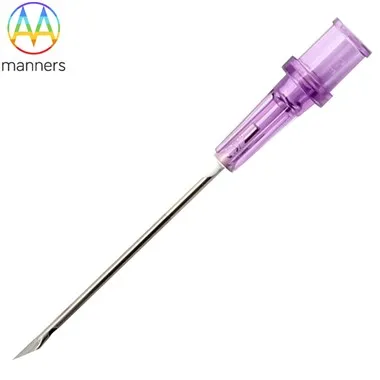
Standardized operation is the key to ensure the safe and effective use of vascular access needles. Professional vascular access needle manufacturers not only focus on product research and development and production, but also summarize and formulate standardized operation guidelines based on product structural characteristics and clinical application data, covering the operational specifications of 25 mm conventional needles and 45 mm extended needles, helping medical staff standardize operations, reduce complications, and give full play to the emergency value of products in critical patient rescue.
In the selection of needle type before operation, medical staff need to make scientific matching according to the patient's body type and puncture site condition. For standard weight adult patients with clear tibial trochanter landmarks and moderate subcutaneous fat, a 25 mm vascular access needle can be selected for conventional puncture, which can complete vascular access establishment with minimal trauma. For obese patients with thick subcutaneous fat, fuzzy bony landmarks and inability to palpate tibial trochanter accurately, 45 mm vascular access needle must be selected preferentially to avoid puncture failure caused by insufficient needle length.
In the formal puncture operation, both 25 mm and 45 mm vascular access needles need to follow the core principle of "pierce the cortex without burying the needle". For the 45 mm long needle specially used for obese patients, excessive needle burial should be strictly avoided to prevent the needle tip from piercing the deep bone tissue and damaging blood vessels and nerves, causing secondary injury. The standard operation is to vertically penetrate the skin and soft tissue, slowly advance the needle body until the resistance drops sharply after piercing the bone cortex, stop advancing immediately, and fix the needle body. At this time, part of the needle body may protrude from the skin, which is a normal and safe state and does not affect the infusion function.
In terms of site selection specifications, both types of vascular access needles are applicable to three common clinical puncture sites: proximal tibia, humerus and sternum. The 45 mm needle has better site adaptability. For obese patients with unclear tibial landmarks, humerus or sternum puncture sites can be alternatively selected, and the extended needle body can still ensure effective penetration depth. After successful puncture, connect the infusion pipeline to carry out drug and liquid infusion. The intraosseous channel directly communicates with the central circulation, with fast drug onset and stable infusion effect, fully meeting the emergency resuscitation needs of critically ill patients.
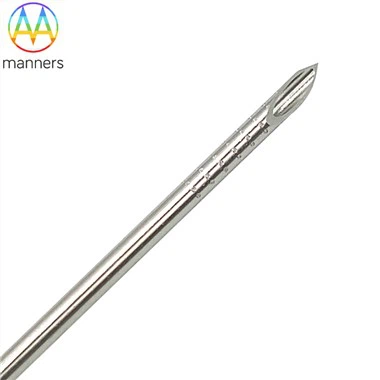
In terms of post-operation safety management, all vascular access needles produced by regular manufacturers are single-use sterile medical devices, and repeated use is strictly prohibited to avoid cross-infection. After the patient's condition is stable and the conventional venous access is successfully established, the intraosseous vascular access needle should be removed in time to avoid long-term indwelling causing local infection, bone inflammation and other complications. Manufacturers have optimized the needle body structure and surface smoothness, making needle removal more convenient and less traumatic. With standardized production and complete operation guidelines, the products can effectively guarantee clinical use safety and become reliable emergency medical supplies for major medical institutions.