Ninety Millimetres: Depth And The Case For 90mm Adult Access
Nov 24, 2026
Meta description: Why 90mm is the working length for adult lumbar puncture, how depth varies with habitus, and how to choose 70, 90, 120mm or a custom shaft.
The Pain Point: When the Hub Reaches the Skin
A spinal needle that is too short announces itself late and unpleasantly. The operator advances through skin, fat, fascia and muscle, feels the ligamentum flavum give, expects the dural pop, and instead watches the hub arrive at the skin with no fluid in sight. The needle is fully inserted and still short of the target. What follows is a second puncture at a new level with a longer needle, added discomfort, more local anaesthetic, and a patient who has already been told the procedure was nearly finished.
The opposite error is quieter but real. An unnecessarily long needle leaves more shaft exposed, flexes more under lateral pressure, and gives the operator a longer lever arm to steer off the midline. In a slim patient, a 120 mm shaft can be awkward to control in the interspace.
Length is therefore not a minor catalogue attribute. In adults it is determined by subcutaneous fat, spinal anatomy and the angle of approach, and the 90 mm shaft exists because it covers the ordinary range of those factors without adding unnecessary flexibility. Understanding where the number comes from is the best way to know when to leave it.
The Working Principle: Skin-to-Subarachnoid Depth in Adults
Depth is the sum of several layers, and each varies. From the skin at the L3-L4 or L4-L5 level the needle crosses subcutaneous fat, the thoracolumbar fascia, the erector spinae and multifidus muscles, the ligamentum flavum, the epidural space and finally the dura. In an adult of average build, the total distance from skin to the subarachnoid space is commonly in the range of about 45 mm to 65 mm.
Body mass index shifts that range substantially. Subcutaneous fat at the lumbar region can add 20 mm or more in a patient with central obesity, pushing the required depth toward 75 mm to 90 mm or beyond. In a slim patient the same landmark may be reached at 40 mm to 50 mm, and a 90 mm needle then exposes a long shaft above the skin.
The angle of approach adds a trigonometric correction. A needle inserted perpendicular to the skin uses the shortest path. An angled approach, whether to follow the lumbar curve or to avoid a midline bony obstruction, lengthens the path, and the effect grows with the angle. A 15-degree deviation adds roughly 3 percent to 4 percent to the track length, which is modest, but a markedly oblique approach in a deep back can exhaust a shaft that looked adequate.
Needle flex matters too. A long, fine cannula deflects under pressure. At 22G the shaft is flexible enough that a 120 mm needle pushed hard against resistance will bow, and the tip can drift off the intended line by several millimetres in dense tissue. The 90 mm shaft balances reach against rigidity, which is part of why it became the adult default.
Product Classification: 50, 70, 90, 120 mm and Custom Lengths
Length families are usually organised around patient populations rather than procedures.
A 50 mm shaft serves paediatric and neonatal lumbar puncture, where the skin-to-subarachnoid distance is small and a long needle offers no advantage.
A 70 mm shaft is a common choice for slim adults, for spinal anaesthesia in obstetric patients, and for departments that want a shorter lever arm while retaining adult reach.
A 90 mm shaft is the general adult default and the length most often stocked for diagnostic lumbar puncture, spinal anaesthesia and intrathecal injection. It covers average habitus with margin, and it remains usable in patients somewhat above average weight.
A 120 mm shaft is reserved for patients with substantial subcutaneous fat, for deep landmarks and for procedures where the hub must remain well clear of the skin. Some suppliers also offer 160 mm and longer for specialist use.
Custom lengths are available on request against a drawing or a sample. Departments that standardise on one gauge but cover a wide body range often prefer a custom length to a mixed stock, though custom orders need a clear specification of shaft length measured from tip to hub and a defined tolerance.
All lengths are available with either tip family at 22G, and the hub colour code stays black regardless of length, which is why length must be read from the label rather than inferred from the hub.
Field Practice: Estimating Depth Before and During Insertion
Depth can be estimated before the needle is opened, and that estimate should inform the choice.
Landmark assessment is the first step. Identify the intercristal line, palpate the spinous processes, and judge the thickness of soft tissue over the intended interspace. In a patient where the spinous processes are barely palpable, the subcutaneous layer is likely deep and a longer needle is prudent.
Ultrasound, where available, converts the estimate into a measurement. A transverse view at the intended level shows skin, subcutaneous tissue, the ligamentum flavum and the dural sac, and the measured depth from skin to the posterior dural wall is a reliable guide. Many departments now record that measurement before selecting the needle.
During insertion, the 90 mm shaft itself is a ruler. Note the length of shaft visible and the depth of each layer as resistance changes. When roughly half the shaft is buried and the ligamentum flavum has not yet been reached, the estimate was too optimistic and a longer needle should be prepared before the hub arrives.
The angle should be adjusted as the needle advances rather than corrected at the end. Walking the tip toward the midline in small steps is easier than levering a deeply inserted shaft, and it protects the needle from bending.
Practical Experience: Long Tracks, Markings and the Second Puncture
Several practical points recur in departments that handle a wide range of body types.
First, keep at least one longer needle in every tray that serves adults. A single 90 mm needle per pack is an assumption about the patient, and assumptions fail at the bedside.
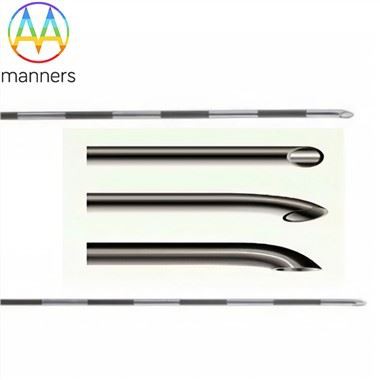
Second, ask for depth markings. A shaft graduated at 10 mm intervals lets the operator record the depth at which fluid was obtained, which is useful for subsequent procedures in the same patient and for teaching.
Third, do not convert a short needle into a long one by depressing the skin. Pressing hard to gain a few millimetres distorts the landmarks and increases the risk of the tip drifting laterally. Select the correct length instead.
Fourth, in patients who have had previous spinal surgery, scarring changes both depth and resistance. The ligamentum flavum may be thin or absent at the operated level, and the epidural space may be obliterated; a longer needle with a cutting bevel and a deliberate approach is often required, with imaging guidance preferred.
Finally, record the depth in the procedure note. It is the single most useful piece of information for the next clinician who has to puncture the same back.
Summary
Ninety millimetres is not an arbitrary figure. It covers the ordinary adult range of skin-to-subarachnoid depth, which commonly sits between 45 mm and 65 mm, with enough margin for moderate obesity and moderate angling, while keeping the shaft short enough to remain controllable at 22G.
Length selection is a three-part judgement: patient habitus, spinal anatomy including previous surgery, and the angle the approach requires. A 70 mm needle suits slim adults, a 90 mm needle is the general default, a 120 mm needle covers deep backs, and custom lengths serve programmes with unusual requirements. Colour coding identifies the gauge, never the length, so the label must be read.
Outlook: Measured Depth Instead of Assumed Depth
The direction of practice is toward measurement. Ultrasound assessment of the lumbar interspace before puncture is becoming routine in difficult cases, and recorded depths are entering procedure notes as a quality indicator. This shifts needle selection from habit to data, and it makes a mixed-length stock more defensible than a single standard.
On the manufacturing side, laser-marked graduations, custom lengths with tight tolerances and packaging that states gauge and length separately are the practical responses. Safety mechanisms add a further constraint, because the retraction stroke must fit within the hub without lengthening the device beyond what the interspace tolerates. For buyers, the sound specification is a 90 mm default with a documented longer option and a graduation standard, rather than a single line item that assumes every adult back is the same.
< img alt="news-1-1" src="/uploads/24240/news/202604241539186d0ff.png " />