Micro-Dot Accuracy Starts At The Tip
Oct 04, 2026
The Pain: Inconsistent Micro Dots Ruin Yield
In modern SMT assembly, 0201 and 01005 components leave pad areas smaller than 0.4 mm². A dispensed adhesive dot intended at 0.25 mm diameter can easily balloon to 0.32 mm if back pressure fluctuates by even 0.02 MPa. That 0.07 mm excess bridges adjacent pads, forcing manual rework under a microscope. At a line running 6,000 UPH, a 3% bridge rate means 180 rework boards per hour-translating into 2–3 operators permanently tied to inspection stations.
Operators often blame the auger valve, the syringe degassing, or adhesive thixotropy. Yet when we instrument the fluid path with in-line pressure sensors, the largest variance appears not at the valve, but at the needle bore exit. A rough tube wall creates localized shear zones: filler particles momentarily jam, pressure spikes, then releases as an oversized dot. The next 8–12 dots compensate in the opposite direction, producing a saw-tooth volume pattern invisible to the naked eye until reflow reveals it.
The Principle: Laminar Exit, Not Forced Extrusion
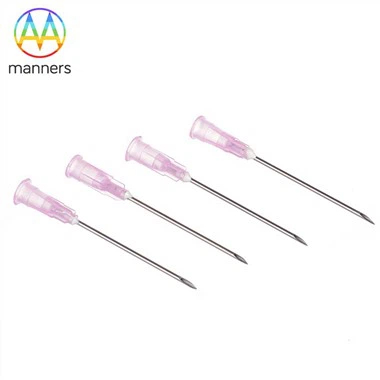
A High Precision Nozzle Type Stainless Steel Dispensing Needle is fundamentally a flow-conditioning element. Fluid enters from the valve with transient pressure pulses; the long, electropolished bore damps those pulses. Wall roughness (Ra) below 0.2 µm prevents particle pinning. The conical or chamfered exit controls the meniscus: surface tension pulls the fluid column inward as the needle lifts, producing a clean snap-off rather than a stretched filament.
Mathematically, for a Newtonian fluid, the exit velocity profile approaches plug flow when L/D > 20. With an 18.25 mm long needle and ID 0.3 mm, L/D ≈ 60-well into the laminar, stable regime. This is why longer fine needles (within reason) dispense more repeatably than short stubby tips, provided deflection is controlled.
The Equipment: Needle Types That Matter
- Straight stainless nozzle (ID 0.1–0.8 mm): baseline workhorse for SMT adhesive, UV glue.
- Fine-OD narrow-wall needle: OD down to 0.45 mm for tight component rows.
- Oval/half-cut needle: deposits a continuous ribbon for dam-and-fill.
- Multi-hole nozzle (2/3/5 holes): single pass for grid arrays, reduces robot travel by 40%.
- Tapered long needle: low-viscosity primers, adds flow resistance.
- One-piece machined needle: eliminates hub dead volume where filled paste cures.
- All variants share 316L stainless bodies, 100 psi rating, and ISO13485 traceability options.
Operation Guide: Set Z Height First
Z standoff = 0.5–1.0 × ID for dots; 1.5 × ID for beads.
Start pressure at 0.05 MPa, ramp in 0.005 MPa steps.
Shot time: 8–25 ms for UV adhesive; 30–60 ms for filled epoxy.
Purge 5 shots after any idle >10 min.
Weigh 20 shots on 0.01 mg balance; accept CV < 3%.
Inspect bore at 40× before each lot change.
Field Experience: "The Needle Was the Process"
A Tier-2 automotive ECU plant dispensing silver-filled adhesive saw dot-CV swing from 2.1% to 7.8% after switching adhesive lots. They re-tuned valve RPM, then robot acceleration, then added a degasser. Nothing helped. Swapping to electropolished one-piece stainless nozzle needles dropped CV back to 1.9% within one shift. Post-mortem: old tips had micro-burrs at the hub thread where silver flakes had embedded. The needle, not the glue, was the hidden variable.
Summary: The Tip Is the Process Boundary
In micro-dispensing, the robot defines where; the needle defines how muchand how clean. Treat the bore finish as a process spec, not a cosmetic feature.
Outlook: Smaller, Cleaner, Smarter
Expect 0.1 mm ID needles with laser-marked lot IDs, automated bore-inspection stations at changeover, and adhesive suppliers publishing "recommended ID vs filler size" matrices. The needle evolves from a consumable into a validated process element with a digital passport.