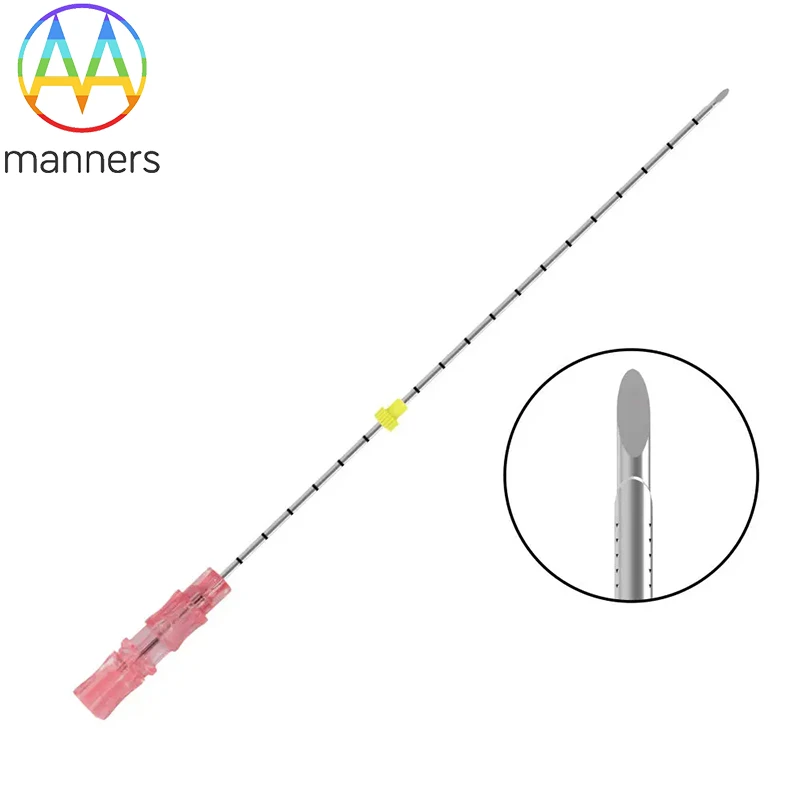
Matters Needing Attention During Ptc Operation:
Nov 10, 2022
1. In order to ensure successful intubation, the tail of the puncture needle can be tilted 10° to 15° to the cephalic side, so that the needle tip can be slightly tilted downward after entering the bile duct, so that the guide wire can be smoothly downward along the bile duct and enter the narrow distal end or duodenum. If the guide wire is entered parallel or the needle tip is upward, the guide wire is likely to touch the opposite tube wall and curl or the guide wire is upward and enter the left hepatic duct.
2. Although PTC shows biliary obstruction, sometimes the guide wire can still enter the duodenum through the obstruction end. If the catheter cannot pass the obstruction, proximal drainage can be performed for 5 to 7 days, and then the guide wire and catheter can be inserted into the distal end of the obstruction after the inflammatory edema caused by the infection in the biliary tract subsides.
3. The drainage catheter should be prevented from falling off and blocking. Rinse with 5 ~ 10ml normal saline 1 ~ 2 times a day and replace the catheter every 3 days. If there is heat after long-term catheterization, it indicates that the catheter is blocked or displaced, and the catheter needs to be replaced. Generally, after 10-14 days of drainage, a granulation channel larger than the catheter has been formed in the liver parenchyma. If the catheter falls off, the catheter can be re-inserted within 24 hours guided by the guide wire.
4. There are four cases of extubation: (1) After surgery, the diaphragm and liver move up and down with respiration, so that the drainage tube can not be completely left in the bile duct cavity, showing that the drainage tube is not smooth; ② The tube departs into hepatic parenchyma; ③ the tube departs into the abdominal cavity; ④ Fixed not firmly, or by mistake by the patient. In order to prevent catheterization, try to insert the casing 3 ~ 4cm deep into the bile duct during catheterization, and do not rush to insert the casing directly into the bile duct when no guide wire is inserted into the bile duct. Therefore, when the bile duct stone is obstructed or the Angle is small, the cannula may enter the hepatic parenchyma along the original needle path. After contrast agent is injected, the biliary tract dilates and thickens, the stone becomes loose and the Angle increases, and then the cannula is slowly inserted to make it easier to penetrate into the bile duct cavity.