Materials Innovation, Structural Design, And Performance Optimization Engineering
Jun 02, 2026
The Evolution of Materials Science: From Common Metals to Biofunctionalized Composites
The performance foundation of breast biopsy needles lies in their materials. The biocompatibility, mechanical properties, and functional characteristics of these materials directly determine puncture resistance, tissue damage, sample quality, and patient experience. The industry is rapidly evolving from traditional generic medical metals toward high-performance alloys, smart materials, and biodegradable materials.
The continuous optimization of medical-grade stainless steel remains the mainstream trend in the market. Austenitic stainless steels 316L and 304L are widely used in the manufacturing of reusable and certain high-end disposable biopsy needles due to their excellent corrosion resistance, good strength, and well-established processing techniques. Current research focuses on ultra-precision machining and surface modification. Through specialized electropolishing processes, the inner wall roughness (Ra value) of needle tubes can be reduced from 0.8 micrometers to below 0.2 micrometers, significantly minimizing tissue adhesion and frictional resistance. Ion implantation technology enables the formation of hard coatings such as titanium nitride on the stainless steel surface, increasing tip hardness to over HV1000 and improving wear resistance by 3 to 5 times, ensuring sharpness even after repeated punctures through dense breast tissue or calcified lesions.
The lightweight advantage of titanium and its alloys is irreplaceable in specific applications. Medical-grade titanium alloys such as TC4 (Ti-6Al-4V) have a density only 60% that of stainless steel, yet offer higher specific strength (strength-to-density ratio), along with superior biocompatibility and fatigue resistance. These properties make titanium alloy biopsy needles particularly suitable for longer needle designs-ideal for deep lesions or obese patients-or for use in MRI-guided biopsies (due to their non-magnetic nature, which avoids image artifacts). However, due to high processing difficulty and cost, they are currently used primarily in high-end product lines where performance demands are extreme.
Breakthroughs in medical polymer materials have driven the widespread adoption of disposable biopsy needles. Polyether ether ketone (PEEK), with its elastic modulus similar to that of bone, excellent fatigue resistance, and radiolucency (non-opaque under X-ray, facilitating identification of calcifications), has become an ideal material for manufacturing biopsy needle shafts and components. New medical-grade polycarbonate (PC) and acrylonitrile-butadiene-styrene copolymer (ABS), modified through blending, significantly enhance impact resistance and dimensional stability while maintaining transparency-enabling clear visualization of tissue samples. Biopsy needles made from these advanced polymers can be used as single-use devices, completely eliminating the risk of cross-contamination. Moreover, their superior elasticity allows for more complex needle tip designs that reduce patient discomfort during puncture.
Revolutionary applications of shape-memory alloys and nanocoatings are defining the next generation of biopsy needles. Shape-memory alloys such as nitinol can return to a pre-set shape at body temperature. Leveraging this property, "straight-in, curved retrieval" biopsy needles have been designed: during insertion, the needle remains straight to minimize resistance; upon reaching the lesion, the tip automatically bends to a specific angle due to body heat, enabling lateral hooking or rotational cutting of tissue-particularly beneficial for superficial lesions parallel to the chest wall, thereby avoiding the risk of pleural penetration. In terms of nanocoatings, diamond-like carbon (DLC) coatings reduce the surface friction coefficient by over 40%. More advanced "bio-inspired hydrogel coatings" form a hydrophilic lubricating layer on the needle surface that becomes exceptionally smooth when exposed to tissue fluid, making the puncture process nearly "pain-free."
The Ingenuity of Structural Design: Balancing Puncturing, Cutting, and Collection at the Millimeter Scale
The structural design of biopsy needles is a precision engineering endeavor that seeks to balance multiple performance factors at the millimeter scale. Every detail-tip geometry, cutting mechanism, sample channel, and internal cavity design-directly impacts the final quality of tissue acquisition.
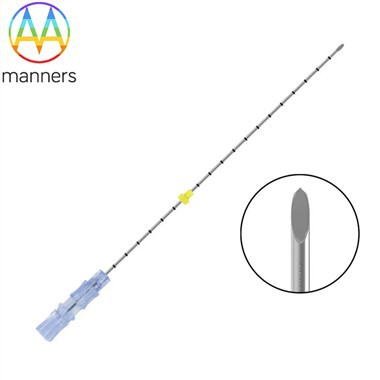
Needle tip geometry is key to reducing puncture resistance. Traditional beveled tips (such as 17°, 20°, and 30° bevel angles) separate tissue fibers through a "wedge" mechanism. For dense breast tissue, new "triple-bevel" or "pencil-point" tips have been developed, which more effectively distribute puncture force, reducing peak insertion force by 15–20%. In vacuum-assisted biopsy needles (VAB), the tip is typically blunt with lateral sampling windows at the front. The edges of these windows are precisely ground to form a micro-serrated structure, enabling efficient tissue capture while producing clean cut surfaces during rotation, thereby minimizing tissue compression and cellular distortion.
Innovation in cutting mechanisms pursues "gentle yet efficient" performance. The automatic biopsy gun for core needle biopsy (CNB) has evolved from simple spring-driven systems to sophisticated electromagnetic drives with multi-stage adjustable speeds, allowing physicians to select the optimal firing velocity based on tissue hardness to obtain the most intact tissue samples. The cutting system of vacuum-assisted biopsy (VAB) is even more complex: its internal cutting blade typically features a double- or triple-edged spiral design that generates continuous shearing force during high-speed rotation (up to 1500–3000 rpm). Combined with a powerful vacuum suction of up to -25 inches of mercury at the window, this mechanism stably draws tissue into the device and severs it instantly. This "adsorption-rotation-cutting" mode causes less tearing and crushing damage compared to CNB's "impact-cutting" approach, resulting in more complete samples and better preservation of cellular morphology.
Optimizing sample collection and transport systems ensures diagnostic accuracy. Early core needle biopsy (CNB) samples required manual removal from the needle slot, which often led to tissue fragmentation or loss. Modern biopsy guns commonly feature an "automatic sample ejection" function, in which the inner needle automatically retracts after firing, gently pushing the tissue core into a specimen container. The VAB system achieves fully automated collection: the excised tissue cores are instantly transported via a closed vacuum pipeline into a sterile specimen container outside the body, eliminating the need for physician contact with the samples. This not only maintains sterility but also prevents sample mix-ups. Specimen containers are typically designed with multiple compartments, allowing samples to be stored in order of collection, facilitating accurate correlation between imaging locations and pathological analysis by pathologists.
The coaxial sheath and safety device feature a human-centered design. Coaxial sheath technology has become standard equipment. The physician first inserts a slightly thicker blunt-tip introducer needle to the edge of the lesion, then uses the biopsy needle through this sheath to perform multiple sampling passes. This eliminates the need for repeated skin punctures during each sample collection, significantly reducing patient discomfort and lowering the risks of pneumothorax and vascular injury. In terms of safety design, disposable safety biopsy needles have become mainstream. Their safety mechanisms automatically or manually retract the needle tip into the protective sleeve after firing, or allow the protective sleeve to slide forward and lock over the needle tip, effectively preventing post-procedural needlestick injuries and ensuring healthcare worker safety.
Quantification and Standardized Testing of Performance Parameters
With the official implementation of the industry standard YY/T 1929-2024 "Breast Biopsy and Vacuum-Assisted Excision Devices" on March 1, 2025, a unified quantitative evaluation system and testing method for breast biopsy needles have been established. Led by Chongqing Xishan Technology Co., Ltd. and other organizations, this standard sets clear requirements for the safety, effectiveness, and reliability of such devices.
Rigidity, toughness, and fatigue performance testing ensure operational safety. Biopsy needles must strike a balance between sufficient rigidity (resistance to bending) and toughness (prevention of breakage). The standard introduces a dedicated rigidity tester that applies a specific pressure to the needle shaft based on principles of elasticity, measuring deformation to accurately calculate rigidity values. For rotational cutting needles, fatigue testing under high-speed rotation is also required to simulate continuous operation, ensuring the blade does not deform or chip under rated speed and load. Puncture performance testing uses standardized simulated tissue materials (such as polyurethane gel) to measure the maximum force required for penetration, assessing the sharpness and smoothness of the needle tip.
Cutting efficiency and sample quality assessment are critical to diagnosis. The standard specifies an upper limit for the rotational sampling time, requiring the system to complete a single cutting cycle within the designated timeframe. More importantly, it emphasizes sample quality evaluation: by analyzing the obtained tissue strips, assess their integrity (whether fragmented), cellular morphology preservation (presence of compression or deformation), and representativeness (inclusion of the target lesion area). For VAB systems, additional testing is required to evaluate the stability of vacuum pressure and suction force, ensuring effective fixation of tissues with varying hardness.
Biocompatibility and chemical safety are fundamental requirements. All materials that come into contact with human tissues must undergo comprehensive biocompatibility evaluation in accordance with the ISO 10993 series standards, including tests for cytotoxicity, sensitization, intracutaneous reactivity, and acute systemic toxicity. For stainless steel and titanium alloy needles, corrosion resistance testing is required, simulating long-term immersion in physiological saline, blood, and other bodily fluids to ensure no harmful metal ions leach out. Polymer materials must undergo extractables testing to analyze potential leaching of plasticizers, monomers, or other small molecules.
Noise and ergonomic design enhance the user experience. The standard sets limits on noise levels during the operation of rotary cutting devices to minimize psychological disturbance for both medical staff and patients. Ergonomic considerations are also incorporated, including handle grip comfort, button layout and tactile feedback, and overall weight balance, aiming to reduce operator fatigue during prolonged use and improve stability and precision.
Future Trends: Intelligence, Minimally Invasive Approaches, and Integrated Diagnosis-Treatment
Innovation in materials and engineering knows no bounds, and breast biopsy needles are evolving toward greater intelligence, less invasiveness, and more integrated functionality.
Intelligent sensing and feedback systems represent a key development direction. Next-generation biopsy needles may integrate miniature pressure sensors and impedance measurement modules. The pressure sensor can detect in real time changes in resistance as the needle tip contacts different tissues (such as fat, glandular tissue, tumors, or blood vessels), automatically issuing warnings or adjusting insertion speed when approaching critical vessels or nerves. Impedance measurement, by exploiting differences in tissue electrical properties, enables preliminary differentiation between normal and diseased tissues during puncture, providing auxiliary information for real-time in vivo diagnosis.
Ultra-minimal invasive techniques and single-cell analysis represent the frontier of exploration. Researchers are developing biopsy tools that are finer in diameter and more functionally advanced.