Material Selection & VHP Compatibility Justification By H₂O₂ Transfer Needle Manufacturer
Jul 10, 2026
H₂O₂ Transfer Needles are in long‑term contact with 35 %–59 % (w/w) concentrated hydrogen peroxide solution and its vapor phase (VH₂O₂ / H₂O / O₂ plasma). The service environment combines strong oxidation, temperature/humidity cycling, and risk of trace metal‑ion catalyzed decomposition. Material selection must balance machinability, corrosion resistance, ion leaching control, and compatibility with the sterilizer injector valve-this is a key technical differentiator for a professional H₂O₂ Transfer Needle Manufacturer.
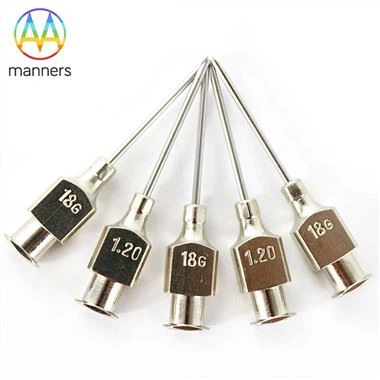
SS303 - Ideal for Hex Hub
SS303 is based on 304 with added S/Pb (≤0.15 % S) to markedly improve machinability, allowing complex hex form + sealing face in one setup on a Swiss lathe with Ra < 0.4 μm achievable. Its H₂O₂ corrosion resistance is slightly lower than 304 but acceptable-provided thorough passivation (citric or low‑nitric acid) forms a chromium‑rich passive film, and the sulfur‑bearing grade is limited to non‑welded zones (hub is mechanically joined, not fusion welded → safe). Typically supplied in full hard (cold drawn) condition to resist deformation during wrench tightening.
SS304 - Standard Choice for Needle Tube
SS304 (UNS S30400), austenitic, non‑magnetic, with excellent resistance to H₂O₂ oxidation. Post‑electropolishing, the surface Cr/Fe ratio increases and the passive film densifies, significantly reducing Fe²⁺/Cr³⁺ ion leaching-important because excess transition metal ions catalyze H₂O₂ decomposition, lowering effective sterilant concentration in the chamber. Manufacturers should provide Material Test Report (MTR) stating C ≤ 0.08 %, Cr 18–20 %, Ni 8–10.5 %, per ASTM A240/A276.
Why Not 316L or 440C?
316L offers better Cl⁻ resistance but no meaningful advantage against H₂O₂; higher cost and Mo provides no benefit in VH₂O₂ environment-can be customized only if end‑user specifies.
440C (high‑C martensitic) is prone to pitting and higher ion leaching in concentrated H₂O₂-unsuitable for Transfer Needle wetted parts.
H₂O₂ Compatibility Validation
A responsible H₂O₂ Transfer Needle Manufacturer performs tests per ISO 10993‑inspired & industry practices:
- Immersion test: 35 %–59 % H₂O₂ at RT / 40 °C cyclically (e.g., 28 days with solution refresh); inspect for discoloration, pitting, weight loss.
- Ion leaching: ICP‑MS of immersion solution for Fe/Cr/Ni to confirm levels do not compromise sterilant stability.
- Cyclic aging: simulate repeated stopper piercing + liquid transfer + dry‑off cycles; check tip for cracking, O‑ring groove for corrosion.
- Host injector valve compatibility: confirm O‑ring material (typically EPDM or peroxide‑cured FKM) matches needle surface finish to prevent seal lip wear.
RoHS & Environmental Compliance
For EU/US export: comply with RoHS 2.0 (2011/65/EU + 2015/863) restricting Cd/Pb/Hg/Cr⁶⁺/PBB/PBDE; provide CoC. Higher‑end lines may include REACH SVHC screening declaration.
Material sets the life‑limit ceiling; electropolishing + passivation + cleaning realize that life. Always request MTR + passivation record + H₂O₂ immersion statement to avoid "rust within six months / catalytic decomposition" risks.