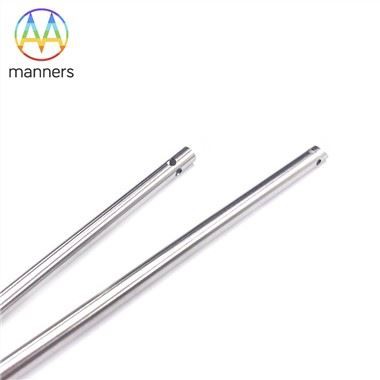
Material Compatibility Of Tube Laser Cutting For Medical Hypotubes
Sep 07, 2026
1. Industry Pain Points
Medical hypotubes adopt diversified high-performance alloy materials, including 304/316L medical stainless steel, high-strength 17-7PH stainless steel, superelastic Nitinol and L605 cobalt-chromium alloy. Different materials have obvious differences in melting point, thermal conductivity, hardness and ductility, leading to different adaptation difficulties in tube laser cutting. Many manufacturers adopt universal laser cutting parameters for all materials, resulting in widespread quality defects: stainless steel tubes have incomplete kerf forming and edge roughness; high-strength alloy tubes have uneven cutting sections and residual burrs; Nitinol tubes are prone to thermal deformation and elastic performance attenuation; L605 alloy tubes have local ablation and surface oxidation. For Ø0.20mm ultra-fine tubes and 0.012mm ultra-narrow kerf cutting, material parameter mismatch will directly cause tube wall damage, pattern distortion and functional failure, making hypotubes unable to meet the precision assembly and clinical safety requirements of high-end minimally invasive interventional devices.
2. Material Adaptive Tube Laser Cutting Principle
The core of material-compatible tube laser cutting is to formulate targeted laser energy and scanning strategies according to the physical and mechanical properties of different medical alloys. 304 and 316L stainless steel have stable metal structure and moderate thermal conductivity, suitable for standard pulse laser cutting, which can form smooth and flat ultra-narrow kerfs with stable efficiency and excellent consistency. 17-7PH high-strength stainless steel has high hardness and high melting point, requiring increased single-point laser energy and optimized scanning speed to ensure complete penetration cutting and neat kerf edges without residual metal particles. Nitinol superelastic alloy has low thermal conductivity and high elastic sensitivity, adopting low-heat fast pulse cutting to reduce thermal radiation range, avoid thermal stress deformation and retain original superelasticity and fatigue resistance. L605 cobalt alloy with high corrosion resistance needs uniform energy distribution cutting to prevent local over-ablation and ensure structural integrity of custom patterns.
3. Material Adaptive Cutting Equipment Classification
Tube laser cutting equipment is classified into four professional types according to material compatibility characteristics. First, stainless steel special laser cutting machines, suitable for batch processing of 304/316L standard hypotubes for cardiovascular and urinary endoscopic devices, with stable cutting precision and high production efficiency. Second, high-strength alloy cutting systems, equipped with high-energy laser modules, specially solving the cutting difficulties of 17-7PH high-hardness tubes, ensuring flat cutting sections and complete pattern structure. Third, Nitinol exclusive laser cutting equipment, adopting cold pulse processing technology, dedicated to zero-deformation precision cutting of superelastic micro-hypotubes. Fourth, cobalt alloy precision cutting lines, customized for L605 alloy, with energy balance control function to avoid local ablation and oxidation defects. All equipment covers Ø0.20mm–20mm full specification range and supports personalized custom cutting per customer drawings and samples.
4. Material Graded Cutting Operation Guidelines
The standardized material adaptive tube laser cutting implements strict graded processing and one-to-one parameter matching. Firstly, strictly distinguish incoming materials and prohibit mixed processing of different alloys to ensure independent parameter configuration for each material. Secondly, set exclusive cutting parameters: standard pulse parameters for conventional stainless steel, enhanced energy parameters for high-strength alloy, low-heat fast pulse parameters for Nitinol, and uniform energy scanning parameters for L605 alloy. Thirdly, carry out diameter segmentation processing: ultra-fine Ø0.20mm–2mm tubes adopt micro-energy precise cutting to prevent tube wall deformation; large-diameter tubes adopt enhanced penetration parameters to ensure cutting completeness. Fourthly, implement material-targeted quality inspection: focus on elastic performance detection for Nitinol products, kerf flatness for stainless steel products, and structural stability for high-strength alloy products. Finally, archive graded processing parameters to form standardized material processing templates for batch repeated production.
5. On-Site Practical Processing Experience
Production verification shows that more than 80% of tube laser cutting quality problems stem from mismatched material parameters. Applying stainless steel cutting parameters to Nitinol hypotubes will produce invisible thermal residual stress, leading to fatigue fracture during repeated bending in clinical navigation. For 0.012mm ultra-narrow kerf cutting, different thermal expansion coefficients of alloys will cause subtle kerf deformation without adaptive parameter compensation. L605 alloy hypotubes used for high-torque interventional devices require precise energy control; unreasonable parameters will cause edge ablation and reduced torque transmission stability. After adopting full material graded adaptive cutting, the batch product qualification rate reaches 99.8%, and the mechanical performance consistency of laser cut hypotubes is significantly improved.
6. Summary and Sublimation
Material compatibility is the core foundation of high-quality tube laser cutting for medical hypotubes. Diversified medical alloy materials have unique processing characteristics, and universal cutting schemes cannot meet high-standard medical manufacturing requirements. Only through material classification, targeted parameter optimization and adaptive equipment matching can we realize zero-deformation, high-precision and zero-defect cutting of multi-specification and multi-pattern hypotubes, ensuring that each material gives full play to its clinical application advantages.
7. Industry Development Suggestions
With the rapid development of composite medical alloy materials, material adaptive tube laser cutting technology will become the core competitiveness of the industry. Manufacturers are recommended to build a complete material cutting parameter database, realize intelligent automatic matching of materials and processes, and improve customized processing efficiency and stability. Strengthen technical research on special alloy ultra-fine tube cutting, optimize ultra-narrow kerf precision forming technology, and continuously improve the comprehensive manufacturing level of medical hypotubes.