Manufacturing Processes And Key Quality Control Points For Core Biopsy Needles
Jul 14, 2026
https://www.mayoclinic.org/tests-procedures/breast-biopsy/about/pac-20384812
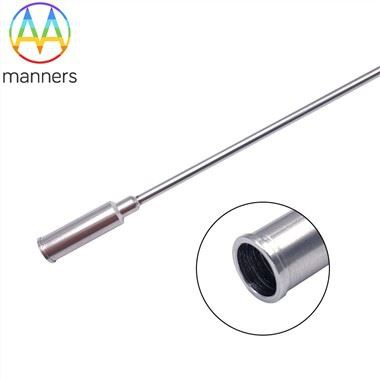
Breast Core Biopsy Needles are precision, thin-walled, elongated sterile devices. Their manufacture integrates precision tube drawing, micro-grinding, laser welding, surface treatment, and sterile packaging. Critical process CPK must be ≥ 1.33.
1. Raw Materials and Tube Drawing
ASTM A580 304 or ASTM F138 316L stainless steel coils/bars are drawn through multiple dies to achieve the required OD/ID of thin-walled seamless tubing (wall thickness typically 0.15–0.25mm). Online eddy current testing rejects micro-cracks; tubes are cut to length.
Tip Forming and Notch Machining
- Trocar Tip Grinding: Centerless grinding with angled wheels forms triple-bevel or penta-bevel tips. Edge radii controlled ≤5μm. Sharpness validated via penetration force testing on synthetic tissue phantoms.
- Sampling Notch (Wire EDM/CNC Milling): Notch length, depth, and radii are machined using fixtures to ensure volume tolerance within ±5%. Edges are deburred to prevent tissue tearing.
- Outer Cannula Front Chamfer & Window: The cutting edge of the outer tube is micro-ground to ensure clean transection without tissue "tugging" during firing.
3. Surface Treatment
- Electropolishing: Immersion electrochemical process removes turning marks, reducing Ra to 0.1–0.2μm, minimizing tissue adhesion and crush artifact.
- Silicone/Hydrophilic Coating (Optional): Sprayed and thermally cured. Particulate shed tested per ISO 10993.
- Laser Marking & Ink Filling: Depth markings are permanently etched and filled with pigment resistant to EO/Gamma sterilization.
4. Assembly and Coaxial Fit
The clearance between the inner stylet and outer cannula is controlled at the micron level (typically 0.01–0.02mm). Excess tightness causes binding; excess looseness allows tissue ingress, impairing cutting. Handles (ABS/PC) are injection molded and bonded/heat-staked to the needle hub. Coaxial introducers are assembled separately.
5. Cleaning, Inspection, and Sterilization
- Ultrasonic Cleaning + DI Water Rinse + IPA Dehydration: Removes metal fines, coolants. Particulate control per ISO 11737-1.
- Critical Inspection: Microscopic examination for rolled edges/chips; probe testing for lumen patency; functional firing test for smooth cutting; projection measurement of dimensions (OD, notch length, total length).
- Packaging & Sterilization: Tyvek/Dialysis paper blister packaging. EO sterilization (or Gamma Irradiation). Release testing includes Sterility, Bacterial Endotoxins, Particulates, and EO Residuals.
6. Process Validation Requirements
Per ISO 13485, Installation Qualification (IQ), Operational Qualification (OQ), and Performance Qualification (PQ) must be completed-specifically validating electropolishing parameters, EO cycles, and coating cures, with documented records. Traceability ensures bidirectional linkage from Melt Number → Raw Material Batch → Process Batch → Sterilization Batch.
Precision process control ensures batch-to-batch consistency. Variability in sharpness is the primary cause of clinical feedback regarding "poor performance"-a key focus during OEM audits.