Manufacturer Clinical Evidence Alignment
Nov 25, 2026
Introduction
Technical machining precision alone is not enough to build credibility for an Atraumatic Pencil Point Spinal Needle manufacturer. The company's product claims, risk warnings and user guidance must align consistently with peer-reviewed clinical evidence and established anaesthesia practice. The primary marketed advantage of the pencil-point design is its mechanical action: the tip separates dural fibres rather than cutting a clean opening, which supports faster dural resealing after withdrawal and reduces the relative risk of post-dural puncture headache compared with traditional Quincke cutting needles. However, manufacturers must communicate this benefit carefully, while openly acknowledging residual procedural risks such as cauda equina nerve injury, which remains possible even with an atraumatic needle tip. This article explains how responsible manufacturers structure evidence packages, avoid overstatement, balance gauge tradeoffs and maintain clinical alignment through post-market surveillance.
Clinical Evidence for PDPH Reduction
The clinical mechanism behind post-dural puncture headache is well established. When the dura mater is breached, cerebrospinal fluid may leak outward, lowering the pressure within the subarachnoid space. This produces the classic positional headache pattern: discomfort eases when the patient lies flat and intensifies when they sit or stand upright. Most cases resolve spontaneously within one to two days with hydration and rest, though persistent headache requires clinical assessment to rule out other neurological pathology.
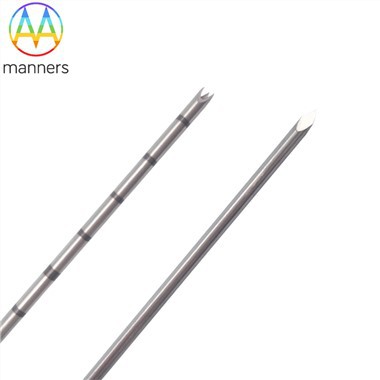
Pencil-point needle geometry is designed to mitigate this problem by spreading dural fibres instead of transecting them. The fibres tend to fall back together and seal the puncture site once the needle is removed. Quincke beveled needles, by contrast, cut a discrete opening that may leak CSF more readily. Manufacturers reference this body of evidence in their technical files, but they are careful not to claim that PDPH can be eliminated entirely. Patient factors, needle gauge, number of insertion attempts, operator technique and spinal anatomy all influence complication rates.
Defining the Boundaries of Neurological Safety Evidence
A critical point of evidence alignment concerns the cauda equina. The cauda equina consists of nerve roots originating from L2 through S5 and caudal ganglia, converging toward the conus medullaris near the L1 vertebral level. The "atraumatic" label describes the needle's intended interaction with the dura; it does not grant protection against nerve compression, direct trauma or chemical irritation. If the needle trajectory is misplaced, even a perfectly manufactured pencil-point needle can contact these delicate neural structures. The manufacturer's technical documentation, IFU and training materials must clearly communicate this boundary to prevent overconfidence among less experienced clinicians.
Evidence Packages for Regulatory Submission
For global product registration, manufacturers assemble comprehensive technical evidence files combining bench performance data, preclinical testing, clinical literature reviews and formal risk analyses. Bench testing may measure penetration force, CSF flow rates, leakage behaviour, tip durability, dimensional consistency and stylet functionality. Literature reviews summarise comparative studies between pencil-point and cutting spinal needles, documenting the expected reduction in PDPH risk while cataloguing known adverse events. This evidence package demonstrates that the device delivers its intended clinical benefit without introducing unmanaged hazards.
Avoiding Non-Compliant, Overstated Marketing Claims
Medical device regulators closely scrutinise promotional content for spinal needles. Absolute claims such as "no headache risk" or "nerve-safe needle" are unsupported by clinical data and violate advertising rules. Responsible manufacturers train sales and distribution partners to use evidence-based phrasing: the pencil-point geometry is designed to separate dural fibres and may reduce the incidence of post-dural puncture headache relative to cutting needles. All marketing language must match the risk disclosures and benefit statements approved in the technical file.
Evidence-Based Tradeoffs Across the Gauge Range
The 16G–27G gauge portfolio creates predictable clinical tradeoffs that manufacturers should document in product guides. Larger gauges provide rapid CSF return, which can be valuable for urgent diagnostic lumbar puncture, but they carry a higher baseline risk of CSF leakage and PDPH. Smaller gauges including 25G, 26G and 27G are preferred when headache reduction is the priority, though CSF flashback may be slower and procedural confirmation can take longer. By publishing these tradeoffs clearly, the manufacturer helps anaesthetists and neurologists select the right gauge for each individual patient and clinical indication.
Human-Factors Evidence for Colour-Coded Hubs
The colour-coded hub system is a safety feature rooted in human-factors testing rather than clinical therapeutic performance. The manufacturer validates that the standard colour mapping remains distinguishable under the variable lighting conditions found in operating rooms, emergency departments and intensive care units. This evidence supports the goal of preventing wrong-gauge selection, a simple but consequential human error in spinal procedures.
Evidence Review for Custom and OEM Modifications
When a manufacturer develops custom needles for OEM customers, every proposed design change triggers a review of the underlying clinical evidence basis. A simple length adjustment may require limited supplementary testing, while a modified tip taper, altered side-orifice placement or new stylet geometry demands a much deeper reassessment of the risk-benefit profile. Skipping this review can result in a custom product whose real clinical behaviour differs from the validated safety profile of the original standard pencil-point needle.
Post-Market Surveillance to Refresh Clinical Understanding
After commercial launch, manufacturers continuously monitor adverse-event reports and real-world clinical performance. If new peer-reviewed evidence emerges, or if repeated field reports identify an unanticipated failure mode, the risk analysis, instructions for use and sales training materials are updated accordingly. This ongoing surveillance keeps the manufacturer's clinical positioning current and helps hospital teams update their local lumbar puncture protocols.
Conclusion
An Atraumatic Pencil Point Spinal Needle manufacturer's clinical credibility depends on balanced, honest evidence alignment. The pencil-point design offers a well-documented mechanical advantage for dural sealing and lowering relative PDPH risk, yet the manufacturer must respect clear evidence boundaries around neurological hazards, gauge tradeoffs and patient variability. Consistent, transparent communication between the factory, distribution partners and clinical end users is essential for safe and appropriate adoption of this spinal access device.
< img alt="news-1-1" src="/uploads/24240/news/202604241539186d0ff.png " />