Manual Vs Powered Bone Marrow Biopsy Needles Size Difference And Specimen Quality Impact
Aug 22, 2026
Size Consistency Between Manual and Powered Biopsy Needles
Manual and powered bone marrow biopsy needles follow the same industry standard external size system, including unified shaft length, outer diameter gauge and interface size, ensuring clinical interchangeability and universal equipment compatibility. The core size difference lies in internal channel structure, cutting gap and core locking mechanism, which finally affect core specimen length, thickness and integrity. Under the same external size parameters, powered needles achieve better specimen quality through internal size optimization.
Manual Needle Size Characteristics and Advantages
Manual bone marrow biopsy needles adopt conventional standard size design with simple internal structure and smooth through-channel. The unified 8–15 cm length and 11–22G gauge sizes fully meet routine clinical operation needs. The standardized external size ensures convenient manual rotation and stable force control. Although the internal fixed channel structure limits core length extension, the mature and stable size system provides high safety and low failure rate for basic routine sampling scenarios.
Powered Needle Internal Size Optimization Advantages
Optimized Core Channel Size
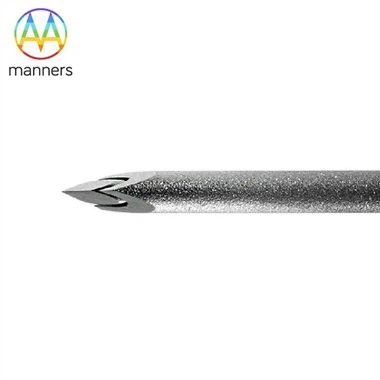
On the basis of unchanged external size, powered biopsy needles optimize internal core channel diameter and cutting gap size, reducing specimen compression and fragmentation during automatic cutting. The precise internal size tolerance ensures uniform core thickness and complete tissue structure, effectively improving specimen availability.
Extended Effective Core Length Size
With consistent needle shaft length size, powered needles rely on mechanical constant-pressure cutting to obtain longer core specimens. Clinical data shows that powered devices can stably achieve an average core length of 17 mm, significantly higher than the 11 mm average of manual needles under the same external size specification, providing more sufficient tissue samples for high-precision diagnosis.
Uniform Specimen Size Stability
Powered needles avoid core length deviation caused by manual force difference. The mechanical automatic sampling mode ensures consistent core length and thickness size in each operation, realizing standardized specimen size output, which is more conducive to unified pathological judgment and comparative analysis of follow-up reexamination specimens.
Size Difference Application Impact
Manual needle standard size is suitable for high-frequency routine screening with stable basic specimen size qualification. Powered needle internal size optimization is more suitable for difficult cases such as myelofibrosis, focal tumor infiltration and low-cellularity bone marrow lesions, relying on longer and more complete core size advantages to reduce missed diagnosis rates. Different size characteristics make manual and powered needles form complementary application scenarios in clinical diagnosis, jointly covering basic screening and high-precision diagnosis needs.