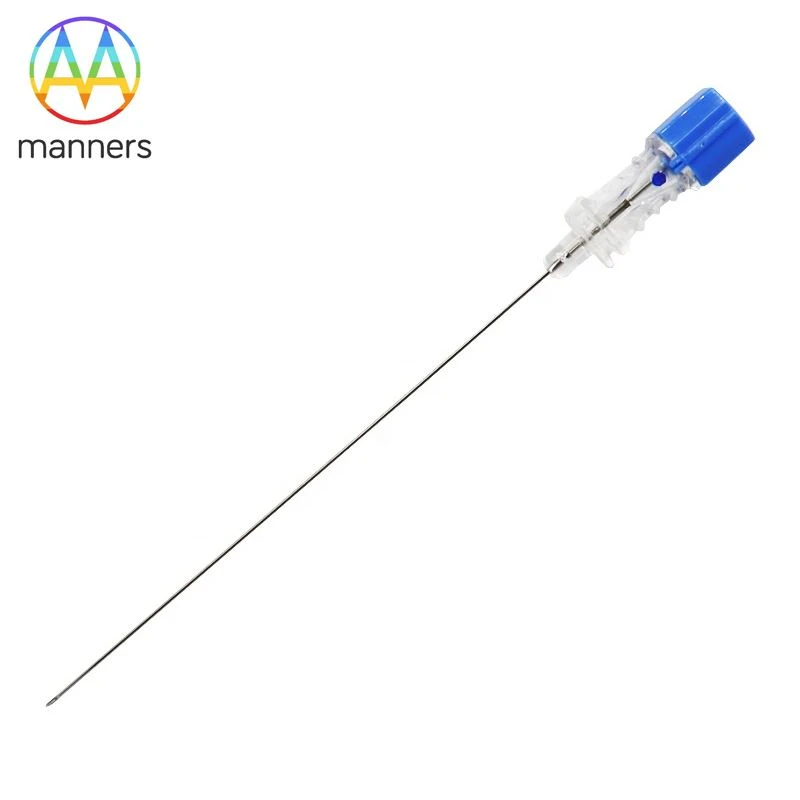
Lumbar Puncture Needle Puncture Method
Jun 15, 2014
Usually take the side-bending position, puncture the intervertebral space from lumbar 2 to sacrum 1 (mainly lumbar 3-4). After local routine disinfection and anesthesia, wear rubber gloves and slowly pierce in the direction of the spinous process with a No. 20 puncture needle (No. 21-22 for children). When the needle tip meets bone during the needle insertion process, the needle should be retracted under the skin. Perform the puncture after correcting the angle. When the needle is inserted about 4-6cm in adults (about 3-4cm in children), it can penetrate the dura mater and reach the subarachnoid space. After the needle core is drawn out to flow out the cerebrospinal fluid, the pressure is measured and the fluid is slowly discharged (no more than 2-3ml) , Then insert the needle core and pull out the puncture needle. Slightly pressurize the puncture point to stop bleeding, apply sterile gauze and fix it with tape. Lie supine for 4-6 hours postoperatively. If the initial pressure exceeds 2.94kPa (300mm water column), it is not suitable to discharge the liquid, just take the cerebrospinal fluid in the piezometer tube for cell count and protein quantification.
1. Instruct the patient to lie on his side on a hardboard bed with his back perpendicular to the bed surface, head forward and chest flexed, hold the knees with both hands close to the abdomen, so that the torso is arched; or have the assistant hold the patient's head with one hand and the other hand on the opposite side of the surgeon Hold the popliteal fossa of both lower limbs and hold it tightly to make the spine as kyphotic as possible to widen the intervertebral space and facilitate needle access.
2. Determine the puncture point. The intersection of the iliac crest line and the posterior midline is the puncture point. Generally, the 3-4th lumbar spinous process space is taken, and sometimes it can be performed in the previous or next lumbar space.
3. After routinely disinfecting the skin, wear sterile gloves and cover the hole, and use 2% lidocaine for local infiltration anesthesia from the skin to the intervertebral ligament layer by layer.
4. The surgeon fixes the skin of the puncture site with his left hand, and slowly pierces the puncture needle in the right hand in a direction perpendicular to the back. The depth of the needle is about 4-6cm for adults and 2-4cm for children. When the needle passes through the ligament and dura, the resistance suddenly disappears and a sense of frustration can be felt. At this time, the needle core can be slowly withdrawn (to prevent the cerebrospinal fluid from flowing out quickly and causing brain herniation), and the cerebrospinal fluid can be seen to flow out.
5. Connect the pressure measuring tube to measure the pressure before discharging. The pressure of the cerebrospinal fluid in the normal lateral position is 0.69-1.764kPa or 40-50 drops/min. If you know whether the subarachnoid space is obstructed, you can do the Queckenstedt test. That is, after the initial pressure is measured, the assistant first compresses one jugular vein for about 10 seconds, then presses the other side, and finally presses both jugular veins at the same time; when the jugular vein is compressed under normal conditions, the pressure of the cerebrospinal fluid immediately doubles rapidly. 10-20s after the compression is relieved, it quickly drops to the original level, which is called a negative obstruction test, indicating that the subarachnoid space is unobstructed. If the pressure of the cerebrospinal fluid cannot be increased after the jugular vein is compressed, the obstruction test is positive, indicating that the subarachnoid space is completely blocked; if the pressure rises slowly after pressure is applied, and then slowly decreases after relaxation, it indicates incomplete blockage. Anyone with increased intracranial pressure is forbidden to do this test.
6. Remove the piezometer tube, collect 2-5ml of cerebrospinal fluid and submit it for inspection; if culture is needed, use aseptic method to retain specimens.
7. After the operation, insert the needle core and pull out the puncture needle together, cover it with sterile gauze, and fix it with tape.
8. After the operation, the patient goes to the pillow and prone (if it is difficult, then lie down) for 4-6 hours, so as to avoid postoperative headache with low intracranial pressure
If you have any questions, please contact us. Our company can produce various customized needles, medical needles, puncture needles, hypodermic needles, biopsy needles, vaccine needles, injection needles, syringe needles, veterinary needles, pencil point needle, ovum pick up needles, spinal needles, etc. If you need customized needle products, please contact us. We look forward to your inquiry! The quality of the products manufactured in our factory will surely satisfy you!
Please contact us if you need: zhang@sz-manners.com