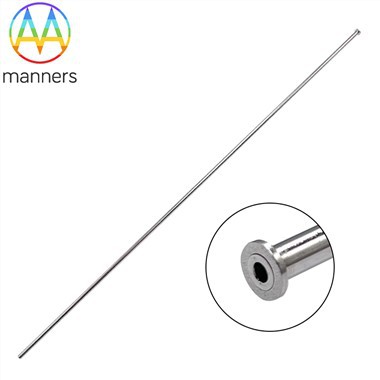
Kink-Resist Core
Sep 15, 2026
Pain Point
Kinking is the most common and most dreaded failure mode of a guide wire. A kink is a permanent, localized deformation of the core wire that can render the device unusable, damage the vessel wall, or trap a micro-catheter, forcing a costly and time-consuming device exchange. The pain point is that kink resistance and flexibility are often mutually exclusive. A solid, thick core wire is highly resistant to kinking but is too stiff to navigate tortuous anatomy. A thin, flexible wire can track beautifully but kinks at the slightest bend. This is particularly problematic in procedures like radial artery access, where the wire must navigate a sharp, 90-degree turn at the radial arch, or in neurovascular interventions, where the wire must traverse the tight loops of the carotid siphon. Traditional solutions, like adding a polymer jacket or a coil to the distal tip, add bulk and can compromise the wire's trackability. The industry needs a core wire that can bend to a very small radius without kinking, and that can recover its original shape after being bent, without any permanent deformation.
Principle
The kink-resistant core wire operates on the principle of "controlled deformation." Instead of trying to prevent bending altogether, the design encourages the wire to bend in a controlled, predictable manner that does not exceed the material's yield strength. This is achieved through a combination of material science and laser-cut hypotube technology. Nitinol is the ideal material for kink resistance due to its superelastic properties. However, even Nitinol can be improved. By using a laser with a 0.012 mm minimum kerf, we can create patterns on a Nitinol hypotube that act as "stress relief valves." A Radial cut pattern, for example, creates a series of microscopic, articulated joints that allow the wire to bend in multiple planes. When the wire is bent, the stress is concentrated at the cut sites, preventing it from exceeding the yield strength of the material. An Interrupted Spiral cut provides a similar benefit, with the uncut bridges preventing the wire from stretching or compressing. This creates a core wire that is "programmed" to bend safely, even at extremely small radii, and that will always return to its original shape.
Equipment Classification
- Nitinol Kink-Resist Core: The gold standard for kink resistance, utilizing the superelastic properties of Nitinol to recover from extreme bends.
- Coil-Reinforced Core: A stainless steel core wire with a flexible coil at the distal tip, providing a balance of push and kink resistance.
- Radial-Cut Hypotube Core: A laser-cut hypotube with a Radial cut pattern, creating a series of articulated joints for extreme flexibility and kink resistance.
- L605 Micro Core: A core wire made from L605 cobalt-chromium alloy, which has a very high yield strength and can resist kinking at very small diameters.
- Bespoke Gradient Core: A custom-designed core wire with a laser-cut pattern that varies along the length of the wire, providing a tailored kink-resistance profile for a specific clinical application.
Practical Guide
- Minimum Bend Radius: Define the minimum bend radius that the core wire will be subjected to in the clinical procedure. This will determine the required kink resistance.
- Material Selection: For most applications, Nitinol is the best choice for kink resistance. For applications requiring a smaller profile, L605 is an excellent alternative.
- Laser-Cut Pattern: Use a Radial or Interrupted Spiral cut pattern to create a "stress relief" mechanism in the core wire. The 0.012 mm kerf width allows for precise control over the flexibility and kink resistance.
- Electropolishing: A critical step to remove any micro-burrs from the laser cutting process. A burr can act as a stress concentration point and initiate a crack that leads to kinking.
- Kink Testing: Subject the core wire to a rigorous kink test by bending it around a mandrel of the minimum specified radius and then releasing it. The wire should return to its original shape without any permanent deformation.
- Fatigue Testing: Conduct cyclic bending tests to ensure that the core wire can withstand repeated bending without kinking or fracturing.
Real-World Experience
A company was developing a guide wire for the treatment of peripheral artery disease (PAD). The initial design used a solid 304 stainless steel core. While the wire provided excellent push, it had an unacceptably high rate of kinking at the distal end when navigating the tight bends of the superficial femoral artery (SFA). The company tried to solve this by using a thinner core, but this resulted in a loss of pushability. The breakthrough came when they switched to a hybrid design: a solid 304V proximal core for push, transitioning to a laser-cut Nitinol hypotube with a Radial cut pattern at the distal end. The 0.012 mm kerf cuts allowed the distal segment to bend to a very small radius without kinking. The result was a wire that could be pushed through the SFA with ease, and its kink resistance was significantly improved. The clinical trial showed a dramatic reduction in device exchanges and an improvement in patient outcomes.
Conclusion
The kink-resistant core wire is a triumph of biomedical engineering. It solves one of the most persistent and frustrating problems in interventional medicine. By combining the unique properties of materials like Nitinol with the precision of laser-cut hypotube technology, engineers have created a device that is both incredibly flexible and remarkably durable. The kink-resistant core wire is not just a tool; it is a testament to the power of innovation to overcome the limitations of the human body.
Outlook & Recommendations
The future of kink-resistant core wires lies in the development of "self-healing" materials that can repair micro-damage before it leads to a kink. We will also see the integration of strain sensors into the core wire to provide real-time feedback on the bending stress, allowing the operator to avoid kinking. The industry must continue to invest in research to understand the complex mechanics of kinking and to develop new and improved laser-cut patterns that can provide even greater kink resistance. Manufacturers should work closely with clinicians to identify the most challenging anatomies and to design core wires that can safely and effectively navigate them.