Intraosseous Access In Hemorrhagic Shock
Nov 20, 2026
The Collapsed Circulation Problem
Hemorrhagic shock is the clinical state in which vascular access is most needed and most difficult. As circulating volume falls, the body defends its core by constricting peripheral vessels. The result is a patient with cool extremities, absent or barely palpable peripheral pulses, and veins that are empty rather than merely small. Cannulation attempts that would succeed in a normovolemic patient fail repeatedly, and each failure consumes time that the patient is spending in ongoing blood loss.
The consequences are sequential. Without access, tranexamic acid cannot be given promptly. Blood products cannot be started. Pressure support and sedation for a painful maneuver cannot be delivered. The patient is transported with an access problem that will be solved in the emergency department, which means a period of avoidable physiological deterioration between the scene and the resuscitation bay.
This is the specific setting in which an intraosseous route earns its place. Not as a substitute for definitive hemorrhage control, and not as an equivalent to a high-flow central line, but as the fastest reliable means of converting a patient with no usable vein into a patient with a working vascular channel. For a patient losing blood by the minute, a needle for intraosseous access is the difference between a resuscitation that starts on time and one that starts late.
Marrow Flow Under Low-Perfusion States
Medullary sinusoids do not constrict the way peripheral veins do. They are enclosed in a rigid trabecular scaffold and drain into the central venous system through emissary veins, so a fall in systemic pressure does not collapse them. In hypovolemia, this is the anatomical reason the route remains patent when the periphery does not.
Flow through the marrow cavity is a different matter. The medullary bed offers resistance, and in a profoundly vasoconstricted patient even a well-placed needle may accept fluid slowly under gravity. This is why intraosseous resuscitation in shock is conducted with pressure-assisted infusion and why the practical flow ceiling of the route must be understood before it is relied upon for volume replacement.
Two operational implications follow. First, the route is excellent for rapid drug delivery and adequate for moderate-volume crystalloid. Second, for large-volume blood product resuscitation, the intraosseous line is best treated as a bridge that buys time while a definitive line is prepared. Teams that plan for that handover avoid the false confidence of a working intraosseous line and the delay that comes with assuming it will carry the entire resuscitation.
Choosing Hardware for Volume, Not Just Drugs
Needle selection in shock involves variables that matter less in an arrest. Flow is the first. A 15G stainless steel needle is the usual adult choice because it balances outer diameter against conductance; custom diameters and lengths are available for patients whose habitus makes a standard length awkward or who require a longer reach.
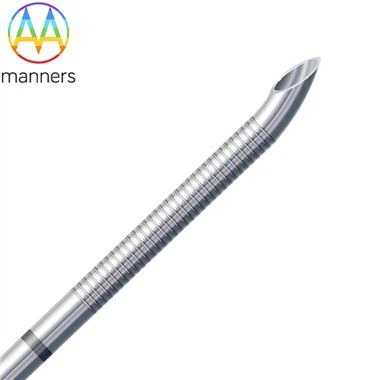
The second variable is stability under pressure. Pressure bags and rapid infusers apply force that a loosely seated needle cannot tolerate. A cutting-tip intraosseous access needle that has machined a clean cortical channel seats more rigidly than one that has split its way in, and rigidity is what keeps the device in place when the infusion is running at its limit. Paired with a low-power driver, the same geometry that makes insertion gentle also makes seating consistent, which matters when a second clinician is about to pressurize the line.
The third variable is site. In shock, the proximal tibia is preferred because it is accessible without moving the patient, does not interfere with airway management or chest interventions, and accommodates the stabilization dressing without competing with a cervical collar or pelvic binder. The proximal humerus is an alternative when the lower limbs are injured or inaccessible, though it is closer to the thorax and less convenient during ongoing resuscitation.
Resuscitation Sequence With an IO Line
Sequence matters as much as equipment. Confirm that peripheral access has failed or would take too long, and choose the intraosseous route without debate. Assign one clinician to insertion while others manage hemorrhage control, airway, and monitoring. Expose the proximal tibia, cleanse the site, and allow the antiseptic to dry while other tasks proceed.
Seat the needle with the driver, stop on loss of resistance, remove the driver, and confirm by aspiration and a flush against resistance. Secure the device before anything is infused under pressure. Connect a pressure infusion set, warm the fluids where equipment permits, and begin with the drugs that are time-critical: tranexamic acid, analgesia, and any agent that must precede blood products.
Then monitor the site continuously. Extravasation in a hypoperfused patient presents as firm swelling that may be mistaken for hematoma from the injury itself. Palpate the site after each significant volume, and confirm that the limb has not become tense. Record the time of insertion and the volumes delivered through the device, because the receiving team needs to know what has already been given and through which route.
Field Lessons and the Traps of High-Volume Infusion
The first trap is overestimating flow. A gravity drip through an intraosseous needle in a cold, vasoconstricted patient can be disappointingly slow, and a team that has not planned for pressure assistance will conclude that the line has failed when it has not. The second trap is underestimating displacement. A needle that accepts a drug bolus may still migrate under the torque of a pressure line, particularly during extrication.
The third trap is tunnel vision. Once the intraosseous line is flowing, teams sometimes stop pursuing definitive access, and the bridge becomes the destination. In hemorrhagic shock, the transition to a definitive line should be planned at the moment of insertion, not discovered later. The fourth trap is site neglect: a dressing that was adequate at insertion can loosen during transport, and a loosened device is functionally absent.
The fifth trap is conceptual, and it is the most expensive. Clinicians sometimes treat the intraosseous route as a lesser form of access and therefore under-use it in exactly the patients who need it most. In a patient with no palpable peripheral pulse and ongoing hemorrhage, the "lesser" route delivered in ten seconds outperforms the ideal route delivered in ten minutes.
Access as Hemorrhage Control Infrastructure
Hemorrhage control is usually described in terms of tourniquets, packing, binders, and blood products. All of those depend on a route. A pelvic binder, a tourniquet, and a massive transfusion protocol are components of a system, and the system requires a channel through which its pharmacology can travel.
Treating access as infrastructure changes procurement and training. Equipment is positioned where hemorrhage control is performed rather than in a distant compartment. The access role is assigned in the first minute of a trauma call. The threshold for using the intraosseous route is written into protocol as a trigger rather than left to individual tolerance for repeated failure. None of this requires new devices; it requires the devices already carried to be treated as part of the hemorrhage response rather than as a preparatory step.
Future Directions and Specification Priorities
Design in this category is converging on devices that are faster, gentler, and more stable once seated. Cutting-tip geometries with low-power drivers reduce dependence on operator strength, integrated stabilization reduces dislodgement under pressure, and consolidated kits reduce the number of items that must be gathered under stress.
For services and hospitals specifying equipment, five priorities are worth stating. Does one driver platform cover adult and pediatric lengths? Is the tip a cutting geometry, and is the driver's energy low enough that insertion does not depend on force? Is the needle stainless steel with a shaft that holds a straight path under pressure? Can the supplier manufacture to your 2D or 3D drawings or to a submitted sample, with standard carton packaging that fits your restocking routine? And is the device documented as an injection and puncture instrument for training and procurement records? A needle for intraosseous access that answers these questions becomes the default route when the periphery has shut down, which is exactly the moment when default behavior saves lives.