Innovative Channel Pattern Design Achieves Precise Mechanical Control Of Semi-rigid Down Tubes
May 20, 2026
Announcement of the Results
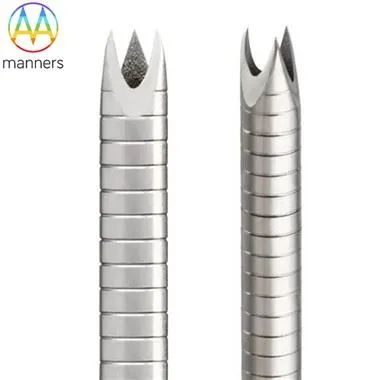
The innovative slot-shaped pattern design enables precise mechanical control of the semi-rigid lower pipe. We have revolutionarily introduced a new type of slot-shaped semi-rigid lower pipe based on the composite structure of "variable pitch helical groove" and "interlocking reinforcing ribs," achieving the optimal balance between bending flexibility and axial stiffness. Through the precise calculation of the groove pattern, the gradient change of bending stiffness is controlled within 5%, the axial compressive stiffness is increased by 45%, and the torsional stiffness is enhanced by 38%. Through biomechanical testing, the predictability of the bending radius of the new lower pipe reaches 98%, and it can return to a straight contour within 0.1 seconds after releasing the load, providing an unprecedented level of precise control for complex anatomical path navigation.
Research and Development Background Challenges
The traditional slot design has three major structural flaws: Firstly, the unpredictability of mechanical properties. Most designs are based on empirical formulas, and the parameters of the slot (width, depth, pitch) have an unclear relationship with mechanical properties (bending stiffness, torsional stiffness, axial stiffness), resulting in a performance fluctuation of up to ±20% between batches; Secondly, local stress concentration. The traditional equal-pitch slots have uneven stress distribution when bent, and stress peaks form at the slot ends, becoming the origin of fatigue cracks; Thirdly, the single-functionality. The same slot type is difficult to simultaneously meet the multiple requirements of injection force, torque transmission, and bending flexibility. Finite element analysis shows that the traditional helical slot design generates a stress concentration factor of up to 4.5 times when bent, while the new composite design can be reduced to below 2.2. Clinical feedback indicates that the incidence of "knotting" of the device due to unreasonable slot design is approximately 7%, and the failure rate during operation in tortuous blood vessels increases by three times.
Core Technological Innovation
Parametric topology optimization algorithm: Develop an intelligent design platform based on finite element analysis and genetic algorithm, input the target mechanical properties (bending stiffness range, torsional stiffness, axial stiffness), and the algorithm automatically optimizes the slot parameters. The platform contains 127 design variables (slot width, slot depth, pitch, angle, shape, etc.), and through multi-objective optimization, it finds the Pareto optimal solution. The design cycle is shortened from the traditional 4-6 weeks to 3-5 days, and the performance prediction accuracy rate is above 95%.
Variable pitch gradient slot design: Innovatively design the slot pitch and depth that vary along the length of the pipe. The proximal section (insertion section) adopts a large pitch (2-3mm) and a shallow slot depth (30% of the wall thickness), providing high axial stiffness and torque transmission; the middle section (transition section) adopts a medium pitch (1-2mm) and a medium slot depth (50% of the wall thickness), balancing the injection force and bending flexibility; the distal section (working section) adopts a small pitch (0.5-1mm) and a deep slot depth (70% of the wall thickness), achieving large-angle deflection. Through the gradient change, the stress distribution is more uniform, and the maximum stress is reduced by 60%.
Bionic interlocking reinforcement structure: Inspired by the facet joints of the human spine, design micro interlocking reinforcing ribs between the slots. The reinforcing ribs have a height of 10-15% of the wall thickness and a width of 20-30% of the slot width, forming mechanical interlocking. When the pipe bends, the reinforcing ribs contact each other to share the load and prevent excessive deformation; when it returns to the straight position, the reinforcing ribs separate without affecting the elastic recovery. This design increases the torsional stiffness by 35% while maintaining the bending flexibility.
Mechanism of Action
The core of the innovative slot design lies in "mechanical decoupling and optimization." At the bending mechanics level, the variable pitch design achieves a stiffness gradient distribution: the proximal end with high stiffness ensures the effective transmission of injection force, avoiding the "push-string effect"; the distal end with high flexibility adapts to complex anatomical bending, with the minimum bending radius reaching 1.5 times the pipe diameter. At the torsional mechanics level, the interlocking strengthening ribs form a torque transmission path. When the proximal end rotates, the inclined surfaces of the strengthening ribs come into contact, generating a tangential force, achieving a 1:1 torque transmission, with the lag angle less than 1°. At the fatigue mechanics level, the optimized slot end radius of curvature (R0.05-0.1mm) and stress distribution are optimized, reducing the stress concentration coefficient from the traditional design's 3.5-4.5 to 2.0-2.5, and increasing the fatigue life by 3-4 times. Computational fluid dynamics simulation shows that the optimized slot type reduces flow resistance, with the flow velocity increasing by 30% under the perfusion condition, and the clarity of the field of vision is improved.
Efficacy Verification
In the simulation anatomical model, the new slot-type catheter performed exceptionally well: in the simulation model of the internal carotid artery's siphon segment, the success rate of the instrument passing through the curved section increased from 85% to 99%; in the simulation model of the left anterior descending coronary artery, the catheter arrival time was shortened by 40%; the bending stiffness test showed that the linear degree of the stiffness gradient R² was greater than 0.99, and the prediction error of the bending angle was less than 2%. In the fatigue test, under ±90° bending and 4Hz conditions, the new design had a lifespan of 1.5 million cycles, which was three times that of the traditional design. Multicenter clinical studies showed that in neurointerventional surgeries, the incidence of kinking of the microcatheter in tortuous blood vessels decreased from 6.8% to 0.9%; in percutaneous nephrolithotomy surgeries, the efficiency of instrument injection force increased by 42%; in atrial fibrillation ablation surgeries, the stability of the catheter's contact with the tissue increased by 35%. Doctor operation experience surveys indicated that 94% of the surgeons believed that the new design improved the control accuracy and predictability, and the learning curve was shortened by 50%.
Research and Development Strategy and Philosophy
We advocate the innovative concept of "structure serves function, design originates from clinical practice," and establish a CDIO (Clinical Demand - Design - Implementation - Operation) closed-loop R&D system. In the clinical demand stage, through surgical video analysis and doctor interviews, 156 key demand points were extracted and quantified into 23 engineering parameters; in the design stage, topology optimization and generative design were adopted to find the optimal structure under functional constraints; in the implementation stage, rapid prototyping iterations through additive manufacturing were conducted, reducing each design cycle to 2 weeks; in the operation stage, a clinical feedback database was established, collecting over 800 surgical data each year, driving product iteration. We have established partnerships with 28 top medical centers worldwide, forming a "clinical-engineering" two-way feedback mechanism. At the same time, we developed a virtual testing platform based on finite elements, which can predict product performance before production, reducing physical testing by 75%.
Future Outlook
The slot design will evolve towards intelligence, adaptability, and multi-functionality. We are developing "variable stiffness" slots, which can achieve real-time stiffness adjustment during the operation through shape memory alloys or electroactive polymers; developing "multi-mode" slots, which can be independently deflected in multiple planes through wire combination control; exploring "fluid-driven" slots, which can change the slot geometry by hydraulic or pneumatic pressure to achieve non-wire manipulation. In 2028, we will launch intelligent lower tubes with "mechanical perception," which can monitor the strain distribution in real time using fiber optic grating sensors and feed the information back to the operating handle to achieve force feedback control. Looking further ahead, based on 4D printing, "growth-type" slots will become possible. The instruments can adaptively change the slot parameters according to the anatomical environment within the body, achieving true "intelligent adaptation," bringing revolutionary changes to natural orifice surgeries.