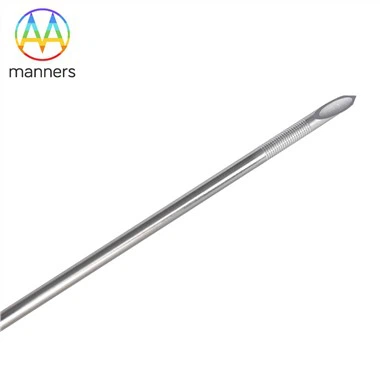
Industry Development Trends: Menghini Liver Biopsy Needles Driving Innovation And Upgrade Of The Medical Needle Industry
May 10, 2026
The medical needle sector is a fundamental segmented field within the medical device industry, covering multiple product categories such as injection, blood collection, biopsy, and interventional therapy. With the improvement of global medical standards, the popularization of minimally invasive technology, and the growing demand for chronic disease prevention and control, the medical needle industry is embracing opportunities for rapid development, innovation, and industrial upgrading. As a core product of diagnostic medical needles, the technological iteration, application upgrading, and market expansion of Menghini liver biopsy needles accurately reflect the development trends of the global medical needle industry, leading the industrial transformation toward high-end positioning, high precision, humanization, and intelligence.
Minimally invasiveness and high precision represent the core development direction of the medical needle industry. Diagnostic medical needles represented by Menghini liver biopsy needles continuously optimize structural design and manufacturing processes, further reducing needle diameter and improving puncture accuracy. While ensuring clinical efficacy, they minimize trauma to human tissues. In the future, the medical needle industry will further break through bottlenecks in precision manufacturing technology, realizing micron-level needle tip processing and integrated visual puncture guidance. Combined with imaging technologies such as ultrasound and CT, precise positioning and puncture of lesion sites will be achieved, completely overcoming the limitations of traditional blind puncture. This will enhance the accuracy of sampling, injection, and treatment, and drive the comprehensive upgrading of minimally invasive medical technology.
Personalization and flexible production are becoming the mainstream model of the medical needle industry. Amid diversified clinical demands, standardized medical needle products can no longer meet the requirements of precision medicine, and customized production will become the industry norm. The customized service model of Menghini liver biopsy needles will be gradually extended to all categories of medical needles. Relying on digital manufacturing systems, enterprises can realize rapid customization based on 2D/3D drawings, flexibly adjusting product specifications, structures, and materials to adapt to the needs of different patients, clinical departments, and application scenarios. This drives the medical needle industry to transform from large-scale standardized production to small-batch, multi-variety flexible production, improving product adaptability and market competitiveness.
Quality compliance and global integrated development continue to deepen. As global medical device regulatory policies become increasingly stringent, the medical needle industry faces rising requirements for quality management systems, product certification, and safety standards. Enterprises must establish a full-process quality control system, benchmark against international standards such as ISO 13485, CE, and FDA, and achieve global compliant circulation of products. Meanwhile, the global medical needle industrial chain demonstrates coordinated development with an obvious integration trend in raw material supply, production and manufacturing, and market sales. High-quality medical needle products will break geographical restrictions, achieve global clinical popularization, and promote the globalization and standardized development of the industry.
Material innovation and process upgrading empower the performance improvement of medical needles. In the future, medical needles will gradually break the limitations of traditional metal materials by adopting new biocompatible materials, biodegradable materials, and super-lubricating coating materials to enhance product biocompatibility, corrosion resistance, and wearing comfort. At the same time, the popularization of high-end processes and equipment including five-axis laser cutting, nano polishing, and intelligent testing will comprehensively improve manufacturing precision and product quality of medical needles. It solves common pain points of traditional medical needles such as burrs, rough surfaces, and easy blockage, promoting the transformation of medical needles from basic consumables to high-end precision devices.
Humanized and safety-oriented design is evolving into the industry standard configuration. Medical needle products will pay greater attention to patient experience and operational safety for medical staff. Optimized needle tip design reduces puncture pain; improved handle structure enhances operational convenience; and additional safety protection devices prevent needlestick injuries. The humanized design of Menghini liver biopsy needles featuring negative pressure aspiration and single puncture will set a design benchmark for the industry. It promotes all categories of medical needles to balance clinical performance and humanistic care, delivering a safe, comfortable, and efficient clinical application experience.
As a classic product in the medical needle industry, the development path and innovation orientation of Menghini liver biopsy needles have pointed out the development direction for the entire medical needle industry. Moving forward, the medical needle industry will continue to focus on technological innovation, quality upgrading, and demand adaptation, constantly breaking through industrial barriers. It will drive products toward high-end positioning, higher precision and humanization, and provide higher-quality and safer medical needle device support for global medical diagnosis and treatment.