Hypotube For Catheters: Material Fatigue Resistance Under Cyclic Bending
Sep 16, 2026
Pain Point Cyclic bending fatigue failure is a hidden but dangerous failure mode for catheter hypotubes. During clinical operations, catheters repeatedly bend, twist and flex while navigating curved blood vessels and body cavities. Even if a hypotube passes static mechanical tests, repeated cyclic deformation can create microcracks at laser cut edges. These tiny cracks expand gradually and eventually cause tube fracture mid-procedure. Many product developers only verify static tensile and torsion properties while ignoring cyclic fatigue performance. Different medical alloys show vastly different fatigue behaviors after laser ablation. Some materials suffer degraded fatigue life due to laser-induced thermal damage. Fatigue failure often occurs unpredictably after dozens of bending cycles, posing severe safety hazards for cardiovascular, peripheral and endoscopic catheter applications.
Working Principle Fatigue resistance of hypotube for catheters describes its ability to withstand repeated cyclic bending and torsion without crack initiation or propagation. Fatigue performance is determined by three key factors: intrinsic alloy fatigue property, laser cut edge quality and residual stress distribution. Our factory can process hypotubes ranging from Ø0.20mm up to 20mm with a minimum kerf width of 0.012mm. High-precision laser cutting reduces heat damage and forms clean slot edges, lowering the risk of microcrack nucleation. Materials such as L605 cobalt-chromium alloy possess outstanding inherent fatigue resistance, suitable for high-cycle bending environments. Nitinol relies on superelasticity to recover shape after repeated deformation. Stainless steel grades like 316L and 17-7PH demonstrate stable fatigue performance when laser parameters are properly tuned. Post-processing like electropolishing removes edge burrs and relieves residual stress, further extending the cyclic service life of hypotube components.
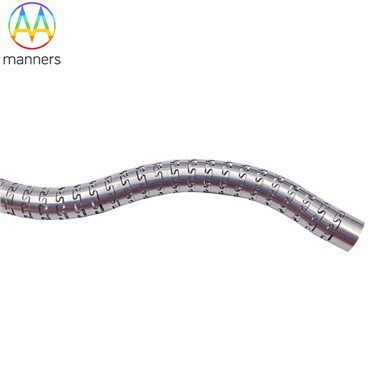
Equipment Classification Hypotube products grouped by fatigue resistance characteristics are classified by alloy type. L605 cobalt-chromium hypotube ranks highest in cyclic fatigue resistance, selected for catheter systems undergoing continuous repeated bending and rotation. 17-7PH hardened stainless steel hypotube delivers high tensile strength and good fatigue performance for thin-wall microcatheters. 316L medical stainless steel hypotube offers balanced fatigue property and cost efficiency for disposable interventional catheters. Nitinol hypotube benefits from superelastic recovery, resisting permanent deformation under cyclic bending, though fatigue performance is sensitive to laser thermal effects. In terms of cut patterns, interrupted spiral cut hypotubes generally achieve better fatigue life than full continuous spiral designs, because retained solid segments reduce stress concentration at cut slots. Radial cut and custom hybrid patterns are engineered for localized fatigue optimization at high-flexion zones.
Practical Operation Guidelines The standardized development process targeting high fatigue resistance hypotube starts with defining cyclic loading requirements. First, collect clinical data on expected bending cycles, bending radius and torsion amplitude for the target catheter procedure. Second, select appropriate base material according to fatigue requirements and biocompatibility specifications. Third, design laser cut patterns to disperse bending stress and avoid sharp notches that act as crack initiation points. Submit 2D/3D drawings or physical samples for custom laser machining. Strictly control laser power, scanning speed and kerf dimension to minimize heat-affected zones. After cutting, implement electropolishing and stress relief procedures to smooth cut edges and remove residual stress. Conduct cyclic bending and torsion fatigue testing to validate service life. All manufacturing processes comply with ISO9001:2015 and ISO13485 medical device standards. Packaging can follow standard carton specifications or customized packaging requests from customers.
Practical Industry Experience From years of production validation and clinical feedback, the majority of fatigue cracks originate at laser cut slot corners. Rough edges, micro-notches and thermal oxidation spots are the most common crack initiation sites. Many manufacturers overlook post-polishing and stress relief steps to cut costs, which drastically shortens fatigue life. Nitinol hypotubes are especially sensitive to laser heat input; excessive heat will form brittle oxide layers and ruin superelasticity and fatigue performance. Another common mistake is applying the same laser parameter set across different alloy materials. Parameters optimized for 304 stainless steel will cause severe thermal damage when directly used on Nitinol. Experienced engineers always conduct material-specific laser parameter trials and carry out fatigue testing on finished samples. It is also important to test fatigue performance under simulated body temperature, as alloy mechanical properties change inside the human body.
Summary and Sublimation Cyclic fatigue resistance is a critical safety metric for hypotube for catheters, directly determining the reliability of catheter systems during minimally invasive intervention. The combination of high-quality medical alloy selection, optimized laser cutting parameters and proper post-treatment can effectively suppress microcrack generation and propagation under repeated bending loads. Ultra-precise 0.012mm kerf machining capability enables designers to create stress-optimized cut geometries. With full compliance with ISO medical quality systems, custom hypotube solutions can meet the strict fatigue safety requirements of various catheter applications. Reliable fatigue performance prevents unexpected in-vivo component fracture and greatly improves clinical safety for patients.
Future Prospects and Suggestions As minimally invasive procedures advance toward longer and more complex catheter paths, fatigue requirements for hypotube components will keep rising. It is suggested that R&D teams adopt in-situ fatigue simulation during design to predict crack growth and optimize cut corner geometry. Process teams should continue refining cold processing and post-polishing techniques to reduce edge defects. Material suppliers and hypotube fabricators can jointly develop modified medical alloys with enhanced fatigue resistance. Regulators are tightening fatigue verification requirements for medical devices, so manufacturers should build standardized fatigue test libraries for different hypotube material and pattern combinations. Future multi-functional catheters integrating imaging and therapeutic tools will impose more complex cyclic loads on hypotube shafts, demanding further breakthroughs in fatigue-resistant hypotube design and manufacturing.