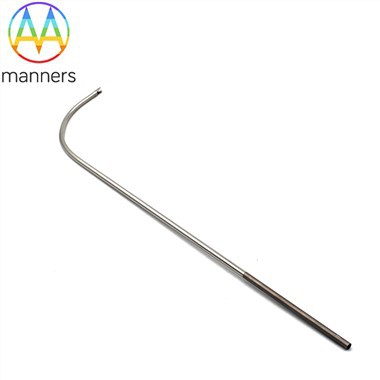
Hypodermic Needle Tubing Gauge Selection For Clinical Delivery Systems
Sep 12, 2026
Pain Point
Improper gauge selection of hypodermic needle tubing creates irreversible design issues. Oversized tubing increases patient trauma and requires larger incision sites, while undersized tubing lacks push strength and buckles during delivery. Designers often select gauge only based on lumen flow requirement without evaluating bending radius and torque transmission. After laser cutting, same-gauge tubing with different wall thickness behaves drastically differently. Gauge conversion confusion between imperial and metric standards leads to specification errors and wrong incoming materials. Small gauge hypodermic needle tubing below 0.3mm OD faces limited manufacturing capacity and long lead times. Changing tubing gauge at late prototype stages triggers costly redesign, delays regulatory testing and increases overall R&D expense.
Introduction Principle
Hypodermic needle tubing gauge is a standardized sizing system correlating outer diameter to clinical use. Higher gauge numbers correspond to smaller OD tubing. Our tubing production range spans Ø0.20mm up to 20mm, and laser cutting can achieve minimum kerf width of 0.012mm. Gauge selection balances three core factors: outer diameter for anatomical access, inner lumen for fluid or device passage, and wall thickness for mechanical strength. The base hypodermic needle tubing can be laser machined with continuous spiral, interrupted spiral, radial or bespoke cut patterns to create graded stiffness. Proximal segments retain rigidity for push and torque transfer; distal sections flex to navigate curved lumens. Different alloy grades including 304,316L,17-7PH, Nitinol and L605 can be matched to the same gauge size for different mechanical targets.
Classification by Gauge Application
Fine gauge hypodermic needle tubing (high gauge number, OD <0.5mm) is used for micro-injection, neurovascular catheters and minimally invasive biopsy tools. Mid-range gauge tubing is widely adopted for cardiovascular PTCA delivery systems, urinary endoscopic instruments and general aspiration needles. Large gauge hypodermic needle tubing (low gauge number, OD>2mm) is applied for abdominal aortic aneurysm stent delivery and large-bore access sheaths. Each gauge can be manufactured from stainless steel, Nitinol or L605 cobalt alloy. Laser cut pattern selection varies by gauge: fine gauge tubing commonly uses interrupted spiral or bespoke patterns to avoid over-weakening, while mid and large gauge tubing can adopt continuous spiral or radial cuts.
Practical Operation Guide
Start gauge selection by defining the maximum allowable outer diameter based on target anatomical access. Calculate required lumen size for fluid flow or device passage. Select wall thickness to meet buckling, push and fatigue requirements. Match alloy grade and laser pattern after gauge is locked: 316L stainless steel for coronary delivery shafts, Nitinol for highly curved peripheral vessels. Submit 2D/3D drawings with metric OD/ID specifications to avoid imperial-metric gauge conversion mistakes. Request first article samples for bench testing including push, torque, kink resistance and fatigue cycles. Verify raw material certification and ISO13485 compliance of suppliers. If prototype performance fails, evaluate wall thickness adjustment before changing gauge entirely.
Practical Industrial Experience
Many engineers focus only on OD gauge and ignore wall thickness, leading to understrength laser-cut shafts. Fine gauge hypodermic needle tubing is vulnerable to thermal damage during laser cutting and requires lower laser power. For vascular applications, reducing tubing gauge lowers vessel trauma but increases difficulty of torque transmission. Gauge standards vary by region, so always define dimensions in millimeters rather than relying only on gauge labels. When multiple segments of different stiffness are needed, use the same base gauge and adjust laser cut density instead of switching tubing gauge. Phantom anatomical testing validates gauge suitability before clinical trials.
Summary
Hypodermic needle tubing gauge defines the outer profile of injection needles and catheter delivery shafts. Gauge selection must combine anatomical constraints, lumen requirements and mechanical performance. Wall thickness and alloy grade significantly change performance even within the same gauge. Laser cut patterns are tuned to match the selected tubing gauge. Bench testing and phantom simulation confirm gauge suitability before formal production.
Prospect and Suggestion
Medical device designers should shift specification practice from gauge-only labeling to full metric OD/ID and wall thickness documentation. Suppliers should expand ultra-fine gauge hypodermic needle tubing production capacity. R&D teams can explore multi-segment variable-gauge hybrid shafts for next-generation minimally invasive devices.