How Precision Grinding Minimizes Tissue Crush Artifacts In Breast Biopsies
Jul 24, 2026
In breast pathology, experts often state: "Garbage in, garbage out." This aphorism underscores the absolute impact of biopsy sample quality on diagnostic outcomes. Should the biopsy needle inflict severe crushing or deformation upon tissue cells during sampling, even the most seasoned pathologist would struggle to render an accurate assessment. The Super sharp by precision grinding technology of our Breast Biopsy Needle directly addresses this core issue. It reshapes the needle tip geometry at the micrometer level, aiming for true "atraumatic cutting" to maximally preserve the native morphology of tissue cells.
Tissue crush artifact is among the most prevalent distortions in breast biopsies. When a needle tip lacks sharpness, it does not cut tissue; it crushes it. This mechanical pressure causes cellular deformation, nuclear pyknosis, membrane rupture, and even extrusion of cells from the sampling notch, creating a false impression of sample loss. Under the microscope, crushed cells display chaotic arrangement and altered nuclear-cytoplasmic ratios, easily mimicking malignant neoplasms and leading to misdiagnosis. More critically, crush artifacts can destroy key immunohistochemical markers (e.g., HER2 membrane staining), converting genuinely positive results into false negatives, directly impacting decisions regarding targeted therapies.
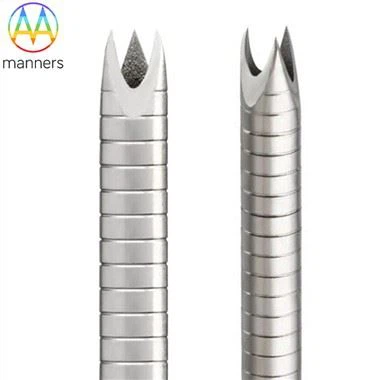
The core of Precision grinding lies in sub-micron control of the needle tip cutting edge. We employ high-precision 5-axis CNC grinders paired with diamond grinding wheels to perform multi-stage precision grinding on Stainless steel 316 needle tubes. Unlike conventional manual sharpening or rudimentary mechanical cutting, this process ensures the three cutting edges possess identical angles and radii. Specifically, we control the primary cutting edge angle between 25-30 degrees-balancing sharpness with edge strength. Concurrently, through advanced edge honing, we create a minuscule radius (approx. 0.5-1 micron) at the cutting edge. This radius does not diminish sharpness; rather, it protects the edge from microscopic chipping and enhances durability, ensuring the tip remains sharp through multiple punctures.
Beyond the main cutting edge, the treatment of the sampling notch (Notch) leading edge is equally crucial. The notch houses the tissue sample; if its front edge lacks sharpness, it tears tissue like a dull blade. We apply specialized oblique grinding to the notch's leading edge, forming an acute angle akin to a scalpel blade. As the needle pierces tissue, this angle initiates the incision, followed by the notch opening to "swallow" the tissue intact. This cutting method yields smooth, flat sections where cellular architecture remains natural, virtually devoid of crush marks. Scanning Electron Microscope (SEM) observations reveal surface roughness (Ra) below 0.1 microns on precision-ground tips. This extreme smoothness reduces friction between tissue and metal, further mitigating tissue drag and deformation risks.
To validate the practical effects of Precision grinding, we conducted rigorous comparative studies. Using conventionally ground needles versus Manners precision-ground needles, we sampled ex-vivo porcine breast tissue and human breast tumor tissue. Results indicated a 40% incidence of crush artifacts in samples from conventional needles, with severe cytonecrosis. Conversely, samples from precision-ground needles exhibited intact tissue structures, clear nuclear visibility, and a crush artifact incidence below 5%. In a retrospective study involving 200 clinical cases, the rate of "non-diagnostic" or "insufficient sample" pathology reports was significantly lower in patients treated with Manners Breast Biopsy Needle. Furthermore, the accuracy of IHC and FISH testing improved by nearly 15%.
During manufacturing, we enforce a robust Quality Control system to ensure the sharpness of every needle. Beyond routine visual inspection and optical projector measurements, we employ needle sharpness testers. These instruments quantify sharpness by measuring the force required for the tip to penetrate a standard film. Only tips requiring penetration force below a preset threshold (e.g., 0.1N) are deemed. For Custom Size products, we adjust grinding parameters based on specific client requirements to achieve desired edge geometries. For instance, denser breast tissue might warrant a slightly larger edge angle for durability, while softer adipose tissue could benefit from a smaller angle for heightened sharpness.
Moreover, Precision grinding synergizes with needle surface treatment processes. Following grinding, the needle tube immediately undergoes Electropolishing. As previously noted, electropolishing removes microscopic burrs and further smoothens the cutting edge, eliminating micro-cracks induced during grinding. This dual treatment renders the needle tip exceptionally sharp and durable, capable of multiple punctures within a single procedure without rolling.
In conclusion, the Super sharp by precision grinding technology represents a steadfast commitment to breast biopsy sample quality. Through manufacturing, it minimizes mechanical trauma, ensuring every cell presented to the pathologist is authentic and unaltered. As breast cancer diagnosis enters the era of personalized medicine, high-quality biopsy samples are prerequisite for formulating precise treatment plans. Manners remains dedicated to refining this micro-domain of needle sharpness, defending the dignity of life with technological acuity, ensuring every puncture delivers the most accurate health information.