How Automatic Firing Changes Marrow Biopsy Control
Nov 21, 2026
The Clinical Pain Point
Manual bone marrow biopsy has always asked a great deal of the operator's hand. The traditional technique depends on a steady wrist, a controlled axial push, and a semi-rotational motion that keeps the cannula advancing into cortical bone without wandering. In a busy hematology unit, that motion is repeated many times a day, often on patients with sclerotic bone, obesity, or a prior biopsy site that has developed scar tissue. The result is a procedure whose quality fluctuates with operator fatigue rather than with patient anatomy.
The consequence is not merely aesthetic. A core that is fragmented, crushed, or shorter than expected can delay a diagnosis of myeloma, lymphoma, or metastatic disease by days or weeks, because the pathologist cannot assess architecture on a damaged specimen. Repeated attempts then expose the patient to additional pain, additional bleeding risk, and additional time in a day-unit bed. Inconsistency between operators also complicates quality reporting.
The real problem, therefore, is not a lack of skill. It is that manual force application places the critical variable, penetration depth and rate, inside a human hand that tires.
How the Mechanism Works
Automatic firing replaces continuous manual push with a stored-energy release. A spring or gas-charged element inside the ergonomic handle is compressed during preparation; when the operator disengages the safety and presses the trigger, that energy drives the cannula and the trocar-tipped stylet forward along the intended axis at a repeatable rate and depth. Because the stroke is guided by the housing rather than by wrist angle, the trajectory stays straight even when the patient's bone surface is oblique.
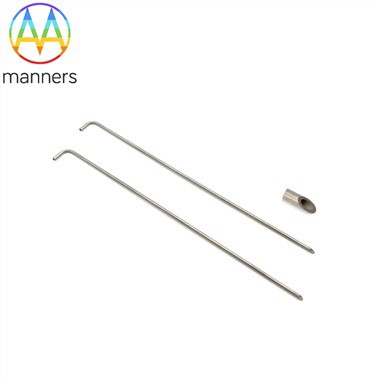
Two design consequences follow. First, the stylet with a trocar bevel penetrates cortical bone before the sampling cannula follows, so the cutting edge meets cancellous bone rather than being forced through the cortex itself. Second, once the sample is captured, the operator no longer needs to withdraw the entire assembly to inspect it. A remover guide with graduated indication allows the sample to be pushed out of the cannula and its length read directly against the markings, so the adequacy of the specimen is known while the patient is still on the table.
This is why Single-use Automatic Bone Marrow Biopsy Needles have gained ground in units that perform high volumes: the mechanism standardizes what the hand cannot, and the disposable format removes reprocessing variability between cases.
Devices and Specification Categories
A typical range covers stainless steel cannulas in 8G, 11G, 13G, 14G, 15G, 16G and 18G, with custom sizes available where a department has a specific protocol. Gauge selection still follows the familiar trade-off between specimen volume and patient comfort, but the automatic mechanism is what makes the smaller gauges reproducible in routine hands.
Tip geometry is a second axis of choice. Trocar, suction and fish tip configurations are all offered, and each answers a different intraprocedural need rather than a marketing preference. Third, the sampling accessory defines the retrieval strategy: MM and MF add-on sampling cannulas allow a second core to be taken without a second puncture, and their design supports atraumatic retrieval so the core is not sheared as it leaves the medullary space. The Luer Lock connector on the hub permits a syringe to be attached for aspiration or for gentle flushing when the cannula needs clearing.
Necking, swaging, grinding, laser cutting, laser marking and electrolytic polishing are all available, and a supplier who can work from a 2D or 3D drawing, or from a physical sample, will usually deliver a better-fitting device than one who only sells catalogue items. Standard carton packaging keeps logistics simple, and related injection and puncture instruments can be ordered together.
Practical Procedure Guide
Preparation begins by confirming that the firing mechanism is fully armed and the safety engaged. Check that the selected gauge matches the planned site and that the sampling cannula, whether MM or MF, is the one the operator intends to use. Confirm the Luer Lock hub is clean and unobstructed, because a blocked hub will make any subsequent aspiration useless.
Mark the site and infiltrate local anesthetic down to the periosteum, allowing adequate time for it to act. Make a small skin incision so that the cannula does not drag skin into the tract. Introduce the assembly with the stylet leading, advance until the trocar bevel is seated on cortical bone, and verify alignment against the planned axis rather than against the skin surface alone.
The operator then disengages the safety and fires. Do not add manual push during firing, since combined forces defeat the purpose of the mechanism. Then advance the cannula with gentle rotation to cut the core. Withdraw the assembly, attach the remover guide, and push the specimen forward until it emerges, reading its length against the graduated indication. Record the length before placing the core in fixative, and inspect the ends for crush artifact. If the core is short, the guide will say so immediately, which is the whole point of the indication.
Field Experience and Misconceptions
The most common misconception is that automatic firing is a substitute for anatomical judgment. It is not. The mechanism controls rate and depth of the stroke; it does not tell the operator where the cortex lies, how thick it is, or whether the needle is drifting. Experienced users still palpate, still confirm landmarks, and still stop when resistance changes unexpectedly.
A second misconception concerns specimen length. Operators new to the remover guide sometimes assume that a longer core is always better. In practice, an intact core of adequate length is superior to a longer core that has been crushed or fragmented by over-advancement. The guide's value lies in making length visible, not in encouraging maximal penetration.
Third, there is a persistent belief that disposable devices are less robust than reusable ones. In reality, a sealed Single-use Automatic Bone Marrow Biopsy Needles unit arrives with a known cutting edge and a known mechanism tension, whereas a reused instrument carries the accumulated history of every previous sharpening and every previous sterilization cycle. For departments that audit specimen adequacy, that predictability is a clinical asset rather than a cost line.
Some operators keep a syringe attached throughout for convenience. The added mass alters handling, and a hub used for aspiration should be cleared before the sampling cannula is advanced again.
Summary
Automatic firing changes the control problem in marrow biopsy from a matter of hand steadiness to a matter of preparation and technique. The device takes over the forward stroke, the trocar-tipped stylet establishes the tract, the Luer Lock hub supports aspiration when needed, and the remover guide makes specimen length visible before the patient leaves the table. Specification choices in gauge, tip geometry, and MM or MF sampling cannulas then determine how well the mechanism suits a given patient and protocol.
For a department, the practical gains are consistency across operators, fewer repeat passes, and a documented specimen length that can be entered into quality records. For the patient, they are fewer attempts and a shorter procedure. Neither benefit depends on the device alone; both depend on an operator who understands what the mechanism does and, equally important, what it does not do.
Technical Outlook and Selection Advice
The direction of development is toward better feedback inside the same sealed format. Mechanical firing is mature; what remains is instrumentation that tells the operator more about the sample in real time, whether through more precise graduated indication on the remover guide or cannula geometries that reduce friction during retrieval.
When selecting a supplier, ask three questions. First, can the manufacturer work from your 2D or 3D drawing or a physical sample, and does the quoted device include the necking, swaging, grinding, laser cutting, laser marking and electrolytic polishing steps your protocol assumes? Second, is the range complete enough that gauge, tip geometry and sampling cannula can be ordered as one consistent family, in stainless steel, with standard carton packaging and the injection and puncture instruments you already use? Third, will the supplier provide samples so your team can evaluate the firing feel and the remover guide indication before committing to a volume order.
Evaluate the whole system, not the spring alone, and the switch to automatic firing will deliver the control it promises.