How 30–50° Blunt Bevel Tip Improves Liquid Aspiration Speed For Dispensing Systems
Nov 12, 2026
1. Pain Points of Slow Aspiration in Automatic Dispensing and Pharmacy Compounding
High-volume pharmacy compounding and high-cycle automatic glue dispensing lines are often limited by slow liquid uptake speed. Traditional sharp needles create narrow flow channels and high flow resistance when drawing fluid from vials. Operators spend extra waiting time for liquid to fill syringes, lowering overall station throughput. For automated glue machines with cyclic aspiration-dispensing logic, slow inflow causes inconsistent fluid supply and unstable dot weight. Many operators try to increase negative pressure to speed up aspiration, but excessive vacuum easily sucks rubber debris off stoppers and introduces air bubbles. Bubbles inside the fluid further lead to missing dots and inaccurate dosing. Some blunt needle products on the market adopt overly flat tip angles, which require large penetration force and easily deform thin stoppers. Standard needle sizes cannot match low-viscosity reagents and high-viscosity glues at the same time. Without optimized bevel transition, fluid accumulates at the tip opening and forms residual liquid droplets, triggering dripping after cutoff. Factories also struggle to balance aspiration speed and particle prevention; fast flow designs usually sacrifice anti-coring performance.
2. Working Principle of High Precise Metal Dispensing Needle For Automatic Glue Machine
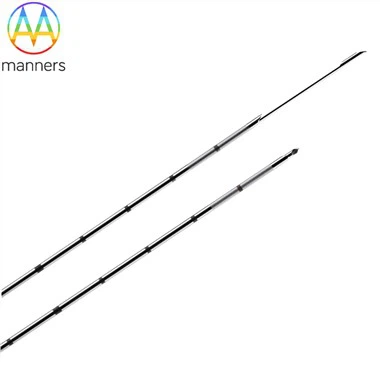
The core design advantage lies in the 30–50° bevel blunt tip after special processing. This moderate bevel angle creates a wider opening cross-section at the tip compared with flat blunt needles, reducing fluid flow resistance during aspiration. The smooth transition from outer wall to inner bore guides fluid into the channel smoothly, shortening the fluid filling path. The stainless steel body maintains dimensional stability under negative pressure and pressure cycles. The built-in <5 μm filter membrane in the hub does not interfere with normal fluid flow while intercepting particles. The needle is designed for direct connection with dispensing syringes, forming a sealed fluid path for automatic glue machines. Inner diameter covers 0.1–0.8 mm, and custom dimensions can be machined from 2D/3D drawings or samples. The blunt profile avoids cutting rubber stoppers, so aspiration acceleration will not be accompanied by rising coring risk. The polished inner surface reduces fluid adhesion and residual liquid retention, supporting clean cutoff after dispensing. For low-viscosity reagents and medium-viscosity adhesives, the gradient bevel geometry optimizes flow velocity distribution without generating turbulent eddies.
3. Classification by Aspiration and Dispensing Scenarios
By bevel function tuning, the series is divided into balanced 30–40° models and high-flow 40–50° models. 30–40° versions are widely used for clinical medication preparation with delicate rubber stoppers; they need lower penetration force and excellent anti-coring performance. 40–50° bevel tips are preferred for automatic glue machines and high-speed liquid extraction, prioritizing higher aspiration flow rate. By filtration configuration, blunt filter needles with hub membrane are for high-purity liquid, while non-filter blunt bevel needles are for clean industrial glue. By inner diameter, ultra-fine 0.1–0.3 mm is for trace reagent micro dispensing; 0.3–0.6 mm is universal for pharmacy and standard automation; 0.6–0.8 mm serves high-flow glue filling. Supply modes include standard off-the-shelf stock and custom development. Custom orders adjust bevel angle, tip length and hub interface to fit proprietary dispensing valves. ISO13485 certified versions are available for medical and medical electronics manufacturing.
4. Practical Operation Guide for Fast and Stable Aspiration
First, match bevel angle to the application. For thin, easily damaged stoppers, select 30–40° bevel tips; for automatic glue machine high-speed cycles, choose 40–50° specifications. Second, select inner diameter according to fluid viscosity. Low-viscosity reagents can use relatively small inner diameter while maintaining fast aspiration; high-viscosity glue needs larger inner diameter to avoid excessive resistance. Third, set negative pressure reasonably. Do not maximize vacuum to chase speed; adjust vacuum until fluid rises steadily without bubble generation. Fourth, align the bevel orientation during stopper penetration. Keep the bevel surface facing upward to reduce rubber extrusion and debris shedding. Fifth, inspect the filter membrane before use for filter-type needles. If the membrane is blocked by residual particles, aspiration speed will drop sharply, and the needle must be replaced. Sixth, on automatic glue machines, synchronize aspiration time with needle geometry. After switching to a 40–50° bevel needle, shorten the programmed aspiration delay to match faster liquid intake. Seventh, post-use cleaning: flush the channel with compatible solvent for industrial glue, and discard clinical filter needles after single use. Check tip deformation after each batch.
5. Practical Experience from High-Speed Dispensing Lines
Process engineers found that 40–50° bevel blunt needles can cut aspiration time by nearly 30% compared with flat blunt needles, while still keeping coring rate at a low level. A common mistake is using high-flow bevel needles on ultra-thin rubber stoppers; larger opening area may squeeze the stopper and cause slow leakage. Many automatic dispensing stations ignore parameter synchronization after needle replacement. If the original long aspiration delay is retained, the system will overfill fluid and cause dripping. Custom needle projects often fail when customers only specify inner diameter without clarifying bevel angle requirements. The same inner diameter with different bevel angles brings completely different flow curves. For filter-equipped models, users should understand that the filter itself creates fixed flow resistance; faster tip geometry cannot offset severe clogging. When validating new formulations, record aspiration time, vacuum value and bevel angle together into the process recipe. Pharmacy teams also note that fast aspiration must not sacrifice visual inspection; slow drawing is still required for high-risk injectable drugs.
6. Conclusion and Value Sublimation
High precise metal dispensing needles for automatic glue machines achieve a balanced breakthrough between fast aspiration and anti-coring safety through optimized 30–50° bevel blunt geometry. It solves the conflict between pursuit of high throughput and particle contamination risk that troubles traditional blunt and sharp needles. The stainless steel precision structure and optional built-in micron filter make it adaptable to both clinical compounding and industrial automated dispensing. Customization based on drawings and samples supports unique speed requirements of special dispensing equipment. Stable, rapid liquid extraction improves equipment utilization and reduces waiting waste in batch production.
7. Suggestions and Future Trend
Automatic dispensing systems keep moving toward shorter cycle times. Equipment designers should reserve adjustable vacuum and timed aspiration parameters for bevel blunt needles. Suppliers can provide flow rate test reports for each bevel specification to help users select quickly. Future technical directions include gradient bevel tip polishing to further reduce fluid adhesion and composite filter membranes with higher dirt holding capacity. For medical applications, users should prioritize ISO13485 certified suppliers and complete validation of aspiration speed and particulate safety before formal use.
< img alt="news-1-1" src="/uploads/24240/news/202604241539186d0ff.png " />