From Puncture To Mass Production: How An OPU Needle Leverages A Revolution in Cattle Breeding
Apr 13, 2026
From "Puncture" to "Mass Production": How an OPU Needle Leverages a Revolution in Cattle Breeding
Provocative Question: Why Can a Single "Needle" Determine the Genetic Future of a Million-Dollar Cow?
When discussing a top-tier breeding cow worth millions, few notice that the key to replicating its genetic value on a massive scale hinges on an instrument slightly thicker than a human hair: the OPU needle. Why can this inconspicuous puncture needle become the "bottleneck" of elite breeding expansion? The answer lies in its disruptive working logic: acquiring precious immature oocytes from living, high-quality cows in a minimally invasive manner, repeatedly and at high frequency, thereby initiating the era of industrialized in vitroembryo production.
Historical Context: The Evolutionary Path from Surgical Instrument to Breeding Engine
The birth of the modern OPU needle was not accidental; it emerged at the intersection of precision manufacturing and reproductive medicine at a specific historical juncture.
1980s: Inspiration from Ultrasound Guidance. Early methods for collecting bovine oocytes relied on slaughterhouses or highly traumatic laparotomies. The introduction of ultrasound technology into veterinary medicine allowed for the first clear visualization of ovarian follicles. Initial attempts borrowed concepts from human laparoscopic surgery, but were complex and difficult to promote. It wasn't until researchers ingeniously combined a slender puncture needle with an ultrasound probe that true, repeatable, transvaginal ultrasound-guided ovum pickup (OPU) became a reality. This was the prototype of modern OPU technology, and that custom needle was the ancestor of all OPU needles used today.
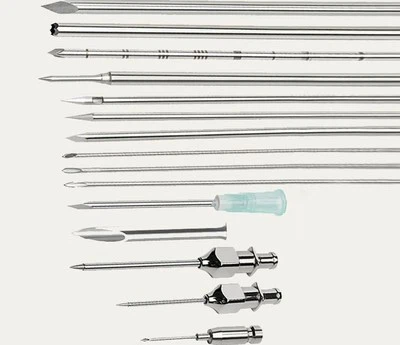
1990s: Standardization of Dedicated Needles. As OPU technology demonstrated immense potential in top-tier ranches worldwide, the demand for standardization arose. Early "modified" tools were replaced by purpose-built, sterile, single-use OPU needles for cattle. The core design philosophy was solidified: specific gauge (typically 17-20G), sufficient rigidity and flexibility to penetrate tissue, a precision bevel tip design to minimize physical damage to oocytes, and a matching negative pressure line system for non-destructive aspiration.
21st Century to Present: Empowerment by Materials Science and Engineering. Modern OPU needles are precision consumables fused with cutting-edge materials. Needle shafts utilize medical-grade ultra-thin stainless steel, with some exploring smoother coatings to minimize puncture resistance and protect ovarian tissue and blood vessels. Leak-proof hub and connector designs ensure vacuum stability, guaranteeing high oocyte recovery rates. Every material iteration aims to enhance operational smoothness, oocyte retrieval rates, and survival rates.
Defining the Standard: The "Performance Code" of OPU Needles
The technical parameters of a qualified OPU needle define the ceiling of operational capability:
Gauge (Specification): Not simply "thinner is better." The mainstream 18G strikes the optimal balance between sufficient rigidity (ensuring accurate puncture paths) and internal diameter (ensuring smooth passage of follicular fluid and oocytes). Excessively fine gauges risk clogging, while overly thick ones increase trauma.
Tip Design: Features unique echo-enhancing treatment to ensure clear visibility on B-scan ultrasound. The bevel angle is optimized to balance "sharpness" and "smoothness"-allowing rapid penetration into follicles while avoiding collateral damage to surrounding follicles.
Length and Rigidity: Typically 55-60 cm, sufficient to reach the ovaries near the uterine horns. Specialized manufacturing processes ensure straightness over this length, preventing deflection and loss of target during puncture.
Biocompatibility and Sterility: The entire needle body must meet the highest biocompatibility standards and be single-use to eliminate any risk of cross-contamination and immune reactions. This is the lifeline for ensuring the long-term health of donor cows, who may undergo hundreds of OPU sessions.
Clinical Application: Value Transfer from "Needle Tip" to "Pasture"
In a top-tier embryo production lab, the mission of an OPU needle begins with a perfect puncture and ends with a high-quality transferable embryo.
Core Procedure: The operator, holding a puncture handle connected to an ultrasound probe, guides the OPU needle under real-time ultrasound to precisely pierce follicles with diameters of merely 3-8 mm. Negative pressure is activated to gently and rapidly aspirate the follicular fluid containing the target oocytes into a temperature-controlled collection tube. A skilled technician can complete the collection from dozens of follicles in a single cow within 15 minutes.
The Efficiency Lever: An elite Holstein donor cow, through OPU once or twice a week, can yield over 1,000 oocytes annually. Combined with in vitrofertilization (IVF) and embryo culture, this can ultimately produce over 300 transferable embryos. This means a single needle can help "create" dozens of genetically elite offspring for a herd in one year-a genetic transmission speed dozens of times faster than natural reproduction.
Industrial Cornerstone: The reliability and efficiency of the OPU needle are the lifelines of commercial embryo transfer companies. It determines not only the cost per collection but also the scale and speed at which high-quality genetic resources are "monetized." When combined with genomic selection technology, OPU/IVP allows ranches to "fix" and massively propagate the best gene combinations within the shortest possible generation interval.
Conclusion
The OPU needle, a seemingly simple instrument, is actually the "last 1 centimeter" connecting elite bovine genetics to the modern embryo production assembly line. Its evolutionary history epitomizes the relentless pursuit of minimally invasive, precise, and highly efficient reproductive technology. Today, when we witness a champion calf born from OPU/IVP technology on a ranch, we should not forget that it all began with a precise flash of a needle tip on an ultrasound screen. For China's breeding industry, mastering and optimizing the entire technical system behind this "needle" means grasping the key to breaking foreign monopolies on breeding stock and achieving independent breeding upgrades.