Fracture Risk And Mechanical Optimization: Manufacturing Insights For Complex Trauma
Jul 25, 2026
While generally safe, IO infusion carries a risk of fracture-particularly in osteoporosis, pediatrics, or repeat insertions. The Vascular Access Needle Sets Manufacturer must understand the biomechanics of fracture occurrence and optimize the 15G needle's material and geometry accordingly. This represents a critical, albeit behind-the-scenes, role in risk mitigation.
Fractures typically stem from three mechanical failures: excessive axial pressure causing cortical shattering; poor tip geometry inducing stress concentration and cortical tearing; and insufficient needle rigidity causing lateral bowing forces that lever against the cortex (especially in long bones like the humerus). Manufacturers select 304 or 316L stainless steel for its balance of yield strength and ductility. For 45mm needles, to counter buckling risks associated with high aspect ratios, some high-end lines utilize cold-drawn, strain-hardened tubing. During necking, controlled diameter reduction ensures tip sharpness while maintaining a high moment of inertia at the base for flexural resistance.
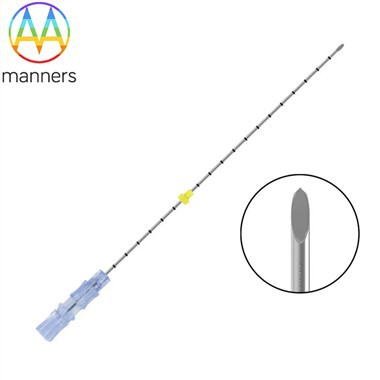
Tip grinding geometry significantly impacts fracture risk. Traditional beveled tips tend to skive on smooth bone surfaces, prompting clinicians to increase downward force, which spikes local pressure and induces micro-fractures. Modern manufacturers employ fluted drill-tip designs (via swaging and grinding), creating dual cutting edges. Driven by power drivers, these tips utilize rotary shear rather than pure compression, distributing axial loads. The point angle is typically set at 118°±5°, emulating optimal high-speed steel drill bit geometry to minimize cortical splitting.
Electropolishing indirectly protects bone integrity. Rough surfaces increase insertion friction and tissue adhesion; during withdrawal, this "wicking effect" can avulse bone spicules or tear the endosteum. Smooth surfaces (Ra<0.2μm) ensure smooth transit, preserving medullary wall integrity. Additionally, laser-cut side ports require thorough de-burring to prevent high-pressure infusion from causing stress concentrations that perforate the thin medullary wall.
Addressing "long fractures" as a contraindication, manufacturers provide supportive design features. Depth-limiting collars on hubs physically prevent over-insertion past the posterior cortex-critical near pediatric growth plates where violation risks growth disturbances. While smart needles with piezoelectric sensors are emerging, conventional manufacturing relies on precise laser-etched depth rings. The specified 5mm safety margin translates to micrometer-accurate scale placement; a 1mm etching error could lead to dangerous over-penetration.
In complex trauma, patients often present with osteoporosis or prior bone pathology. Manufacturers conduct cadaveric or synthetic bone (polyurethane foam) penetration tests during R&D, simulating fracture rates across bone densities. Data informs swaging parameters-adjusting tip micro-chamfers to reduce initial切入 impact. Offering multiple lengths (15mm for infants, 25mm standard, 45mm deep tissue) is itself a fracture prevention strategy; forcing a 25mm needle into a thick humerus increases force and fracture risk, whereas selecting the correct length reduces effort and stabilizes placement.
Packaging and labeling convey safety information. External boxes should feature pictograms warning against use on fractured limbs or near epiphyses. Training materials explain why "prior orthopedic surgery" is contraindicated-implants (plates, screws) obstruct the needle path and create uneven stress planes prone to fracture or needle breakage.
Finally, post-market surveillance systems must capture fracture adverse events, analyzing whether they stem from tip dulling (linked to expired products or inappropriate reuse), manufacturing defects, or parameter drift during grinding. Batch tracing enables root-cause analysis.
In conclusion, the Vascular Access Needle Sets Manufacturer plays a pivotal role in preventing iatrogenic fractures. By optimizing stainless steel mechanics, precision-grinding self-tapping drill tips, controlling electropolished surface quality, ensuring accurate depth calibration, and validating designs against cadaveric bone, manufacturers embed "bone-safe" principles into every 15G needle. When clinicians face compromised anatomy and challenging bone quality, this meticulously engineered instrument becomes their most reliable fulcrum-where microscopic manufacturing precision ensures macroscopic skeletal safety.