Fluid Transport Dimension - Microscale Flow And Drug Delivery Kinetics
Jun 03, 2026
https://litfl.com/intraosseous-access/
The subcutaneous injection system is essentially a microfluidic device that follows unique transport laws. In a laminar flow state with a Reynolds number Re < 100, the flow of the drug solution is dominated by viscous forces. According to the modified Hagen-Poiseuille equation, the volumetric flow rate Q through the needle tube is given by Q = πΔP(D⁴ - d⁴) / (128μL), where D is the inner diameter and d is the diameter of the needle core (if any), and μ is the dynamic viscosity. For a commonly used 27G needle (inner diameter 0.21 mm) under standard thrust, the flow rate of the aqueous solution is approximately 0.15 ml/s, while the flow rate of a suspension with a viscosity of 50 cP drops to 0.03 ml/s. At this point, a 22G needle (inner diameter 0.41 mm) needs to be used to maintain a reasonable injection time.
The surface tension effect cannot be ignored in micro-scale flows. The curved liquid surface formed inside a syringe generates an additional pressure ΔP = 2γcosθ/r, where γ is the surface tension coefficient (72 mN/m for the water-air interface), θ is the contact angle, and r is the inner radius of the tube. When r = 0.1 mm, this pressure can reach 1.4 kPa, equivalent to 10 cm of water column. Hydrophilic coatings (with a contact angle of 30-40°) can reduce this resistance by 20%, but may increase protein adsorption. The newly developed biomimetic super-smooth surface, by locking the lubricating liquid layer through micro-nano structures, can achieve nearly frictionless flow with a contact angle approaching 0°.
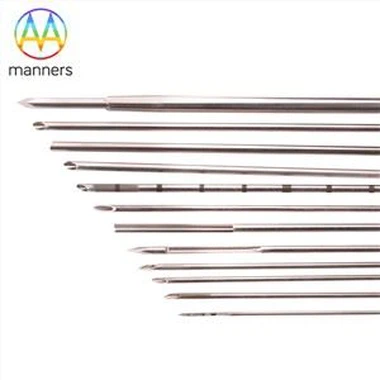
The research on the dynamics of needle tip jet flow indicates that after the liquid medicine leaves the needle tip, it forms three typical flow states: continuous jet (We > 100), droplet flow (4 < We < 100), and atomized flow (We < 4). The Weber number We = ρv²d/γ represents the ratio of inertial force to surface tension. The optimal state for insulin injection is the droplet flow with We = 20 - 40, at which the droplet diameter is approximately 0.5 - 0.8 mm, forming an ideal deposition area in the tissue. Computational fluid dynamics simulation shows that the diffusion angle of the liquid flow generated by the five-slope needle tip is 8 - 12°, while that of the traditional slope needle tip is 15 - 20°, indicating that the new design can reduce the distribution range of the liquid medicine by 40%.
The non-Newtonian properties of blood during collection require special handling. Blood exhibits shear thinning behavior at low shear rates, with the apparent viscosity dropping from 4-5 cP at rest to 3-3.5 cP at a shear rate of 100 s⁻¹. The design of vacuum blood collection systems needs to be precisely matched: for blood with a hematocrit of 45%, at a 21G needle and -40 kPa negative pressure, the shear rate is approximately 3000 s⁻¹. At this point, the blood is approximately a Newtonian fluid (with a viscosity of 3.2 cP), and the flow rate can reach 40 ml/min. If a 25G fine needle is used, the shear rate increases to 12000 s⁻¹ at the same negative pressure, which may trigger shear-induced platelet activation.
Drug-narrow interaction is crucial for stability. Protein-based drugs adhere to metal surfaces following the Langmuir isotherm. The maximum adsorption capacity of 316L stainless steel for insulin is approximately 0.8 μg/cm². A silicone coating can reduce the adsorption to 0.2 μg/cm², but it may release silicone oil droplets (with a diameter of 0.5 - 5 μm), triggering an immune response. The newly developed covalently bonded polyethylene glycol (PEG) coating forms a 2-3 nm molecular brush by sulfur醇-gold bonding on the inner wall of the needle tube, resulting in a protein adsorption capacity of less than 0.05 μg/cm² and no leachable substances.
Turbulence control is crucial for certain drugs. Large molecule drugs such as monoclonal antibodies may undergo conformational changes when the shear rate is greater than 10,000 s⁻¹. The new laminar needle incorporates spiral guide plates in the lumen, converting the flow energy into rotational kinetic energy, thereby keeping the shear rate below 5,000 s⁻¹. Animal experiments have shown that after trastuzumab was injected through the traditional needle, the antigen binding activity decreased by 8%, while it decreased by only 2% when injected through the laminar needle. This design also reduces cavitation phenomena and reduces the generation of microbubbles from the conventional 0.3 ml/min to 0.05 ml/min.