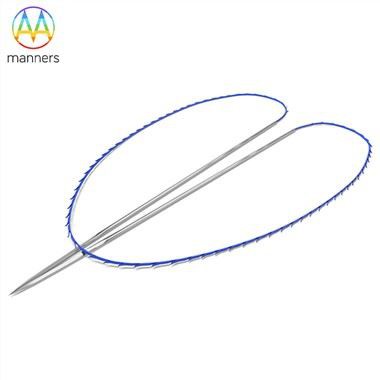
Electropolishing Process Of Radioactive Particle Localization Needles
Aug 07, 2026
Solve Insufficient Sharpness and Poor Biostability
1. Industry Pain Points Traditional mechanically polished puncture needles have obvious defects such as uneven needle tip sharpness, residual microscopic burrs and inconsistent surface finish. Unpolished rough needle tips require large puncture force, causing excessive extrusion and tearing of human tissues, increasing intraoperative bleeding and postoperative pain. In addition, mechanical polishing easily produces metal surface stress and tiny cracks, leading to poor corrosion resistance. After sterilization and body fluid contact, oxidation and metal precipitation may occur, causing tissue irritation and low biocompatibility. Unstable sharpness also leads to inconsistent puncture effect of different needle bodies, affecting surgical standardization.
2. Working Principle Radioactive particle localization needles adopt professional electropolishing technology as the core surface treatment process. Different from mechanical physical polishing, electropolishing realizes electrochemical uniform leveling of the needle body surface, completely removing microscopic burrs, machining traces and surface stress layers. The treatment forms a smooth and dense protective film on the stainless steel surface, improving surface finish, corrosion resistance and oxidation resistance. For needle tip parts, precise electropolishing ensures uniform ultra-sharp bevel angle, stable cutting performance and minimal puncture trauma, while optimizing overall biocompatibility and sterilization stability of the needle body.
3. Product Classification According to electropolishing precision and application scenarios, products are divided into conventional electropolished needles and high-precision full electropolished needles. Conventional electropolished needles only polish key parts such as needle tips and inner walls, meeting basic sharpness and smoothness requirements for routine surgery. Full electropolished needles realize overall internal and external integrated electrolytic treatment, with zero stress, zero burr and super corrosion resistance, suitable for high-standard sterile operating rooms, repeated use and high-risk delicate tumor surgery scenarios.
4. Practical Operation Standards Select polishing grades based on surgical precision and sterile requirements. Routine general tumor implantation adopts conventional electropolished needles; delicate parts such as brain, neck and chest tumors and high-standard sterile surgery must use full electropolished needles. Before operation, check needle tip sharpness and surface smoothness to ensure no burrs or passivation. Adopt standard sterilization procedures adapted to electropolished surfaces to avoid surface layer damage. Utilize ultra-sharp and smooth advantages to complete one-time rapid and low-trauma puncture, reducing tissue extrusion damage.
5. Industry Application Experience Clinical practice proves that electropolished radioactive particle localization needles have uniform and lasting sharpness, effectively reducing surgical puncture trauma and improving patient comfort. The smooth passive film formed by electrolytic treatment avoids metal ion precipitation and tissue irritation, with excellent biocompatibility and zero foreign body reaction. The anti-oxidation and anti-corrosion performance ensures stable product performance after long-term repeated sterilization, solving the problem of easy passivation and unstable quality of traditional mechanically polished needles.
6. Summary Insufficient sharpness, residual burrs and poor biostability caused by backward polishing processes are common quality defects of traditional brachytherapy needles. Electropolishing technology of radioactive particle localization needles realizes ultra-smooth and ultra-sharp optimization of needle body structure, improves surgical low-trauma performance and biological safety. Graded polishing products meet different clinical grade requirements, providing stable and reliable quality guarantee for standardized minimally invasive brachytherapy.
7. Future Prospect With the continuous improvement of medical device biocompatibility standards, electrolytic polishing technology will develop toward ultra-precision nano-level treatment and intelligent uniform processing. Future products will achieve zero-defect surface quality and permanent sterilization stability, further reduce surgical trauma, improve biological safety, and drive the industry's surface processing technology to a higher standardized and refined level.
https://apgar.dk/wp-content/uploads/2019/06/10292014-RSLN-IFU-Rev-D.pdf