Echogenic Needles For Safe Regional Anesthesia in Pediatric Patients: Clinical Applications
Aug 13, 2026
https://www.nature.com/articles/s41598-024-72620-8
1. Clinical Pain Points
Pediatric surgical anesthesia has extremely strict safety and minimally invasive requirements due to children's delicate physiological characteristics. Children's peripheral nerves are thin and fragile, subcutaneous fat is thin, and nerve distribution is shallow and dense. Traditional ordinary needle nerve block has poor ultrasound visualization effect, and slight puncture deviation is easy to cause nerve contusion, vascular rupture and local hematoma. Children's nervous system is sensitive, and excessive local anesthetic dosage or inaccurate injection position is easy to cause drug poisoning and respiratory adverse reactions. In addition, children cannot cooperate with intraoperative pain feedback, and single ultrasound guidance cannot accurately judge the distance between the needle tip and nerve tissue, which easily leads to excessive puncture compression nerve or insufficient block depth. Traditional anesthesia technology has high operation risk and low safety tolerance, which restricts the development of pediatric minimally invasive surgery.
2. Product Core Working Principle
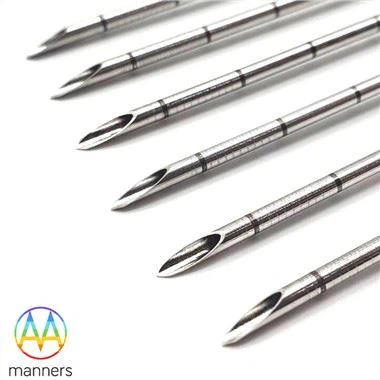
Echogenic Needle for Nerve Block is specially adapted to pediatric delicate anesthesia scenarios through dual safe positioning technology. The optimized laser echo enhancement structure enables the ultra-fine needle body to present ultra-clear high-brightness images in children's shallow soft tissues, realizing full-process micro-monitoring of needle entry trajectory and real-time fine adjustment of puncture position, avoiding nerve and tissue damage caused by excessive puncture. The electrical nerve stimulation system supports ultra-low intensity current output, which can induce mild and safe nerve reflex responses without damaging children's delicate nerve tissues. Clinicians verify the needle tip proximity through weak nerve electrical feedback to realize ultra-precise positioning. The dual-mode complementary technology of visual imaging and low-intensity nerve feedback minimizes puncture trauma and drug dosage, realizing the highest standard of safe and precise pediatric nerve block anesthesia.
3. Product Specification Classification for Pediatrics
According to pediatric age, weight and surgical trauma degree, echogenic needles form a hierarchical pediatric special specification system. The 25G-26G ultra-fine infant specifications are suitable for newborn and infant minor surgery nerve block, with minimal puncture trauma and zero nerve compression risk, meeting the ultra-high safety requirements of infant anesthesia. The 23G-24G children's conventional specifications are applied to school-age children's limb and trunk surgery anesthesia, balancing puncture stability and minimally invasive performance. All pediatric products adopt high-purity medical stainless steel,经过 super fine electropolishing treatment with smooth needle tip and no burr, low puncture resistance and less tissue damage. After strict sterile treatment, they support disposable safe use, and can customize sizes and packaging according to pediatric clinical needs.
4. Pediatric Standard Anesthesia Operation Guidelines
Before pediatric nerve block, select ultra-fine matched needle specifications according to the child's age and weight, complete preoperative sedation and vital sign real-time monitoring. Fix the child's limbs and body position to avoid body movement affecting puncture accuracy. Use high-frequency ultra-high resolution ultrasound probe to finely scan superficial target nerves and surrounding tiny blood vessels, clarify the anatomical hierarchy. Adopt ultra-slow micro-puncture in-plane technique to advance the needle stably, monitor the needle tip micro-position in real time through high-definition echo images. Turn on the ultra-low intensity nerve stimulation mode, confirm targeted nerve mild response to verify accurate needle tip positioning. After negative pressure aspiration is negative, inject local anesthetic in micro-dosage and multiple times, observe the uniform diffusion of low-concentration drugs around the nerve, confirm no vascular infiltration and nerve compression, and complete the safe block operation.
5. Pediatric Clinical Application Experience
Clinical application in pediatric anesthesia fully verifies the superior safety of dual-technology echogenic needles. Compared with traditional ordinary needles, the puncture trauma of pediatric nerve block is reduced by more than 80%, and the incidence of postoperative local swelling, bleeding and nerve irritation complications is reduced to below 2%. The dual precise positioning technology increases the one-time puncture success rate of pediatric nerve block from 80% to 99%, completely avoiding repeated puncture pain and psychological fear in children. Accurate positioning achieves precise drug delivery, reducing pediatric local anesthetic dosage by 25%-30%, effectively reducing the risk of drug adverse reactions. Children have stable intraoperative anesthesia, low postoperative agitation rate, fast sensory and motor function recovery, and significantly improved perioperative safety and comfort.
6. Summary and Safety Sublimation
Pediatric regional anesthesia is a high-precision and high-risk clinical operation, which puts forward extremely strict requirements for puncture safety, positioning accuracy and drug control. Traditional puncture tools and single guidance technology are difficult to adapt to the physiological characteristics of children's delicate nerves and tissues. Echogenic nerve block needles rely on ultra-fine minimally invasive design and dual-mode safe positioning technology to solve the core pain points of easy injury, low accuracy and high drug risk in pediatric anesthesia. It realizes safe, minimally invasive and precise pediatric regional anesthesia, protects children's nerve development, and provides reliable technical support for the rapid development of pediatric minimally invasive surgery.
7. Future Pediatric Anesthesia Application Suggestions
With the popularization of pediatric day surgery and minimally invasive technology, the clinical demand for safe regional anesthesia is increasing. It is suggested that children's specialized hospitals fully popularize pediatric special ultra-fine echogenic needles and formulate exclusive pediatric nerve block operation specifications. Strengthen professional training for pediatric anesthesiologists on micro-puncture and low-intensity nerve stimulation operation skills. Manufacturers should continue to optimize the echo performance of ultra-fine needles, develop more delicate infant special specifications, and further improve the safety of early childhood anesthesia. At the same time, establish long-term clinical follow-up data to continuously verify the long-term safety of echogenic needles in pediatric nerve block application.