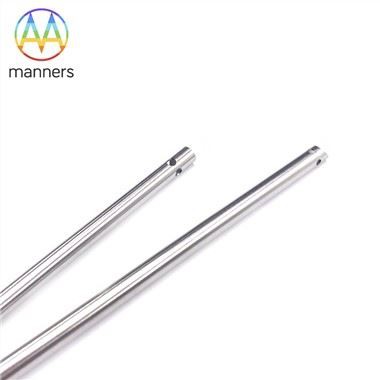
Disposable Nerve Block Needles: Echo Markers And Shaft Design
Nov 29, 2026
The needle is the hardest object in the ultrasound field to see. It is thin, straight, and reflective only when the beam strikes it at the right angle, and the angle changes constantly while it advances. Every design decision in an echogenic shaft exists to answer that single problem, and the difference between a device that is easy to follow and one that keeps disappearing is usually engineering rather than luck.
Clinical Challenge: Losing the Tip at the Wrong Moment
In-plane needling fails in a recognisable way. The shaft shows clearly near the surface, then fades as the angle steepens, and the operator advances the last few centimetres without visual confirmation. That is the interval in which an unintended puncture happens, and it happens most often in deeper blocks where the target is far from the probe and the angle is necessarily steep.
Out-of-plane needling has the mirror problem. The needle appears as a dot that may be the tip, the shaft, or a reflection, and the operator cannot distinguish between them without moving the needle. A shaft with a deliberate, asymmetric marker resolves that ambiguity because the pattern changes as the needle advances, which is precisely the information the operator needs and cannot otherwise obtain.
Working Principle: How a Surface Returns a Signal
Ultrasound reflection depends on the acoustic impedance difference between materials and on the angle of incidence. A smooth steel cylinder reflects strongly only when the beam is perpendicular, which for a steep needle means almost never. The remedy is to create features on the surface that scatter the beam in many directions, so that a portion of the returning energy reaches the transducer regardless of the incident angle.
Three approaches are common. Machining a series of circumferential grooves creates multiple reflecting facets at different orientations, which is robust across angles but can increase friction. Laser etching produces a controlled pattern of small dimples or a helical marking with similar effect and less mechanical disturbance to the shaft. Adding a discrete tip marker, such as a band of differing surface finish or an internal stylet feature, gives a distinct signature at the point that matters most.
Shaft design interacts with all of this. Wall thickness determines how much material is available for the pattern, and a thin wall limits depth of etching. The alloy determines how the surface responds to polishing, and the temper determines whether the shaft can be straightened accurately after the pattern is applied. A design that improves visibility at the cost of straightness is a net loss, which is why these properties have to be specified together rather than one at a time.
Product Classification and Specification Choices
Visibility specifications should be written in terms the operator can verify on a phantom.
|
Feature |
Design Options |
Practical Effect |
|
Echogenic pattern |
Circumferential grooves, laser dimples, helix |
Signal strength across incident angles |
|
Tip marker |
Contrasting band, internal reflector, facet |
Tip identification out of plane |
|
Gauge range |
8G to 26G, custom sizes |
Pattern depth constrained by wall thickness |
|
Shaft length |
25 mm to 150 mm, custom |
Longer shafts suffer more angle loss |
|
Wall type |
Thin wall, regular wall |
Visibility against stiffness and flow rate |
|
Surface finish |
Electropolished with pattern retained |
Low friction without losing echogenicity |
|
Depth marking |
Laser graduations every 10 mm |
Depth without leaving the image |
|
Hub type |
Luer lock or fixed |
Secure injection and stable orientation |
Two trade-offs deserve comment. First, more aggressive surface features return a brighter signal but increase insertion resistance, and the balance point is different for a 25 mm superficial needle and a 150 mm deep one. Second, depth markings must be applied in a way that leaves them visible after sterilization and does not create a smooth band that disappears under ultrasound; laser marking on an already patterned shaft usually achieves both.
Practical Technique: Getting the Best From the Design
Beam steering is the operator's contribution to visibility. Tilt the probe slightly away from the needle so the beam meets the shaft closer to perpendicular, and accept the small loss of image quality elsewhere in exchange for a clear shaft. With an echogenic device this adjustment is subtle; with a smooth one it is essential, which is a useful way to judge whether the pattern is doing its job.
Hydrodissection helps more than any setting. A small injection of fluid or local anesthetic opens a plane and creates an acoustic window along the shaft, and the needle becomes visible as a bright line inside a dark space. Use it early rather than as a rescue, and the pattern on the shaft will do the rest.
For out-of-plane approaches, move the needle rather than the probe. Watch for the marker to appear as a defined element that advances with each increment, and confirm the tip position by injecting a small volume and observing the spread. If the marker does not behave as expected, the needle may be outside the plane, and continuing without correction is the beginning of the failure described earlier.
Cost and Operational Experience: Value Visible in Seconds
Better visibility returns time in every case. The operator who finds the shaft immediately saves perhaps twenty seconds in an easy block and several minutes in a difficult one, and the difficult cases are where the schedule is lost. Across a year, the difference between a patterned shaft and a smooth one is likely to exceed the price gap between them, though the calculation is rarely done because the saving is invisible on an invoice.
There is a training cost to poor visibility as well. Trainees who cannot see the needle confidently advance more slowly, ask for more supervision, and take longer to reach independent practice. A device that is easy to follow shortens that curve, and the effect compounds through the cohort. Departments that invest in echogenic devices usually find the benefit most visible in their teaching lists rather than in their easiest ones.
The reverse risk is over-specification. A pattern optimised for a deep block may add friction that is undesirable in a fine superficial needle, so the specification should match the pattern to the size and the intended approach rather than applying one design across a range.
Disposable Nerve Block Needles bring a second benefit to this discussion: because each unit is used once, the pattern is used as manufactured. A reprocessed shaft accumulates cleaning marks, deposits, and micro-abrasion that scatter the beam unpredictably, and the operator has no way to know how the surface will behave until the needle is already in tissue. Uniform, single-use surfaces make the echo signature something the department can plan around rather than something it hopes for.
Matching the pattern to the approach also changes how lists are organised. A block performed with a steep in-plane trajectory benefits from the strongest circumferential design in the range, while a shallow superficial block benefits from a smoother, lower-friction shaft with clear depth graduations. Holding both in stock, rather than compromising on one, is usually cheaper than the repeat passes that a poor match produces.
Procurement and Compliance: Testing Visibility Rather Than Accepting It
Ask for visibility data rather than a description. A supplier should be able to provide images or measurements showing signal strength at defined angles, and the claim should be tied to the specific gauge and length being purchased, since the pattern depth varies with wall thickness. Where such data is unavailable, a phantom test performed by your own operators with the actual product is the next best evidence.
Include handling in the evaluation. Insertion force through a tissue phantom, the feel of the pattern against resistance, and the legibility of depth markings after sterilization all matter, and all can be assessed in an afternoon. Record the results against a named comparator so the decision is documented, and keep the samples for reference when the next review arrives. A short written note of what was tested, by whom, and at what angle costs an hour and settles the question for years.
Documentation should confirm that the laser marking or etching does not compromise the sterile barrier, that the pattern survives the declared sterilization method, and that the stainless steel grade is stated for the shaft. If the device is intended for stimulation, the insulation and tip exposure need their own specification, since a surface pattern and an insulating coating are not always compatible.
Conclusion: Visibility Is a Specification
The ability to see the needle is not a bonus feature; it is the property that makes the technique safe. A shaft designed to return signal across angles and a tip marker that identifies the point of the needle together convert ultrasound guidance from an aspiration into a routine. That property can be specified, tested, and compared, and it should be.
The practical rule is to match the pattern to the work. Deep, steep approaches need the strongest and most angle-tolerant design; superficial work needs low friction and clear depth marks. Once the match is right, the operator's attention returns to the anatomy, which is where it belongs.
Future Trends: Machine Vision and Passive Markers
Automated needle tracking is moving from laboratory demonstration into clinical trials, and it depends entirely on the device having a consistent signature. Algorithms trained on one pattern will not perform on another, which means hospitals adopting these systems will have a strong reason to standardise their stock on a single echogenic design.
Marker technology is developing in parallel. Passive resonators and textured surfaces that respond across a wider angular range than conventional grooves are under investigation, and thinner walls made possible by improved alloys will allow deeper patterns without sacrificing stiffness. Both directions reward the same discipline: specify visibility explicitly, verify it on a phantom, and keep the specification stable as imaging technology advances.