Diamond Tip Bone Marrow Biopsy Needle: The Extraction Cord
Nov 21, 2026
Meta description: How the extraction cord on a diamond tip bone marrow biopsy needle measures core length and removes the specimen without shear.
The core is most vulnerable after it has been cut. It sits inside a narrow tube, attached to nothing, and the next action decides whether it reaches the laboratory intact. An extraction cord addresses that moment by giving the operator a controlled way to measure and remove the specimen, rather than pushing or tapping it out.
Where Specimens Are Lost
Loss happens in small ways. The core sticks to a rough bore and is pushed out in pieces. The stylet is reinserted and shears the specimen. The needle is tapped against a container rim, and the core falls onto the drape. Each of these actions is a response to not having a dedicated extraction tool.
Measurement is the second gap. Depth markings on the cannula describe how far the needle travelled, not how much tissue was collected. Without knowing the core length, the operator cannot judge whether the sample is adequate, and the laboratory cannot correlate fragmentation with technique. A cord that is graduated or indexed closes that gap.
A third gap is contamination. A core pushed onto a drape or handled with gloves passes through surfaces that are not sterile. A cord that keeps the specimen within the controlled path of the cannula and guide reduces handling, and handling is where most contamination and drying occur.
How the Cord Works
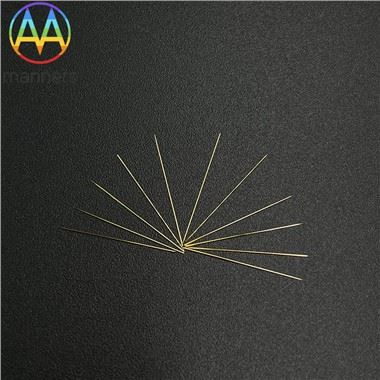
An extraction cord runs through the cannula or alongside the stylet and connects to the specimen or to a retrieval element at the distal end. When the needle is withdrawn, the cord allows the core to be drawn out along the axis of the bore rather than pushed from behind. Axial extraction avoids the ledge effect that occurs when a specimen meets a step in the lumen.
Graduations on the cord provide a length reference. As the core emerges, the operator can read the exposed length and record it before fixation. The cord also keeps the specimen under control during transfer, reducing the chance of dropping it or losing it in gauze. For a procedure where the diagnostic yield depends on a single core, that control is disproportionately valuable.
The system must be designed as a whole. Cord diameter, tensile strength and knot or connector geometry determine whether it pulls smoothly or bunches. A cord that is too thick increases friction; one that is too thin can break under tension. The cannula bore, the cord and the retrieval element therefore need to be qualified together rather than assembled from independent parts.
Friction is the hidden variable. A cord made from a material that swells in contact with blood will tighten inside the bore, and the operator will feel resistance that looks like a blocked specimen. Hydrophobic coatings can reduce that effect, but they must be biocompatible and must not shed into the sample. Where a coating is used, extraction force should be measured before and after simulated use.
Classifying Extraction Systems
Extraction systems fall into three groups: a simple guide that pushes from the proximal end, a cord that draws from the distal end, and a combined system that offers both routes. Guides are simple and inexpensive but rely on a straight push; cords add control and measurement but require a compatible bore and connector.
Graduation style forms a second distinction. Some cords carry printed markings, others use indexed beads or a measured tail. Printed markings are easy to read but can wear; physical indices are durable but add diameter. A third distinction is single-use status: a cord integrated into a disposable needle eliminates cleaning risk, while a separate reusable cord introduces verification work.
Compatibility is the practical classification that matters most. A cord designed for one cannula may not pass a bend, may catch on a side hole, or may fail to engage a specimen of a given diameter. Buyers should require verification with the exact needle family and gauge they intend to use.
A fifth distinction is whether the cord is intended for measurement only or for retrieval as well. A measurement tail can be thin and flexible because it carries no load; a retrieval cord must transmit tension through the full length of the cannula. Combining both functions in one component requires a compromise in diameter, and that compromise should be explicit in the specification.
Practical Guide to Extraction
Confirm the cord is intact and correctly threaded before puncture. A cord that has been kinked or trapped during packaging may fail at the moment of extraction. Check that the Luer cap and safety cap are present and that the probe lock holds the stylet without compressing the cord.
After the core is cut and the needle withdrawn, release the stylet and attach the extraction element according to the instructions. Draw the cord slowly and steadily, keeping the cannula aligned with the direction of pull. If resistance rises, stop and check for a bend or a blocked side hole rather than pulling harder.
Read the length as the specimen emerges, place it directly into fixative, and record both length and any fragmentation. Do not let the core rest on gauze, where it will dry and distort. Dispose of the needle and cord as a single sharps unit if the design is single-use.
Field Experience
The most common cord failure is not breakage but bunching. A cord that is slightly oversized for the bore folds on itself when pushed, and the fold becomes a plug. Sizing and surface finish solve the problem, but both must be specified; a supplier who treats the cord as an accessory will produce an inconsistent system.
Measurement discipline improves with use. Once operators record core length routinely, they begin to notice the relationship between depth, gauge and yield. That feedback is more useful than a general instruction to take an adequate sample, because it ties technique to a number that can be reviewed.
Single-use integration is the direction most units prefer. A cord supplied sterile with the needle removes cleaning, prevents cross-contamination and ensures compatibility. The cost is borne per procedure, but it replaces the hidden cost of a lost specimen and a repeat biopsy.
Documentation of cord performance is thin across the industry. Few suppliers publish extraction force or failure rates, and buyers rarely ask. A simple bench test, pulling a simulated core through the bore and recording peak force, would give procurement a basis for comparison and give manufacturing a target for surface finish.
Summary
An extraction cord turns removal into a controlled, measurable action. It draws the core along the bore axis, reduces shear and gives the operator a length reference before fixation. The benefit depends on cord sizing, bore compatibility and a connector that engages without damage.
Outlook
Integrated extraction systems are likely to become standard in single-use kits, with cords pre-threaded and graduations printed at the point of manufacture. That reduces assembly errors and makes the measurement step part of the routine rather than an optional extra. It also removes a small but real risk: a cord that is threaded in a hurry can kink, and a kinked cord fails when tension is applied.
There is also room for specimen containers designed around the cord, so that the core can be lowered into fixative without being handled. Such packaging innovation addresses a small step that has a large effect on sample quality.
Standardisation of measurement would help as well. If core length were recorded in a consistent way, with a defined start and end point, units could compare their results with published data and with their own historical performance. At present, many records say only that a core was obtained, which is not enough to reveal a slow decline in needle performance.
Designers should also consider how the cord behaves at the end of extraction. A tail that remains attached to the specimen can pull it out of the container or tip it onto the bench, undoing the care taken during removal. A releasable connector, or a cord that is shorter than the container depth, prevents that final mishap.