Detailed Explanation Of Thin-Wall Drawing, Obturator Grinding, And Electropolishing Processes For Laparoscopic Cannulas
Jul 01, 2026
https://www.laparoscopyhospital.com/v5.htm
A laparoscopic cannula appears to be just a perforated metal tube, but its manufacturing difficulty far exceeds that of ordinary puncture needles or catheters. Its core challenges lie in an extremely high aspect ratio (length-to-diameter ratio often exceeding 150:1), a mirror-smooth inner lumen requirement (to prevent instrument sticking during insertion/withdrawal), and extremely tight outer diameter tolerances (requiring perfect fit with seals and obturators). Typical specifications include outer diameters of 5 mm, 10 mm, and 12 mm, with thin-wall structures having wall thicknesses controlled between 0.15-0.30 mm, and lengths ranging from 70 mm to 150 mm.
The entire manufacturing process begins with the precision preparation of tube blanks. Manufacturers must select medical-grade 304, 316L stainless steel, or titanium alloy bar stock. For thin-walled cannulas, centerless grinders are typically used to first reduce the outer diameter to near size, followed by progressive drawing through multiple cold-drawing dies to achieve the target outer and inner diameters. During this process, wall thickness tolerance must be controlled within ±0.01 mm, while straightness requirements are extremely high (bending must not exceed 0.1 mm per 100 mm length). Poor straightness causes the cannula to deflect during puncture, increasing tissue damage risk and causing uneven resistance when inserting instruments.
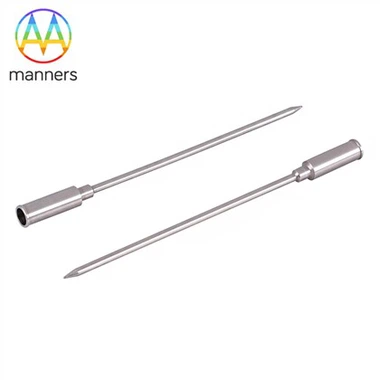
Next comes obturator forming and assembly. For detachable obturators (whether pyramidal or blunt conical), CNC lathes and 5-axis grinders are required for precision machining to ensure symmetrical geometry and appropriate tip sharpness. The connection between the obturator and cannula body is usually brazed or laser welded. After welding, helium leak testing must be performed to ensure absolutely no micro-gaps at the seams-because during surgery, if blood or irrigation fluid seeps into the interlayer, it is not only difficult to clean but may also become a breeding ground for bacteria.
Surface treatment is the key to the tactile feel. Both the inner and outer surfaces of the cannula must undergo electropolishing to reduce surface roughness (Ra) below 0.2 μm. Especially for the inner lumen, a near-mirror finish must be achieved so that surgeons experience smooth, unimpeded movement when exchanging instruments like electrocautery hooks and grasping forceps, avoiding operational delays caused by frictional resistance. The outer surface can be sandblasted to a matte finish (reducing surgical light glare interference) or kept bright, depending on requirements.
The final quality control stage is extremely rigorous. In addition to routine AOI (Automated Optical Inspection) checking obturator symmetry and CMM (Coordinate Measuring Machine) measuring dimensions, torque testing (bending strength ≥ 5 N·m without breaking) and simulated puncture testing are also required. Only laparoscopic cannula manufacturers capable of independently controlling the entire process chain of "thin-wall tube drawing → precision welding → electropolishing" possess true core competitiveness; factories that merely outsource semi-finished products for simple assembly often cannot stably control inner wall smoothness and obturator fit-this is the critical dividing line that high-end OEM brands value most when selecting suppliers.