Degenerative Spines And Medical Quincke Tip Spinal Needles
Nov 26, 2026
The elderly patient is positioned, the landmarks are marked, the needle is advanced, and instead of the expected progression of soft-then-firm-then-give, nothing informative happens. The needle meets dense resistance and then passes suddenly, or it deflects sideways and never reaches the space at all. Degenerative change is the most common reason a spinal becomes difficult, and it is also the reason equipment choice deserves more thought than it usually receives.
The Problem: When Landmarks Stop Predicting Anatomy
Degeneration attacks the very structures that make a lumbar puncture teachable. The spinous processes become less prominent, the interspinous ligaments calcify, the ligamentum flavum thickens and loses its distinct edge, and osteophytes grow at the margins of the vertebral bodies and facet joints. A landmark that reliably indicated the L3/L4 interspace in a young patient may point at a different level in an eighty-year-old with scoliosis and a compressed disc space.
The clinical result is a procedure that fails without obvious cause. The operator is confident about the level, the needle is long enough, and still no fluid appears. Under that uncertainty, the usual responses are to push harder, to redirect repeatedly along the same tract, or to convert to a completely different technique after several attempts. Each of these has costs that accumulate quickly in an older patient who may not tolerate prolonged positioning.
Why Calcified Tissue Changes the Mechanics
Normal ligamentum flavum provides a characteristic elastic resistance that ends in a distinct release as the needle enters the epidural space. Calcification replaces that elastic tissue with a dense, sometimes bony barrier that must be penetrated by pressure rather than by feel. The needle then advances through the barrier in a single uncontrolled movement, and the tip can pass through the dura and into the subarachnoid space before the operator has time to stop.
Osteophytes introduce a different problem, because they deflect rather than resist. A bevel encountering a bony margin will tend to slide along it, and the shaft bends slightly while the tip travels laterally. The operator feels continuing resistance, interprets it as depth, and continues advancing along a path that is no longer directed at the subarachnoid space. Stainless steel helps here, since a cannula stiff enough to transmit feel without permanent deformation allows the operator to detect that lateral drift.
Scoliosis and prior surgery add a third element: the space itself may be narrowed or obliterated at the chosen level, so that a technically perfect puncture at that level cannot succeed. The solution in these cases is not more force at the same spot but a different level or a different trajectory.
Choosing Equipment for a Difficult Spine
Length is the first decision. A standard 90mm needle covers most adults, but when the space is deep or the approach is paramedian and oblique, the additional distance can exceed what a standard needle comfortably reaches. For Medical Quincke Tip Spinal Needles, custom lengths exist precisely for this situation. Choosing a longer needle before the attempt is far safer than discovering the limit mid-procedure and advancing with pressure to gain the last few millimeters.
Gauge involves a genuine trade-off. Smaller gauges reduce headache risk but flex more under load and transmit less force through calcified tissue, which makes them harder to place in a degenerative spine. A pragmatic approach is to use a slightly larger gauge for the first attempt in a patient whose anatomy is known to be difficult, then convert to a smaller gauge only if the first attempt confirms an easy trajectory. The headache risk from one clean 22G pass is lower than from four attempts with a 27G needle that will not penetrate, a trade-off that anesthesia trainees are rarely taught explicitly.
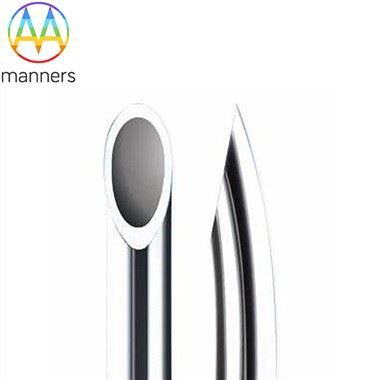
Tip geometry deserves equal attention. A Quincke Point cutting bevel penetrates calcified ligament more readily than a blunt Pencil Point tip, which relies on separation and therefore requires greater axial force in dense tissue. When headache prevention is a priority, a Pencil Point needle can still be used, but the operator should expect a firmer feel and should not interpret that firmness as a need to push abruptly.
Color-coded hubs across the twelve gauge steps from 16G to 27G are a practical advantage in these cases, because a difficult spine often requires changing gauge mid-procedure and the color band confirms the switch without reading fine print.
A Practical Guide to the Degenerative Lumbar Puncture
Assess before you touch. Ask about previous spinal procedures and their difficulty, inspect the back for scoliosis and surgical scars, and palpate for the iliac crest line to identify the L3/L4 level rather than assuming it. If the anatomy is clearly distorted, plan a paramedian approach from the outset instead of discovering the need after two failed midline passes.
Position with intention. A sitting position with the back flexed opens the posterior interspaces more reliably in a stiff spine than a lateral position, and it allows an assistant to stabilize the patient. Take time over positioning; it is the least invasive way to improve the mechanics.
Advance with a walk, not a push. Move in small increments, checking resistance at each step, and keep the stylet seated until the estimated depth of the ligamentum flavum. If resistance increases without any give, stop and reassess the trajectory rather than applying more force. A needle that will not advance is telling you that the path is wrong, not that the effort is insufficient.
Use imaging when the anatomy is unclear. Ultrasound can identify the level, the depth to the ligamentum flavum and the presence of midline ossification, and it converts a blind attempt into a planned one. When ultrasound is unavailable, a paramedian trajectory that bypasses the calcified midline is often the most efficient alternative.
Set an attempt limit in advance. After two unsuccessful trajectories, change something structural: the level, the approach, the gauge or the operator. Repeated attempts at the same target in the same tissue cause the most harm.
What Experience With Stiff Spines Shows
The most common pattern is a patient in whom a first attempt fails at what seemed a clearly identified level, and a second attempt one space lower succeeds easily. The level was the problem, not the needle. The second most common is a sudden, unheralded advance through a calcified ligament followed by a dense block that required resuscitation, a sequence that a gentler tactile approach and a smaller final increment would have prevented.
A third pattern is under-appreciation of depth in patients with high body mass index combined with degeneration. Standard-length needles reach the ligament and no further, and the resulting struggle is misread as bony obstruction. A custom length resolves it in one pass. Recording the level used and the trajectory that succeeded also shortens the next procedure for the same patient, which matters in anyone likely to return for repeat sampling.
Summary
Degenerative change removes the tactile landmarks that make lumbar puncture predictable, substituting dense calcified barriers, deflecting osteophytes and narrowed spaces. Success depends less on force than on planning: correct level, appropriate trajectory, adequate length, a gauge chosen for the tissue rather than for the label, and a tip geometry whose behavior the operator anticipates. A custom-length stainless steel needle and a willingness to change approach after two attempts solve most of these cases.
Looking Ahead
The trend in difficult-spine management is toward pre-procedure imaging and protocolized escalation rather than heroic persistence. That shift increases demand for equipment flexibility: needles available in every step from 16G to 27G with unambiguous color coding, Quincke Point and Pencil Point tips in matched lengths, and custom lengths specified from 2D or 3D drawings or physical samples so that departments can match local anatomy and technique. Standard carton packaging keeps such a broad range manageable in storage, and consistent labeling ensures that the needle selected for a difficult spine is the one the plan called for.