Deconstructing EBUS-TBNA Needle Price—Materials, Precision Machining, And Process Costs
Jul 08, 2026
https://profed.olympuschina.com/gs/thoracicsurgery/12628/
Understanding the formation mechanism of the EBUS-TBNA Needle Price requires looking beyond the finished product quote into its manufacturing value chain-from raw material selection, precision grinding, and laser etching to electropolishing and sterile packaging. Each step directly influences the final cost. Using a typical 19G EBUS-TBNA needle (ID 0.86mm / OD 1.06mm / L 115mm / Back-Cut Point / SS304 or Nitinol) as an example, this section dissects its Bill of Materials (BOM) and processing cost structure.
Material 1: Medical-Grade Stainless Steel Tube (304V / 316L). ASTM F899 standard medical stainless steel capillary tubing (OD 1.06mm, wall ~0.10mm) costs approx. USD 15–25/kg. The tubing required per needle is less than 0.5g, making raw material costs negligible (approx. RMB 0.1–0.3/unit). However, compliance costs increase marginally as steel requires Material Test Reports (MTRs) and incoming inspection for metallography and hardness (HV 200–250).
Material 2: Nitinol (NiTi) Shape Memory Alloy Tube. Used in premium EBUS-TBNA needles demanding higher flexibility and navigability (especially 19G histology needles), Nitinol core tubing costs USD 100–150/kg. It requires strict control of transformation temperatures (Af point), fatigue life, and superelasticity validation. The BOM material cost for a Nitinol version is 3–6 times that of the stainless steel version, making it a primary driver of high-end EBUS-TBNA Needle Prices.
Precision Grinding-Back-Cut Point Formation. EBUS-TBNA needles utilize a back-cut tip design (bevel extending to the posterior tube surface forming a cutting edge). This requires multi-step processing on CNC grinders: rough forming → primary bevel grinding → back-cut trimming → edge radiusing/deburring. Equipment depreciation (Swiss or Japanese 5-axis grinders) and skilled labor constitute the majority of processing costs. Amortized grinding cost per needle is approx. RMB 2–8/unit (mass production scale); prototype/small batch costs are significantly higher.
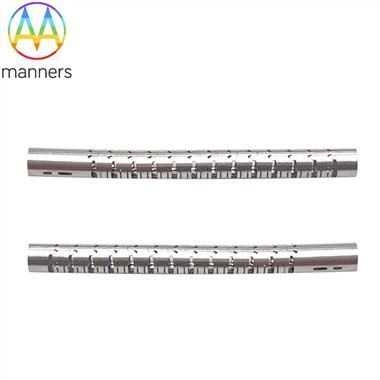
Laser Etching / Marking-Echogenic Marker Creation. To enhance ultrasound visibility, the needle shaft segment near the tip requires laser ablation of micro-helical grooves or dot matrices (groove depth 3–15μm). 5-axis laser systems ensure positioning accuracy of ±0.01mm, guaranteeing texture uniformity without compromising tube strength. Amortized laser etching cost is approx. RMB 1–3/unit. Custom logos or specialized echo patterns (for patent avoidance) incur additional tooling/programming and first-article verification fees.
Electropolishing (EP) & Ultrasonic Cleaning (USC). EP removes micro-burrs and creates a mirror finish compliant with ASTM B912/A967. USC (28–40kHz) utilizes cavitation to eliminate sub-micron contaminants. These batch-processed steps amortize to approx. RMB 0.5–1.5/unit, though operational costs for cleanrooms (ISO Class 7/8) and Water for Injection (WFI) or Ultra-Pure Water (UPW) systems represent significant overhead.
Assembly, Handle & Sterile Packaging. EBUS-TBNA needles are typically supplied as single-use kits with retractable locking handles. Costs for injection-molded handles (ABS/PC), sheaths (PEBAX/PTFE coated), seal valves, EO sterilization (or Gamma irradiation), and Tyvek blister packaging amortize to approx. RMB 15–40/unit for domestic lines. Imported brands may double this cost due to patented handle designs and stricter sterilization validation.
In summary, the total factory cost for a domestic compliant 19G EBUS-TBNA needle (Stainless Steel version, including handle + sterile packaging) ranges from RMB 25–60/unit. Nitinol versions range from RMB 50–90/unit. OEM trade quotes add gross margin and costs for certification/after-sales support, resulting in the previously mentioned wholesale market EBUS-TBNA Needle Price of USD 12–28/unit. Imported brands incorporate R&D amortization, global registration fees, brand premiums, and channel margins, pushing terminal prices to 8–15 times that of domestic equivalents.
For purchasers, evaluating suppliers should not rely solely on EBUS-TBNA Needle Price. Critical review points include: (1) Possession of ISO 13485 certificates and corresponding CE/NMPA registrations; (2) Microscopic images of Back-Cut grinding quality and puncture simulation test reports; (3) Validation of laser-etched ripple patterns via ultrasound phantom visibility testing; (4) Batch consistency records (ID/OD tolerance ±0.01mm, hardness HV 200–250 test logs). Factories possessing these capabilities, even with slightly higher prices, offer lower clinical failure and return risks, resulting in a superior Total Cost of Ownership (TCO).