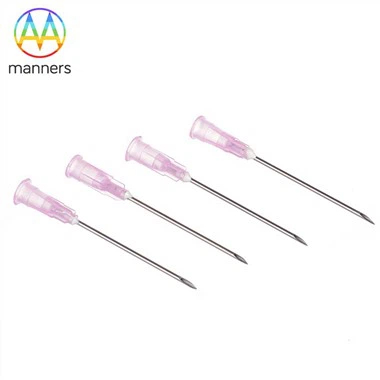
Customization Service System Of Radioactive Particle Localization Needle Manufacturers
Aug 07, 2026
1. Industry Pain Points Most traditional medical device suppliers only provide fixed standard-specification particle localization needles, with single product structure, single color and single hub style. In the face of special clinical scenarios such as special-shaped tumor lesions, personalized surgical paths, differentiated hospital management specifications and special equipment matching, standard needles cannot meet the demand. It is impossible to adjust the needle body length, needle tip angle, aperture and hub color according to actual needs, resulting in poor surgical adaptability, difficult equipment matching and chaotic classification management, which restricts the development of personalized minimally invasive brachytherapy.
2. Working Principle Professional radioactive particle localization needle manufacturers rely on flexible modular production systems and mature precision machining technology to realize full-dimensional personalized customization based on customers' 2D/3D drawings or physical samples. Through adjustable laser cutting, flexible swaging and targeted surface treatment processes, manufacturers can independently adjust product size parameters, structural forms, surface colors and identification designs. The modular production mode realizes rapid switching of different process schemes, ensuring that customized products can maintain the same high precision, smoothness and biocompatibility as standard products, realizing one-to-one precise matching of clinical personalized scenarios.
3. Product Classification Manufacturer customization services are divided into four major categories. First, size customization: including non-standard needle body length, special aperture, special gauge and needle tip angle adjustment. Second, structural customization: round hub, square hub, special bevel orientation and personalized depth scale design. Third, appearance customization: customized hub identification colors and personalized marking content to facilitate rapid classification. Fourth, scheme customization: overall configuration adjustment according to special surgical equipment and lesion characteristics, supporting full-scene personalized customization beyond standard specifications.
4. Practical Operation Standards Clinicians need to sort out personalized demand points according to preoperative surgical planning and hospital management standards, provide clear 2D/3D design drawings or physical samples to manufacturers, and clarify customized parameters such as size, structure and color. Manufacturers conduct technical verification and process optimization according to the demand, and produce sample products for clinical test. After confirming that the customized products meet the surgical matching standard, batch production is carried out. In clinical use, customized products are managed in classified files to match corresponding special surgical scenarios.
5. Industry Application Experience Customization services of formal radioactive particle localization needle manufacturers effectively make up for the limitations of standard products, perfectly adapting to special difficult tumor surgeries and personalized hospital management needs. Customized colored hubs help medical staff quickly distinguish different specifications of needles, improving operating efficiency and avoiding misuse. Special-sized customized needles solve the matching problems of special surgical paths and special equipment, greatly improving the success rate of difficult operations. The sample drawing customization mode has high fitting accuracy, short production cycle and stable product quality, which is widely praised by clinical medical institutions.
6. Summary Single standard product configuration cannot adapt to the diversified and personalized development trend of modern tumor minimally invasive surgery. Radioactive particle localization needle manufacturers build a full-dimensional customization system based on precision machining technology, covering size, structure, appearance and overall scheme customization. The flexible customization mode solves the industry pain point of poor scenario adaptability of traditional products, provides targeted equipment support for personalized clinical surgery, and enriches the application boundary of brachytherapy technology.
7. Future Prospect In the future, manufacturers will build intelligent rapid customization platforms, realize automatic parameter identification and rapid prototyping of customer drawings and samples, and greatly shorten the customization cycle. Combined with big data of clinical surgical scenarios, standardized customized module packages will be formed to realize efficient matching of personalized needs and further improve the refined level of clinical equipment application.
https://apgar.dk/wp-content/uploads/2019/06/10292014-RSLN-IFU-Rev-D.pdf