Core Technical Barriers For Quincke Spinal Needle Manufacturers
Aug 03, 2026
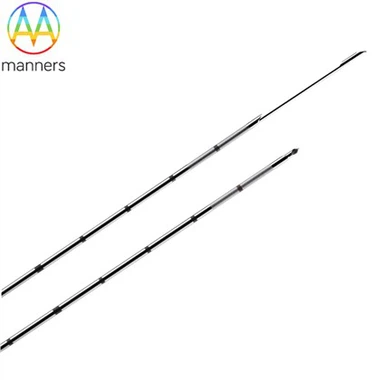
The needle tip determines puncture experience, tissue trauma and postoperative complication rate, and tip processing technology forms the core technical barrier between different Quincke Spinal Needle manufacturers. Products support two tip types: Quincke Point and Pencil Point. Different grinding equipment and process parameters lead to huge differences in finished product quality, directly influencing clinical feedback from hospitals.
The Quincke Point is a classic bevel-cut tip. High-end manufacturers adopt automatic sliding spindle grinding equipment to control the bevel angle within precise tolerance. Smooth cutting edges reduce dural fiber tearing. Inferior products have uneven grinding and tiny burrs. During lumbar puncture, burrs scratch nerve roots and soft tissues, increasing patient pain and inflammation risk. The mainstream 22G 90mm Quincke Spinal Needle mostly adopts Quincke Point for routine adult spinal anesthesia.
Pencil Point requires split blunt tip forming technology. Instead of cutting dura fibers, the tip separates fibers outward. After needle withdrawal, dural tissue rebounds naturally to lower CSF leakage risks. This technology demands higher processing precision. Many manufacturers cannot stably mass-produce qualified Pencil Point needles and only focus on Quincke Point production.
Deburring and micro-polishing are easily ignored processes. Qualified manufacturers implement multi-stage polishing for all tips, followed by ultrasonic cleaning to eliminate tiny metal particles. Many low-cost manufacturers skip fine polishing to shorten production cycles. Hidden defects will trigger adverse clinical reactions.
Manufacturers must match different tip processes with corresponding gauge parameters. Ultra-fine 25G–27G tips are easy to deform during grinding, requiring reduced grinding speed and optimized fixture design. Thick 16G–19G tips need to balance sharpness and structural strength to avoid tip fracture under heavy penetration resistance.
Global buyers should verify tip quality through sample testing before bulk orders. Observe tip smoothness under magnification and test penetration performance on simulated tissue. Reliable Quincke Spinal Needle manufacturers can provide both tip options for all sizes. Mature tip technology not only improves product competitiveness, but also helps manufacturers obtain international certifications such as FDA 510(k) and CE MDR, expanding overseas market access.