Core Clinical Pain Points & Fundamental Working Principles Of Brachytherapy Particle Implant Puncture Needles
Aug 08, 2026
1. Industry & Clinical Pain Points
CT-guided transthoracic puncture is the gold standard for modern lung tumor biopsy and brachytherapy particle implantation, yet it faces persistent operational bottlenecks caused by unqualified puncture needle performance. The most prominent pain point is mismatched needle precision during multi-scan CT dynamic adjustment. Ordinary low-grade puncture needles feature uneven tip sharpness, rough stainless steel surfaces and unstable caliber tolerance, which easily cause tissue scratching when penetrating skin, subcutaneous tissue, intercostal muscles and pleura. This leads to unnecessary intraoperative bleeding, pleural irritation and increased risk of pneumothorax. In clinical practice, repeated CT scanning and needle direction/depth adjustment are mandatory for accurate mass targeting, but inferior needles are prone to bending and deflection under tissue extrusion, resulting in prolonged surgery, increased radiation exposure and low biopsy success rate. Additionally, fixed-size conventional needles fail to adapt to individualized differences in tumor mass size, density and skin linear distance, making it difficult to achieve precise edge positioning for irregular lung lesions. Lack of fine surface treatment also causes tissue adhesion during rapid needle withdrawal, leading to incomplete tissue sampling and inaccurate particle release, which severely compromises brachytherapy treatment efficacy and pathological diagnosis accuracy.
2. Fundamental Working Principles
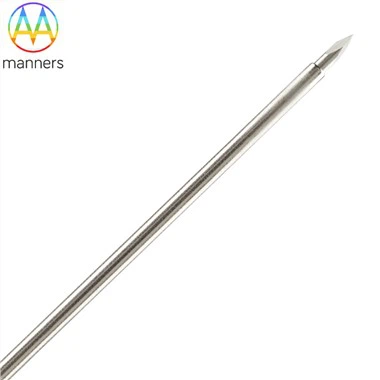
Brachytherapy particle implant puncture needles adopt medical-grade stainless steel as the base material, combining structural mechanical principles and CT-guided minimally invasive interventional medical principles to achieve high-precision, low-trauma clinical performance. Mechanically, standardized necking and swaging processes reinforce the needle body structure, enhancing rigidity and toughness to resist deformation during multi-angle adjustment and deep tissue penetration, ensuring consistent needle path alignment with CT preoperative planning. Surface finishing technologies including precision grinding and electropolishing eliminate burrs and processing residues, forming an ultra-smooth surface that minimizes friction damage to layered thoracic tissues. Medically, the graded gauge design matches different tissue densities and lesion depths: thin needles reduce vascular and pleural injury for high-risk deep masses, while thick needles improve implantation efficiency for superficial large masses. Cooperating with CT real-time scanning positioning, the needle accurately reaches the mass edge, completes stable particle implantation and tissue sampling, and coordinates with patient breath-holding cooperation to realize rapid, safe and minimally invasive puncture surgery.
3. Product Specification Classification & Scenario Matching
The product covers a full range of standard gauges including 8G, 11G, 13G, 14G, 15G, 16G, 18G and 20G, plus fully customizable sizes to cover all CT-guided puncture scenarios. Thick-gauge needles (8G–13G) feature large diameter and strong structural stability, suitable for superficial high-density lung masses and subcutaneous tumor puncture, with high particle implantation efficiency and stable performance during repeated CT adjustment. Medium-gauge universal needles (14G–16G) balance trauma and stability, adapting to most routine thoracic and abdominal tumor biopsy and particle implantation surgeries, serving as the mainstream clinical universal model. Thin-gauge precision needles (18G–20G), especially the 18G disposable biopsy needle specified in standard procedures, are dedicated to high-risk intercostal and deep lung mass surgery, effectively reducing pleural penetration damage and bleeding risk. Custom-sized products are customized based on 2D/3D lesion drawings and physical samples, adapting to special lesion depths, irregular shapes and unique skin puncture distances to fill the scenario gaps of standard products.
4. Standard CT-Guided Puncture Operational Guidelines
Combined with product structural characteristics and standardized clinical procedures, a complete set of operational specifications is formed. First, preoperative CT positioning and marking: perform full chest CT scanning to measure tumor mass size, density and the shortest linear distance from the lesion to the skin, mark CT bed numbers and accurate skin puncture points to formulate a precise puncture path. Second, preoperative sterile preparation: lay hole towels and complete standardized disinfection of the puncture area, implement local anesthesia for subcutaneous and muscular tissues to reduce intraoperative pain and tissue tension. Third, staged puncture and dynamic adjustment: select matched gauge needles to penetrate skin, subcutaneous tissue, intercostal muscles and pleura sequentially; conduct multiple CT scans to adjust needle direction and insertion depth until the needle tip accurately reaches the mass edge. Fourth, synchronous breath control and sampling: instruct patients to hold their breath stably to avoid respiratory displacement, rapidly puncture and withdraw the needle to complete lesion tissue removal for pathological examination. Fifth, postoperative CT re-scanning to verify needle path accuracy and exclude complications such as bleeding and pneumothorax.
5. Clinical Practical Application Experience
Large-scale clinical application data verifies that standardized brachytherapy particle implant puncture needles significantly optimize CT-guided puncture surgical effects compared with ordinary products. The reinforced stainless steel structure and precision processing technology reduce needle deflection and bending rate during dynamic adjustment to below 0.5%, improving the one-time puncture success rate by more than 28%. The electropolished ultra-smooth surface eliminates tissue adhesion during rapid needle withdrawal, ensuring complete and accurate lesion tissue sampling with a pathological diagnosis accuracy rate of over 97%. Graded gauge matching effectively reduces intraoperative trauma: 18G thin needles minimize intercostal vascular and pleural damage, with mild intraoperative bleeding that can achieve rapid self-coagulation without additional hemostatic intervention. Customized products perfectly adapt to complex irregular lung masses and special anatomical structure patients, solving the clinical pain point of repeated puncture and positioning failure caused by specification mismatch, greatly improving the safety and efficiency of complex brachytherapy surgeries.
6. Summary & Technical Sublimation
As the core precision medical device for CT-guided tumor brachytherapy and biopsy, brachytherapy particle implant puncture needles solve the key clinical pain points of low positioning accuracy, large surgical trauma and unstable treatment effect of traditional puncture equipment through high-quality material selection and multi-process precision manufacturing. The full-size graded product system and personalized customization capabilities realize full coverage of routine and complex lesion scenarios, and the standardized structural design perfectly matches the whole-process operational logic of modern CT positioning puncture surgery. The integration of mechanical stability and minimally invasive medical performance not only improves the precision and safety of tumor particle implantation and pathological diagnosis, but also reduces postoperative complication rates and shortens patient recovery cycles, becoming an indispensable core equipment for standardized minimally invasive treatment of thoracic tumors.
7. Industry Prospects & Optimization Suggestions
With the continuous popularization of precise minimally invasive tumor treatment and intelligent CT interventional technology, brachytherapy particle implant puncture needles present a clear high-precision and personalized development trend. In the future, product optimization should focus on scenario refinement and intelligent adaptation: first, further upgrade micron-level precision processing to reduce needle tip tolerance and improve positioning accuracy for tiny micro-lesions; second, enrich specialized specifications for different tumor densities and anatomical positions to enhance scenario matching professionalism; third, optimize surface anti-adhesion technology to further reduce tissue damage and improve sampling integrity; fourth, strengthen the integration with intelligent CT positioning systems to adapt to automated surgical development. Continuous product precision upgrading and scenario iteration will further expand the clinical application value and market competitiveness of brachytherapy puncture needles.