Clinical Value Of Radioactive Particle Localization Needles In Brachytherapy
Oct 01, 2026
1. Industry Clinical Pain Points
Traditional brachytherapy and preoperative lesion localization have long faced prominent clinical bottlenecks in precision, safety and operational efficiency. Conventional localization tools lack specialized echo-enhanced design, resulting in poor ultrasound visualization and blurred needle tip positioning during intraoperative guidance, which easily causes deviation of radioactive seed placement. Most ordinary puncture needles have rough inner and outer walls, leading to excessive friction during seed loading and deployment, prone to seed jamming, offset or incomplete release, seriously affecting the accuracy of particle implantation dose and position. Traditional needle bodies have no intuitive depth marking and bevel direction identification structure, making it difficult for clinicians to control puncture depth and angle stably, resulting in inconsistent particle placement uniformity. In addition, uncoated ordinary needles cause large tissue resistance during insertion, easily damaging normal tissues and increasing intraoperative trauma and bleeding. The lack of personalized size and structure customization cannot adapt to complex lesion locations and different tissue density scenarios, leading to low one-time success rate of particle localization, repeated operations and prolonged surgical time, restricting the standardized and precise development of modern brachytherapy.
2. Core Working Principle of Radioactive Particle Localization Needles
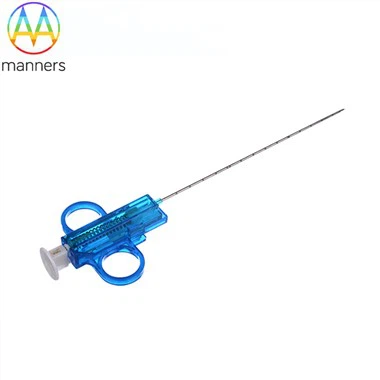
Radioactive Particle Localization Needles are professionally optimized and customized for brachytherapy and radioactive seed localization surgery, solving the core pain points of traditional equipment's low precision and poor operability. The product adopts high-quality medical stainless steel as the base material, combined with multi-process precision processing technology to realize dual optimization of puncture performance and seed deployment efficiency. The exclusive silicon coating on the outer wall greatly reduces tissue friction resistance, enabling smooth and low-trauma needle insertion and avoiding tissue tearing and vascular damage. The electropolished ultra-smooth inner diameter eliminates internal burrs and friction resistance, ensuring zero-jam stable deployment of radioactive seeds and accurate in-place release. The echo-enhanced needle tip structure strengthens ultrasonic signal feedback, making the needle tip trajectory and positioning point clearly displayed under real-time ultrasound guidance. Equipped with centimeter depth scales and foil hub orientation markers, it realizes intuitive and accurate control of puncture depth and bevel direction, ensuring high-precision and uniform placement of radioactive particles in target lesions.
3. Product Classification and Performance Characteristics
According to clinical application scenarios and structural configuration, Radioactive Particle Localization Needles are divided into routine round hub type and directional square hub type. The round hub conventional model features flexible operation and universal adaptability, suitable for routine superficial tumor lesion particle localization and brachytherapy seed implantation, with stable basic performance and high cost performance for large-scale clinical promotion. The square hub directional model is equipped with professional foil hub markers, which can accurately identify the bevel tip orientation in real time, effectively avoiding direction deviation during deep tissue puncture, specially suitable for precise localization of deep occult lesions and complex anatomical position tumors. In terms of specifications, the product covers full-size gauges from 8G to 20G, and supports personalized customization of special sizes, colors and overall configurations according to customers' 2D/3D drawings or physical samples. All products adopt integrated processing technologies including necking, swaging, laser cutting and laser marking, with stable structural performance and reliable clinical adaptability.
4. Standard Clinical Operation Guidelines
Preoperative preparation: Select matching needle gauge and hub type according to lesion depth, tissue density and surgical precision requirements. Inspect the integrity of the silicon coating, the smoothness of the inner wall, the clarity of depth scales and the effectiveness of echo-enhanced needle tip to eliminate defective products. Complete preoperative ultrasound positioning to mark the target lesion range and optimal puncture path, formulate particle implantation spacing and depth plan, and implement standardized local anesthesia. Intraoperative operation: Hold the needle body stably, perform slow and uniform-speed puncture along the preset path under real-time ultrasound guidance, observe the echo-enhanced needle tip advancement dynamically, and adjust the bevel direction accurately combined with hub markers. After reaching the preset depth and position, stably push and deploy radioactive seeds through the smooth inner cavity to ensure single-point accurate placement without offset or jamming. Postoperative processing: Slowly extract the needle body after completing particle implantation, perform local compression hemostasis and sterile dressing. Record puncture depth, seed placement quantity and position distribution in detail, and verify particle implantation accuracy through postoperative imaging review.
5. Practical Clinical Application Experience
Long-term brachytherapy and preoperative localization clinical practice verifies that Radioactive Particle Localization Needles have irreplaceable comprehensive advantages over traditional puncture instruments. The silicon coating low-resistance design greatly reduces intraoperative puncture trauma and tissue bleeding, improving patient intraoperative comfort and postoperative recovery speed. The electropolished smooth inner wall completely solves the common problem of seed jamming and incomplete release of traditional needles, and the one-time qualified rate of seed deployment reaches 99%. The echo-enhanced needle tip achieves ultra-clear ultrasound imaging display, effectively avoiding positioning deviation caused by blurred vision, and significantly improving the accuracy of lesion localization and particle implantation. The intuitive depth scales and orientation markers reduce clinician's operational difficulty, shorten surgical time by more than 30%, and avoid repeated puncture adjustments. Customized size and color configuration can meet the differentiated needs of complex surgeries and multi-lesion simultaneous localization, which is widely recognized by oncology and interventional clinical departments.
6. Summary and Sublimation
Radioactive Particle Localization Needles effectively solve the industry pain points of low positioning accuracy, poor seed deployment stability, large operational trauma and low efficiency of traditional brachytherapy localization instruments. Through innovative silicon coating treatment, echo-enhanced structural design and multi-process precision finishing, it realizes the organic integration of low-trauma puncture, high-precision ultrasound visualization and stable seed deployment. It standardizes the clinical operation process of tumor radioactive particle implantation and preoperative lesion localization, greatly improves the accuracy, safety and efficiency of brachytherapy, provides reliable instrument support for precise tumor radiotherapy, and promotes the minimally invasive and standardized development of modern tumor interventional therapy technology.
7. Industry Development Suggestions and Prospects
With the continuous popularization of precise tumor radiotherapy and minimally invasive interventional therapy, the market demand for high-precision radioactive particle localization instruments will maintain steady growth. It is suggested that medical device enterprises continuously optimize the echo enhancement effect of needle tips to further improve the clarity of intraoperative ultrasound imaging under complex tissue interference. Strengthen the R&D of anti-radiation and durable silicon coating materials to improve the reuse safety and service life of instruments. Enrich customized product configurations such as special colors and multi-specification composite sizes to adapt to individualized treatment of different tumor types. The industry should formulate unified operation and product quality standards for particle localization needles, strengthen clinical standardized training, and accelerate the popularization and application of high-precision localization instruments in primary medical institutions, promoting the high-quality upgrading of tumor brachytherapy industry.