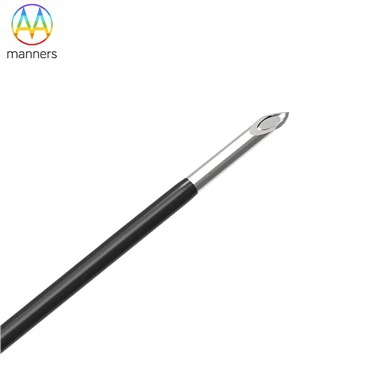
Clinical Value Of Echogenic Needle Tips in Vascular Access And Deep Biopsy
Jul 05, 2026
Soaring First-Puncture Success Rates
https://www.nature.com/articles/s41598-024-72620-8
① Vascular Access - From Palpating Pulses to "Seeing Pulses"
Central venous catheterization (CVC), PICC, and arterial cannulation become increasingly difficult in patients with shock, obesity, or post-chemoradiation venous sclerosis. Traditional anatomical landmark blind puncture failure rates can reach 15%–20%, with not-uncommon accidental carotid puncture, pneumothorax, and hematomas. Ultrasound-guided use of echogenic introducer needles-typically 18G or 20G, approximately 7–15 cm long with bubble coatings or micro-etching-allows real-time display of the exact moment the needle tip penetrates the anterior wall into the lumen (seeing the bright tip dot inside the vessel, confirmed by blood flashback).
Clinical statistics: Ultrasound + echogenic needles for internal jugular/subclavian/femoral vein catheterization increase first-attempt success from 64% → 91%, with total puncture attempts reduced by over 50% and hematoma complications down by 60%+. In neonatal ICUs, 1.9 Fr minimally invasive echogenic needles have even been used to complete PICC placement in extremely low birth weight infants.
② Tissue Biopsy - The "Eyes" of Tumor Diagnosis
Thyroid fine-needle aspiration (FNA) uses 25G, liver core biopsy (Tru-Cut) uses 16–18G, prostate/breast biopsies use specialized coaxial echogenic biopsy needles. Key point: the biopsy notch must also feature echo enhancement, otherwise the notch "goes dark" upon entering the target zone, causing over-puncture or sampling deviation. Bubble coatings have a clear advantage here-they can cover irregular surfaces.
In liver biopsies, echogenic needles allow operators to confirm the path avoids large bile ducts and vessels before firing the trigger to obtain intact tissue cores. In thyroid micro-nodule (<5 mm) punctures, high-frequency probes paired with 25G fine echogenic needles enable millimeter-level positioning, avoiding accidental tracheal or adjacent vessel puncture.
③ Fluid Drainage (Paracentesis/Thoracentesis)
Ascites/pleural effusion drainage uses 16–18G echogenic drainage needles with side holes, visually avoiding bowel loops, parietal pleura, and diaphragm in real time. Literature reports ultrasound guidance + visual needles reduce pneumothorax rates from 8.6% to 1.2%.
Procurement recommendations: For vascular puncture, 18G bubble-coated echogenic needles are preferred (paired with guidewire sheath sets); for biopsy, select 16–18G (liver/kidney) or 20–22G (thyroid/lymph node) based on organ, confirming the notch features visualization; for drainage, use 16–18G large-flow side-hole types. All products must confirm MRI compatibility statements (stainless steel is generally compatible but verification is required).