Clinical Matching Logic Of Nerve Block Needles And Lidocaine Concentration
Aug 28, 2026
Pain Points In daily regional anesthesia practice, many clinical staff face core mismatching risks between nerve block needle specifications and lidocaine anesthetic concentrations. Most frontline practitioners can master basic 0.5%–2% lidocaine application ranges but lack standardized matching criteria for different needle gauges, puncture depths and block types. Uniform high-concentration lidocaine application easily causes local tissue irritation, neurotoxicity and systemic adverse reactions, while excessive low concentration leads to insufficient analgesic effect, repeated injection and prolonged operation time. In addition, many junior clinicians rely on empirical dilution methods without systematic dose control, resulting in unstable anesthesia quality. Small clinics and primary medical institutions lack unified operation specifications, and mismatched needle-anesthetic schemes increase postoperative neuralgia and block failure rates, affecting patient experience and clinical safety management standards.
Core Principle The clinical efficacy and safety of nerve block anesthesia depend on the dual coordination of puncture instrument performance and anesthetic concentration. Medical nerve block needles adopt medical stainless steel substrates, processed through precision necking, swaging, grinding and electropolishing, featuring smooth inner and outer walls, uniform lumen and stable puncture performance. Different needle gauges determine the anesthetic injection rate, diffusion range and local tissue pressure. Lidocaine, as the mainstream local anesthetic, has a linear concentration-effect relationship: 2% high concentration provides rapid anesthesia and strong nerve blocking effect, suitable for deep nerve block; 0.5%–1% low concentration offers mild stimulation and slow sustained effect, suitable for superficial infiltration and fine nerve block. The scientific dilution of 2% standard lidocaine with normal saline can accurately adjust the target concentration, realizing precise anesthesia matching for different puncture scenarios.
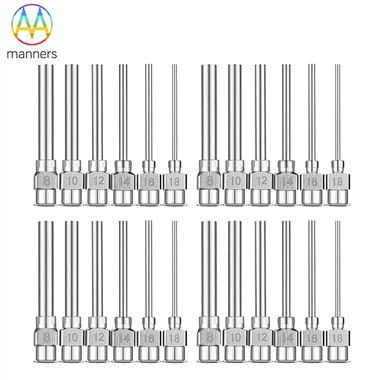
Device Classification Medical nerve block needles cover a complete gauge range from 8G to 26G, fully adapting to all nerve block scenarios from deep large nerve trunk block to superficial fine nerve infiltration. Large-gauge needles (8G–14G) have large lumen diameter and fast injection speed, matching high-concentration (1.5%–2%) lidocaine for deep tissue and thick nerve block; medium-gauge needles (15G–18G) are the universal clinical model, suitable for routine 1%–1.5% lidocaine anesthesia of limb and trunk nerves; fine-gauge needles (20G–26G) cause minimal tissue trauma, matching low-concentration (0.5%–1%) lidocaine for superficial delicate tissue block. All needles support customized production according to 2D/3D drawings or samples, and undergo strict laser marking, laser cutting and sterilization treatment to meet disposable clinical medical standards.
Operational Guidelines Clinicians should establish a standardized needle-anesthetic matching and dilution workflow. Take the clinically mainstream 2% 5ml lidocaine standard preparation as the base solution, and adopt a 20ml syringe for proportional dilution: the target concentration value corresponds to the volume of original lidocaine solution, and normal saline is supplemented to 20ml total volume. For example, 17ml of 2% lidocaine plus 3ml normal saline prepares 1.7% concentration; 8ml original solution plus 12ml normal saline prepares 0.8% concentration. Select large-gauge needles for deep sciatic nerve and brachial plexus block with 1.5%–2% lidocaine; use medium gauges for routine peripheral nerve block with 1%–1.5% concentration; adopt fine needles for facial and superficial nerve block with 0.5%–1% low concentration. Strictly control single injection volume to avoid excessive local drug accumulation.
Real-World Experience Long-term clinical verification shows that standardized proportional dilution can achieve accurate lidocaine concentration control without professional precision instruments, which is highly suitable for primary clinics and on-site emergency anesthesia. Many clinical adverse events are caused by blind concentration adjustment and mismatched needle selection: high-concentration lidocaine injected through fine needles leads to excessive local pressure and nerve irritation, while low-concentration drugs injected through large-gauge needles result in insufficient effective drug concentration and failed block. Clinicians with standardized matching habits can effectively reduce repeated injections and postoperative numbness complications. In addition, sterilized disposable nerve block needles can avoid cross-infection, and smooth lumen ensures uniform drug diffusion and stable anesthesia effect.
Conclusion The precise matching of nerve block needle specifications and lidocaine concentration is the core key to standardized regional anesthesia. The complete gauge portfolio of medical nerve block needles covers all clinical block scenarios, and the simple proportional dilution method of 2% lidocaine solves the pain point of inaccurate manual concentration preparation. Scientific instrument-drug matching can balance anesthesia efficacy, operation efficiency and patient safety, and is an essential basic skill for anesthesiologists and clinical operators.
Outlook & Suggestions Medical institutions should formulate unified internal operating specifications for nerve block anesthesia, clarify the corresponding relationship between needle gauge, puncture depth and lidocaine concentration. Popularize the simple proportional dilution method in primary medical training to standardize manual preparation operations. Procurement departments should configure full-series gauge nerve block needles to meet differentiated anesthesia needs. It is recommended to combine digital concentration monitoring equipment on the basis of manual proportional dilution to further improve the accuracy of clinical anesthesia preparation and promote the standardized development of regional anesthesia technology.