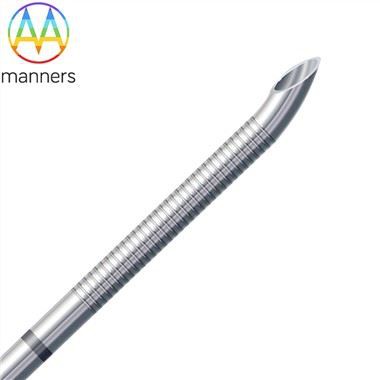
Brachial Plexus Block Anesthesia Needle
Dec 02, 2022
It can be divided into the following three methods according to different puncture sites:
① Intermuscular sulcus method: the preferred anesthesia method for shoulder and upper arm surgery. Patients to pillow supine, head to the opposite side, the affected side shoulder pad under the thin pillow, the upper limb close to the side. Above the clavicle, the posterior edge of the sternocleidomastoid muscle touched a triangular gap formed by the anterior and middle scalenus muscles and omohyoid muscles. The pulsation of the subclavian artery could be touched at the bottom of the triangle, and the puncture point was equivalent to the level of the cricoid cartilage margin of the sixth cervical vertebra. Routine skin disinfection, spread sterile towel. The left index finger was fixed to the skin, and the right hand was held with a 7G injection needle. The needle was pierced vertically into the groove and pushed slightly downward to the rear (about C5 transverse process). After passing through the superficial fascia, there was a sense of emptying. If the patient has abnormal sensation at the same time, it is a more reliable sign. If the patient has no abnormal sensation, the needle can be slowly injected to the transverse process of C6, the needle can be slightly withdrawn, the needle can be connected to the local anesthetic liquid syringe, and the local anesthetic 15 ~ 25ml (adult) can be injected without blood, cerebrospinal fluid or large amount of gas. Bilateral block should not be performed simultaneously.
② Axillary method: It is suitable for the operation of the lower 1/3 of the upper arm or the surgical reduction of the fracture, with the operation of the hand, wrist and ulnar part of the forearm as the first choice. The patient lay supine and removed the pillow. The affected limb was extended to 90 degrees and the bent limb was 90 degrees. The back of the hand was attached to the bed and made military salute close to the head, and the armpit was completely exposed. Routine disinfection, spread sterile towel: The axillary artery was fixed in the left hand, and the 7G injection needle was held in the right hand, and the needle was vertically inserted into the skin, oblique to the armpit, and the Angle between the needle and the artery was 20 degrees. The needle was slowly inserted until there was a sense of fascia emptying, and the needle swung with the pulsation of the artery or appeared abnormal sensation. The needle was fixed in the left hand, and the local anesthetic liquid syringe prepared in advance was connected to the right hand, and no blood was drawn, and 20-40ml of local anesthetic was injected. After injection, a fusiform mass can appear in the axils, which proves that local anesthetics are injected into the axillary sheath and massaged locally to help the drug spread.
③ Supraclavicular method: the patient lies supine with a thin pillow under the shoulder of the affected side, the head turns to the opposite side, and the skin is routinely disinfected with a towel. About 1cm above the midpoint of the clavicle, local anesthetics were used to make piculus, and a 6 1/2 No.3.5cm injection needle was used to enter the needle inward, posteriorly and downward to find the first rib. The rib could be punctured with the approximately 1-3cm injection needle, and the sensation was found along the rib. The appearance of nonsensical sensation can be fan-shaped injection along the ribs.