Bevel Geometry And Low-Trauma Needle Insertion
Nov 05, 2026
Pain Points: Sharp-Looking Needles That Still Tear Tissue
A needle can appear perfectly sharp under casual inspection and still perform poorly in the field. The reason usually lies in bevel geometry. An asymmetric or poorly ground tip acts like a dull blade: instead of cleanly separating tissue planes, it tears and compresses them. In veterinary practice this problem is amplified because patients move unpredictably, skin is often tougher than in human medicine, and repeated injections create scar tissue that resists penetration. Poor bevels raise insertion force, increase bleeding and bruising, prolong procedure time, and reduce operator control. In extreme cases, a defective tip can coring-removing a small plug of tissue that travels into the animal or blocks the lumen. These failures are rarely visible to the naked eye, which is why bevel quality must be engineered and verified rather than assumed.
Working Principle: The Mechanics of the Bevel Cut
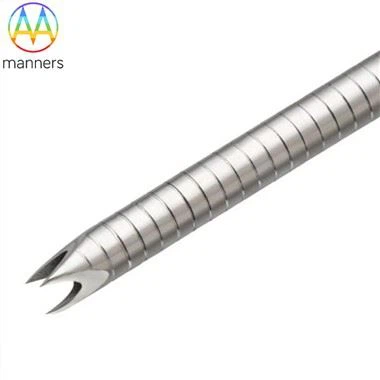
The needle tip functions as a micro-lancet. A standard three-bevel grind creates three intersecting planes that converge at a central cutting edge, allowing the tip to part tissue with minimal lateral displacement. Penetration force depends on bevel angle, tip symmetry, edge radius, and surface friction. Typical veterinary bevel angles sit between roughly 12 and 18 degrees; a shorter, steeper bevel increases stiffness and works well for tough tissue, while a longer, shallower bevel reduces perceived sharpness but improves smoothness in delicate work. Advanced designs-five-bevel, reverse-bevel, and back-cut geometries-distribute cutting load across additional edges, lowering peak resistance and improving control during insertion. The central insight is that sharpness is not a single property but a combination of geometry, edge quality, and surface finish, all of which must be controlled together.
Equipment Classification: Grinding and Tip-Forming Systems
Bevel quality is determined by the grinding equipment and process control behind it. CNC needle grinders using diamond or CBN wheels provide repeatable multi-axis control and are the backbone of high-volume production. High-speed rotary lancet grinders shape the primary bevel efficiently and are often paired with secondary grinding stations for multi-bevel tips. Laser bevel systems offer non-contact shaping for burr-sensitive micro-needles and exotic geometries, though they require careful thermal management. Multi-axis fixtures ensure consistent tip alignment and symmetry, which is critical because even a slight offset produces an asymmetric cut that drags on one side. Downstream, electropolishing and inspection equipment complete the system, converting a geometrically correct tip into a functionally smooth one.
Practical Guide: Controlling the Grinding Process
Effective bevel grinding requires disciplined parameter control. Wheel speed, feed rate, coolant flow, and tip centering must all be monitored, because a defect as small as 0.2 micrometers on the cutting edge can double tissue drag. After grinding, electropolishing removes micro-burrs and reduces surface roughness below roughly 0.2 micrometers, while medical-grade silicone lubrication further lowers friction. Inspection should combine optical magnification, penetration-force testing on synthetic tissue, and periodic scanning electron microscopy sampling. Operators should establish a reference standard-a "golden tip"-and compare production batches against it. Any drift in penetration force signals a process problem long before visual defects appear.
Field Experience: Matching Bevel to Real Patients
Three-bevel 22G needles penetrate canine skin smoothly and predictably, making them a reliable default for routine injection. However, on thickened, scarred hide-common in older working dogs or repeatedly injected livestock-a shorter bevel with higher rigidity performs noticeably better because it resists deflection. Five-bevel tips excel in 30G to 32G exotic-animal work, where minimizing trauma is paramount and the cannula is too fine to tolerate a blunt or asymmetric edge. Field veterinarians report that tip quality becomes most obvious in fractions of a second: a good needle enters with a single controlled motion, while a poor one requires pressure and produces a visible reaction from the animal.
Summary: Sharpness Is Engineered, Not Accidental
A reliable needle tip is the product of deliberate geometry, controlled grinding, and verified surface quality. When these elements align, insertion becomes faster, less painful, and safer for both animal and operator.
Outlook and Recommendations
The next frontier is adaptive bevel libraries tailored to species and tissue type, supported by digital penetration-force modeling. Manufacturers should publish bevel angle and tip-style specifications, and buyers should request penetration-force data as part of qualification. Clinics can improve outcomes immediately by standardizing on validated tip geometries and rejecting batches that fail simple penetration tests.