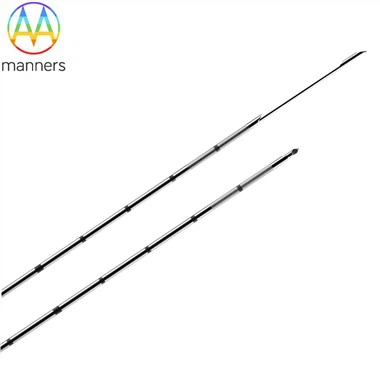
Basic Definition And Core Clinical Value Of Hypodermic Needles
Aug 19, 2026
https://en.wikipedia.org/wiki/Hypodermic
Pain Points Modern clinical minimally invasive diagnosis and treatment has long faced the pain points of inaccurate fluid delivery, traumatic puncture and cross-infection risks. Traditional thick puncture tools cause excessive tissue damage during injection and blood collection, resulting in obvious patient pain, subcutaneous bruising and slow wound recovery. Unstandardized common puncture tools often lead to unstable dosage delivery, insufficient or excessive injection volume, affecting the accuracy of medication treatment. In addition, non-specialized medical needles have poor corrosion resistance and biological inertness, which may cause local tissue irritation, inflammatory reactions and secondary infection during repeated use. The lack of professional minimally invasive puncture equipment has restricted the popularization of precise, safe and low-trauma clinical diagnosis and treatment, and cannot meet the high-standard needs of modern medical injection, blood collection and fluid management.
Working Principle A hypodermic needle is a thin, hollow medical core tool specially designed for human percutaneous puncture, with the core working principle of minimally invasive piercing and precise fluid transmission. Its hollow tubular structure realizes bidirectional medical functions: one is to deliver external fluids including therapeutic drugs, vaccines and contrast agents into human tissues and blood vessels; the other is to extract internal bodily fluids such as blood and tissue fluid for clinical diagnostic testing. The slender needle body design reduces skin and soft tissue piercing resistance, while professional structural polishing and coating technology minimize intraoperative friction and tissue damage. As a bridge connecting external medical reagents and human internal circulation, hypodermic needles ensure the safety, accuracy and efficiency of various percutaneous minimally invasive medical operations, and are the basic guarantee for standardized clinical injection and sampling diagnosis and treatment.
Equipment Classification According to manufacturing materials and functional positioning, hypodermic needles are divided into five core categories with differentiated clinical advantages. First, stainless steel hypodermic needles, the most mainstream conventional model, featuring excellent structural strength, long-term durability and strong corrosion resistance, suitable for most routine clinical puncture scenarios. Second, nickel-chromium alloy needles represented by Inconel and Monel materials, with ultra-high corrosion resistance and oxidation resistance, adapting to special high-temperature and chemical medical environments that conventional materials cannot bear. Third, medical-grade plastic hypodermic needles, dedicated to single-use disposable scenarios, effectively eliminating cross-contamination risks and ensuring clinical sterile safety. Fourth, glass hypodermic needles, with extreme biological inertness, applied in special precise medical experiments and high-purity reagent injection scenarios. Fifth, siliconized coated hypodermic needles, with low-friction coating on the needle surface, greatly reducing piercing resistance and tissue trauma during operation.
Practical Operation Guide Standardized clinical application of hypodermic needles follows scenario-based matching and standardized operational specifications. Before operation, select targeted needle types according to clinical needs: adopt stainless steel needles for routine medication injection and blood drawing; choose disposable plastic needles for infectious patient treatment to avoid cross-infection; use siliconized coated needles for sensitive skin and repeated puncture operations to reduce trauma. During operation, strictly implement sterile disinfection procedures, adjust the puncture angle and depth according to subcutaneous tissue thickness and operational types, slowly pierce the skin to avoid violent puncture causing tissue tearing. For medication administration and vaccination, control the injection speed stably to ensure uniform drug absorption; for blood drawing and fluid extraction, maintain stable needle body fixation to avoid vascular damage and hemolysis. After operation, withdraw the needle gently and implement standardized compression hemostasis and wound nursing to prevent exudation and bruising.
Practical Experience Global clinical medical practice fully verifies that standardized application of graded hypodermic needles comprehensively improves the quality of minimally invasive medical operations. Stainless steel universal needles maintain stable operational effects in long-term clinical application, with low failure rate and high cost performance, becoming the basic equipment of primary and tertiary hospitals. Disposable plastic needles completely solve the hospital cross-infection problem, realizing zero secondary infection in routine vaccination and outpatient injection scenarios. Siliconized low-friction needles reduce patient puncture pain and subcutaneous bruising rate by more than 60%, greatly improving medical experience. Special alloy and glass needles fill the technical gap of special medical scenarios, ensuring the safety and accuracy of high-precision and special environment diagnosis and treatment. Graded needle matching makes clinical puncture operation safer, more efficient and more standardized.
Summary and Sublimation Hypodermic needles are the most basic and core minimally invasive medical equipment in modern clinical medicine, undertaking the key tasks of clinical medication delivery, disease prevention vaccination, diagnostic blood collection and intravenous treatment. Diversified material classification and functional design realize full-scene coverage of conventional and special medical scenarios, solving the pain points of large trauma, low precision and poor safety of traditional puncture tools. As an indispensable basic medical device, hypodermic needles support the standardized development of global minimally invasive medicine, and lay a solid hardware foundation for precise treatment, disease prevention and clinical diagnosis.
Future Suggestions The future development of hypodermic needles focuses on ultra-minimization, intelligent functionalization and scenario refinement. First, optimize material composite technology to develop lightweight, high-strength and fully inert composite needles suitable for full-scene application. Second, upgrade coating technology to develop multi-functional coatings with antibacterial, low-friction and anti-inflammatory effects to further reduce postoperative tissue reaction. Third, develop intelligent hypodermic needles with dosage monitoring and pressure sensing functions to realize precise intelligent injection. Fourth, formulate exclusive industry standards for special scenario needles to standardize the application of alloy and glass special needles in high-precision medical fields.